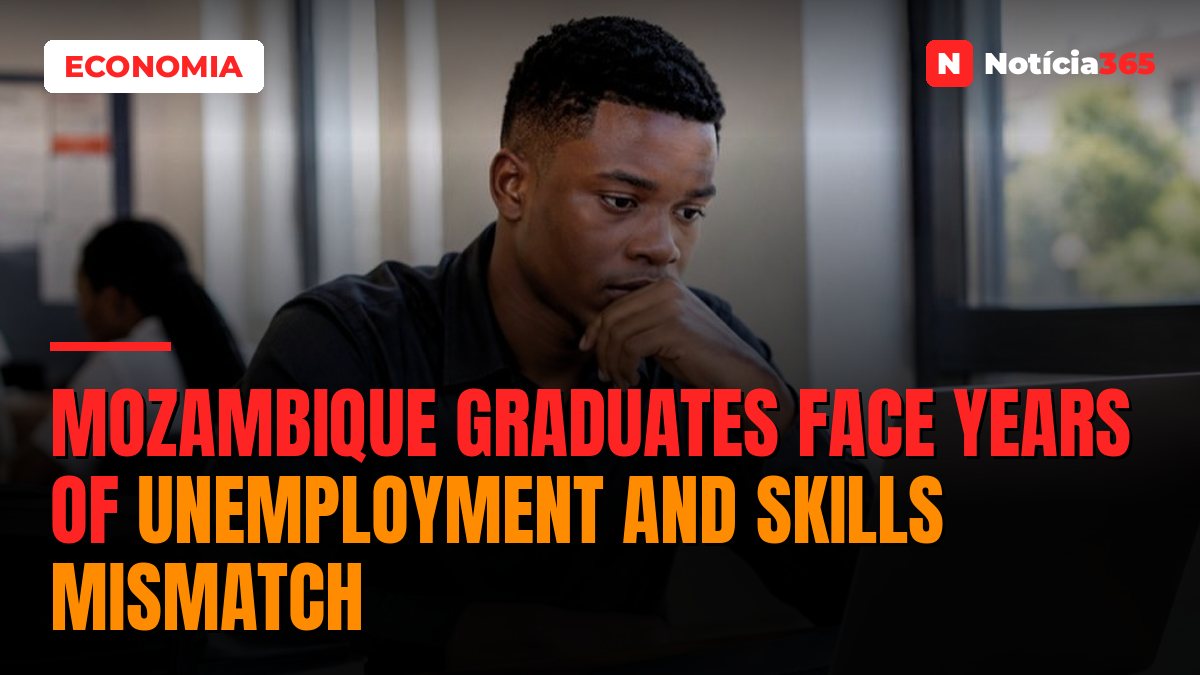

Young Mozambicans face a difficult transition into the labour market. A university degree does not always guarantee stability, and a persistent mismatch between the skills graduates acquire and the opportunities available to them points to a deeper structural problem: the economy is simply not generating enough jobs.
When Sílvio Mapure completed his degree in English-Portuguese Translation, he expected to turn his academic training into a career in international communications. He imagined himself working at an embassy, a ministry dealing with foreign affairs, or a non-governmental organisation. When he entered the job market, however, he found that available opportunities frequently demanded more than he had. He applied for more than 100 positions across different fields, without success and often without even receiving a response. The experience led him to conclude that university gave him a foundation, but that something more is required.
"No graduate is ready for the market in the way companies demand," Sílvio said. In his view, academic training must be complemented with practical skills that can only be developed through professional experience.
Neyma Bay completed her studies in Organisational Psychology. She applied for numerous vacancies, volunteer positions, and scholarships. In some processes she reached the interview stage, but never heard back. "I don't get called," she said. Neyma questions the connection between what is taught at university and what the market actually requires. "When you arrive at a company, people are not so concerned with what you studied. What matters most is what you can do."
Only half find work in the first year
A research paper by the United Nations University – World Institute for Development Economics Research (UNU-WIDER) sought to examine the situation in Mozambique. The study tracked university graduates and technical-vocational graduates between 2019 and 2024. "Almost half manage to find employment in the first year. For the rest, the process takes significantly longer," wrote authors Sam Jones and Ricardo Santos. It is only three to four years after completing their studies that the large majority manage to find some form of work.
Among university graduates, the proportion of those employed rises from approximately 69% shortly after completing their course to nearly 90% five years later. Among technical-vocational graduates, progress is even slower: starting at 42% and reaching 79% four years after graduation.
The researchers caution, however, that these averages conceal very different trajectories. Some young people find work quickly, while others spend years alternating between job searches, occasional work, and periods of inactivity. This is what the research describes as a "staggered" transition to stable employment.
Employment does not mean stability
The study warns of what employment statistics can obscure. Being in work does not necessarily mean having a stable, formal, or satisfactory job. Among employed university graduates, approximately 72% hold fixed positions with an employer. In the technical-vocational stream, that proportion falls to just 39%, with a greater reliance on self-employment and occasional work.
The situation is particularly pronounced among technical-vocational graduates: 42% have no written contract and 41% are not registered with social security. For the researchers, these figures show that the question should not only be "how many young people have a job" but also "what kind of job do they have".
Job dissatisfaction is also high. Around two thirds of university graduates say they are dissatisfied with their employment, while among technical-vocational graduates the proportion exceeds four fifths. "Wage jobs are not always good jobs," the authors warn, stressing that earning a salary is not synonymous with having a good job.
One in three works outside their area of study
Another finding of the research directly mirrors the experiences of the two young graduates: the distance between the field studied and the work actually performed. Approximately 31% of university graduates work in areas different from those in which they trained. Among technical-vocational graduates, the proportion rises to 43%. Furthermore, 32% of the latter group say that the work they perform does not even use the skills for which they were trained. The situation does not affect all fields equally, however. Graduates in specialised areas perform markedly better. In health, the employment rate reaches 95%, while in engineering it exceeds 90%.
Economy grows, but jobs do not keep pace
For UNU-WIDER, this is one of the principal challenges facing the national economy. Economic growth has been driven in part by capital-intensive sectors, such as the extractive industries. "Growth and employment are becoming decoupled, just as skills and opportunities are," the researchers state. Expanding education on its own does not resolve the problem if the economy does not simultaneously create jobs capable of absorbing trained young people.
The scale of the challenge becomes clearer when the number of graduates is compared with the size of the new cohorts entering working age. In 2017, approximately 18,000 young people completed university education, at an average age of 26. In the technical-vocational stream, around 16,000 completed their training in 2019, at an average age of 22. Each group represented approximately 2.5% of its respective age cohort, in a country where around 600,000 young people turn 18 every year.
For the researchers, the fact that even these relatively small groups face significant difficulties integrating into the labour market constitutes a warning signal. In other words, "expanding education on its own will not resolve the challenges of youth employment."
Another priority should be improving the bridge between school and work. Internships, professional apprenticeships, and effective vocational guidance services can bring educational institutions closer to employers and reduce the period that young people spend between completing their training and entering the market.
Job quality is also part of the problem
UNU-WIDER also argues that employment policies should not measure only the number of jobs created, but their quality. At the same time, it cautions that overly rapid formalisation or rigid labour regulations can produce the opposite effect, pushing more workers and firms further into informality.
The recourse to self-employment and informality among trained young people should not be interpreted purely as an individual choice. According to the researchers, when graduates end up in informal activities, this also reflects the limited capacity of the formal economy to absorb skilled workers.
"Informality among graduates represents, for the most part, an underutilisation of human capital," they write. When a trained young person cannot apply their skills in their work, it is not only the individual who loses: the economy itself fails to fully capture the return on the investment made in their education.
The study therefore advocates a policy that combines education, the creation of productive employment, stronger links between educational institutions and businesses, and greater attention to the quality of available opportunities.
Source: Diário Económico
Original article: https://www.diarioeconomico.co.mz/?p=551113