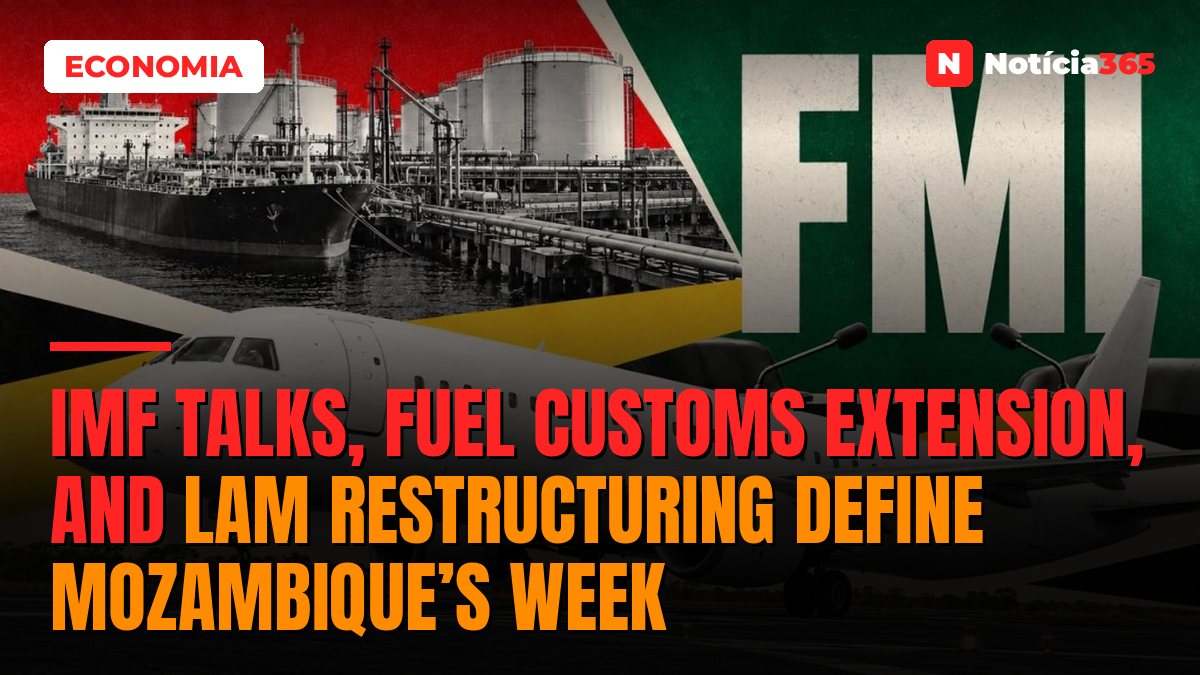

Progress in negotiations for a new programme with the International Monetary Fund (IMF), an extension of customs deadlines for fuel imports, and government demands for concrete results in the restructuring of Linhas Aéreas de Moçambique (LAM) defined the economic week in Mozambique. The developments come against a backdrop of gradual economic recovery and persistent pressure on public finances.
Finance Minister Carla Louveira said, in an interview with Lusa on the sidelines of the IMF and World Bank annual meetings in Bangkok, Thailand, that negotiations are proceeding satisfactorily and without significant obstacles.
"We can say that we are moving forward with notable steps. On Mozambique's side, we have provided all the information required by the IMF and have also presented the political commitment of the Mozambican government," she said.

According to the minister, the government is committed to drawing up a fiscal consolidation plan centred on modernising revenue collection, controlling expenditure, managing debt, and strengthening social protection, alongside monetary and exchange-rate stability.
The talks follow the Finance Ministry's announcement in April of the full and early repayment of a US$701.4 million debt to the IMF, related to financing extended through the Poverty Reduction and Growth Trust (PRGT).
The IMF's latest projections point to a gradual recovery of the Mozambican economy following an estimated contraction of 0.2% in 2025. According to the World Economic Outlook, GDP is forecast to grow 1% in 2026 and 2% in 2027, while inflation could reach 5.6% and 6.8% respectively.
The Fund also projects an external deficit of 41% of GDP in 2026 and 37.8% in 2027.
Extended customs deadlines for fuel imports
The week also brought the publication of an exceptional regime extending deadlines for warehouse entry declarations and customs clearance of petroleum products, applicable until 31 December 2026.
The measures are set out in Ministerial Decree No. 80/2026 and cover fuels destined for domestic consumption.
Warehouse entry declarations may be submitted up to 30 calendar days after the completion of unloading at the destination customs post, with the possibility of a further 15-day extension upon authorisation.
For customs clearance, the maximum period is 65 days, extendable by a further 15 days upon justification. Operators must also notify Customs in advance of the arrival of goods, as stipulated in the decree. During the period in which these measures are in force, general deadlines applicable to covered procedures are suspended.
The relaxation of rules follows supply disruptions recorded at the end of September that caused queues at fuel stations in Maputo and other provinces. At the time, the Ministry of Mineral Resources and Energy attributed the difficulties to logistical problems in loading and distribution over an extended weekend.
According to the central bank, Mozambique spent US$236.4 million on fuel imports in the first quarter of 2026, down 1.4% from the same period a year earlier. In May, administered prices rose 45.5% for diesel and 12.1% for petrol, in a context of supply shortages and rising international prices.
Government demands results from LAM recovery
On Wednesday, 14 October, the government demanded concrete solutions, timelines, and verifiable results from the restructuring of Linhas Aéreas de Moçambique. The objective is to improve operations and passenger services, restore financial sustainability, and reduce dependence on state support.
"LAM does not just need to survive. It needs to recover its capacity to serve the country and to operate sustainably," said Minister of Transport and Logistics João Matlombe, speaking at the ministry's coordinating council in Macaneta, in the district of Marracuene.
The minister identified fleet management, cost control, revenue growth, and management accountability as priorities. He acknowledged the airline's importance for connectivity, tourism, and territorial integration, but warned that this role does not justify inefficiencies or a permanent dependence on public financing.
The restructuring includes the entry of state-owned companies into the carrier's capital. In 2025, Hidroeléctrica de Cahora Bassa approved the acquisition of a 25.2% stake, while Empresa Moçambicana de Seguros and Caminhos de Ferro de Moçambique each came to hold 15.4%.
Source: Diário Económico
Original article: https://www.diarioeconomico.co.mz/?p=553133