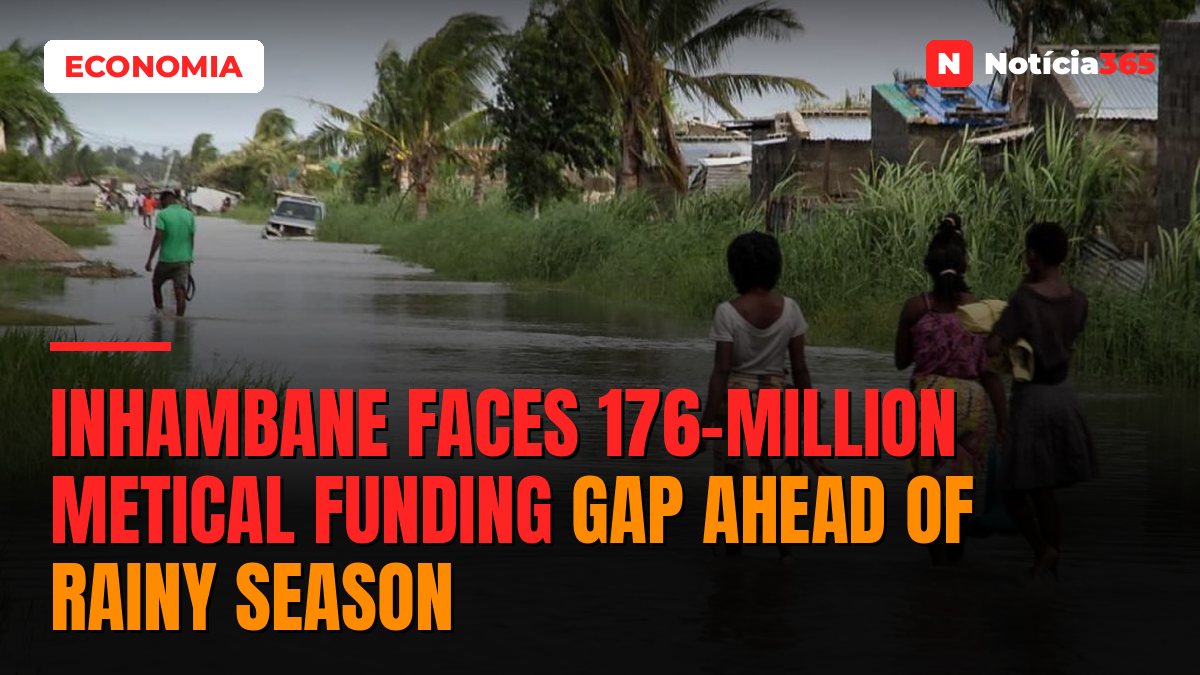

Inhambane province faces a financing shortfall of approximately 176 million meticais to prepare and ensure an adequate response to the 2026–27 rainy season. Under the most comprehensive risk scenario outlined by authorities, floods, inundations, and cyclones could affect as many as 228,904 people.
The figures were presented on Thursday, 15 October, by Gilberto Miguel, the provincial delegate of the National Disaster Risk Management and Reduction Institute (INGD), according to Lusa.
Miguel explained that two scenarios have been defined. The first covers floods and inundations of limited magnitude, but with potentially significant impacts on the most vulnerable communities. The second adds the possibility of flooding across river basins and the occurrence of cyclones, placing a larger number of people at risk.

The shortage of resources is constraining preparations for prevention and response measures. In light of the identified risks, Francisco Pagula, the governor of Inhambane, called for early interventions to protect community livelihoods, with particular emphasis on agricultural production.
The governor urged the identification of crops whose production could be scaled up rapidly and yield food within a short period, thereby contributing to food security for local populations.
“Which crops can we scale up production of at this time that will bring quick results for our communities?” he asked.
Arsénia Massingue, the Secretary of State in the province, in turn advocated for the involvement of community leaders, local authorities, and neighbourhood secretaries. She called for rapid mobilisation to ensure community participation in preventive measures.
Inhambane was affected by flooding in January and by the impacts of intense tropical cyclone Gezani in February. In a preliminary assessment released at the time, the INGD recorded at least four deaths, one seriously injured person, and damage to 1,253 homes.
A further 67 schools, including 200 classrooms, eight health units, and energy supply and water distribution infrastructure were also affected. Authorities warned at the time that the damage assessment was still ongoing.
At the national level, the previous rainy season, between October 2025 and April 2026, claimed 311 lives and affected approximately 1.07 million people, according to INGD data cited by Lusa.
The scenarios now presented are intended to anticipate intervention needs and guide the mobilisation of resources to reduce the impact of extreme weather events across the province.
Source: Diário Económico
Original article: https://www.diarioeconomico.co.mz/?p=552966