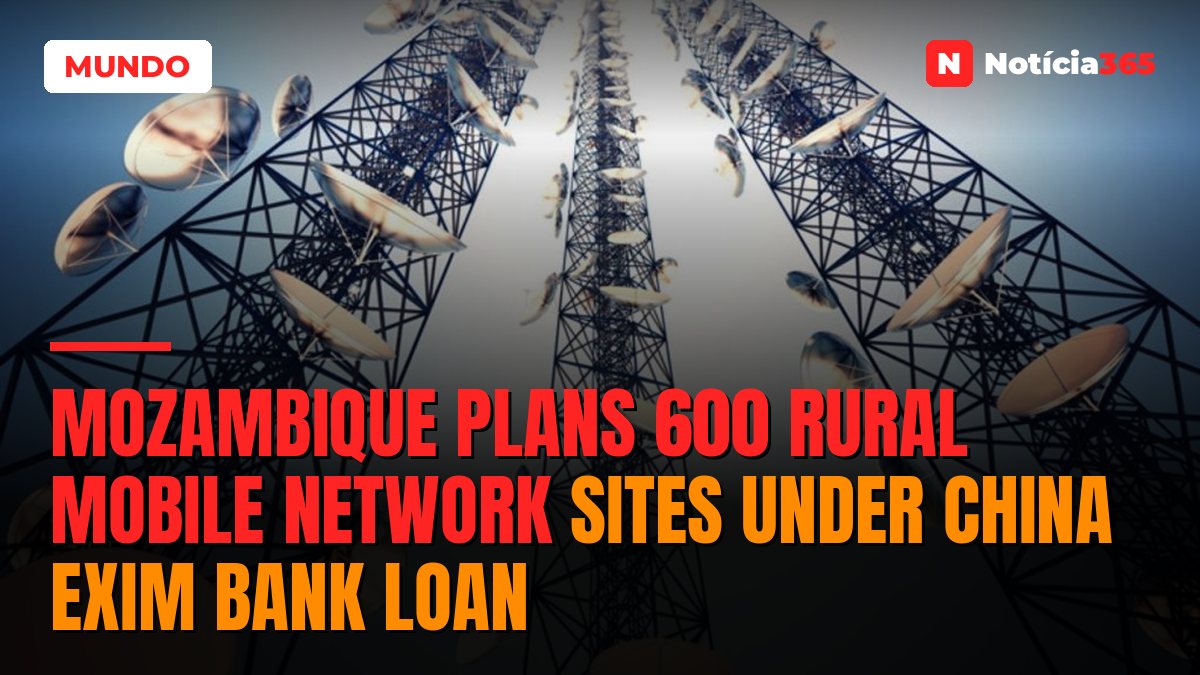

The Mozambican government plans to install 600 new mobile network sites equipped with 2G and 4G technology in rural areas, with the aim of extending telecommunications coverage to approximately 90% of the national population. The project will be financed through a concessional loan from the Export-Import Bank of China (Exim Bank), though the loan amount has not been disclosed.
According to an international public tender notice cited by Lusa, the initiative is being promoted by the Ministry of Communications and Digital Transformation through the National Communications Institute of Mozambique (INCM), under the Universal Access Project framework.
The investment is directed primarily at localities with no coverage or insufficient connectivity. The tender notice indicates, on an indicative basis, 600 new rural network points, each to be equipped with a tower, wireless access and transmission equipment, and an autonomous solar or hybrid energy system. Network management systems are also envisaged to ensure operational continuity.

The project includes the procurement of devices for end users, to be distributed in covered localities through mobile network operators. The initiative aims to reduce inequalities in communications access and strengthen digital inclusion.
The tender is divided into four lots, to be evaluated and awarded separately. Companies may submit bids for one, several, or all lots.
Eligible bidders must be legally constituted and qualified to execute projects financed by Exim Bank concessional loans, with associations between companies permitted under the terms of the tender specifications. The deadline for submission of proposals is 13 November.
The initiative forms part of broader efforts to expand telecommunications and internet services in the country’s most remote areas through the Universal Access Service Fund (FSAU).
Alongside the rollout of 2G and 4G networks, Mozambique is also advancing its 5G expansion. In June, INCM awarded spectrum licences to Tmcel, Vodacom Mozambique, and Movitel for the deployment of 5G technology, while also requiring operators to expand 4G coverage and reinforce digital inclusion commitments.
Under the terms of those licences, the three operators committed to making available 710,000 subsidised smartphones — of which 290,000 are 5G-compatible and 420,000 are 4G-compatible. They also undertook to provide broadband connections to at least 3,000 schools and 1,000 community institutions.
On the same occasion, President Daniel Chapo stated that 5G should reach provincial capitals, tourist destinations, and special economic zones by 2027.
Source: Diário Económico
Original article: https://www.diarioeconomico.co.mz/2026/10/13/trends/telecom/governo-preve-instalar-600-infra-estruturas-de-telecomunicacoes-nas-zonas-rurais/