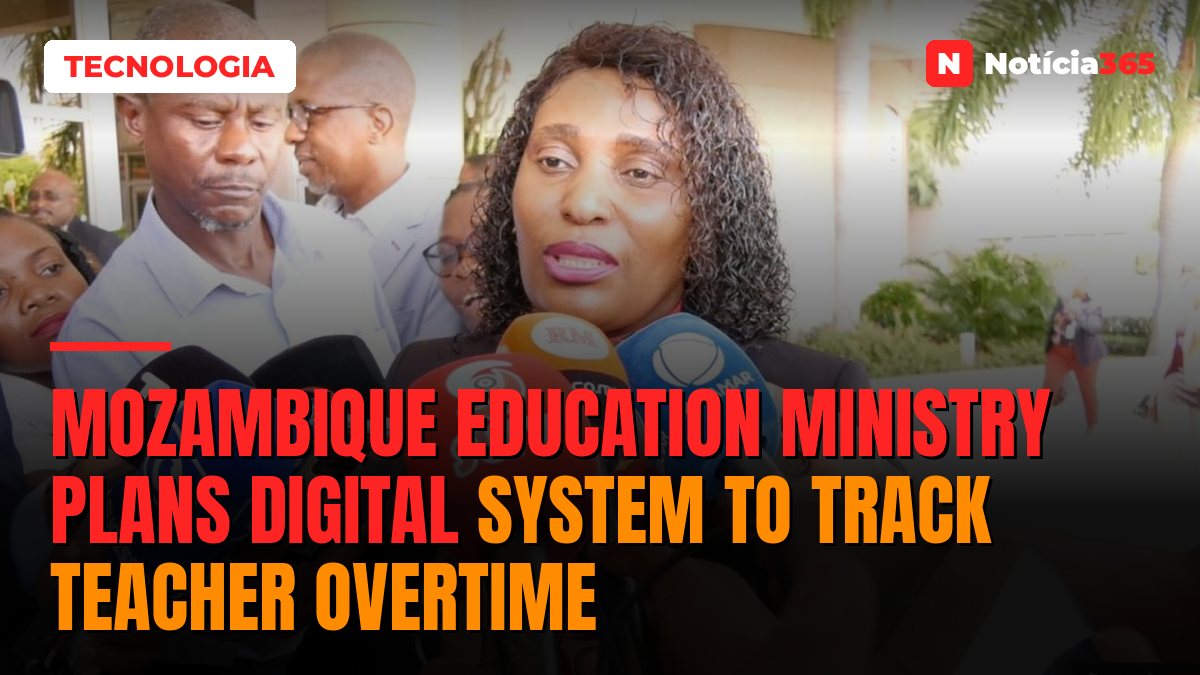

Mozambique’s Ministry of Education and Culture (MEC) is developing digital mechanisms to record and verify teacher overtime hours, with the aim of making payments more accurate and timely. The initiative was announced on Monday, 12 October, by minister Samaria Tovela, who did not indicate a timeline for the system’s implementation, according to the Mozambique Information Agency (AIM).
“We are all working towards having a digital component, because it will allow us to know that if a teacher works five hours beyond her standard 24, she has worked exactly 29 hours. This will be fundamental to ensuring fairer and more timely payment,” Tovela said.
Samaria Tovela was speaking to the press following a wreath-laying ceremony at the Square of Mozambican Heroes, held as part of celebrations marking Teachers’ Day, which this year coincides with the 45th anniversary of the National Teachers’ Organisation (ONP).

According to the minister, the processing of overtime payments currently depends on manual procedures and the validation of records by financial structures before payment authorisation is granted.
During that verification process, some declared hours are not confirmed, requiring clarification from those involved. The minister also referenced cases of record falsification, including payments made for hours that were never worked.
In such cases, she argued that improperly paid amounts should be recovered. Digitalisation is expected to strengthen transparency and ensure that payments correspond to work actually carried out.
Samaria Tovela also attributed payment delays to the need to balance education expenditure against other state obligations, including civil service salaries and healthcare costs.
The minister assured that the government is working to bring forward overtime payments, but did not present a schedule for settling outstanding amounts.
For its part, ONP secretary-general Teodoro Muidumbe said payments are being made on a gradual basis, although difficulties in clearing the backlog of debts persist.
He explained that the organisation is unable to determine how many teachers have already received payment, as not all of them report payments to the union or to their school directorates.
“Teachers do not share information with their union, and sometimes not even with their own school management. That is why we cannot present figures,” he said.
The ONP continues to engage in dialogue with the government to monitor the process, acknowledging that the pace of payments depends on the availability of state funding. The lack of up-to-date information, however, prevents the organisation from providing a full account of progress in settling overtime arrears.
Source: Diário Económico
Original article: https://www.diarioeconomico.co.mz/?p=551700