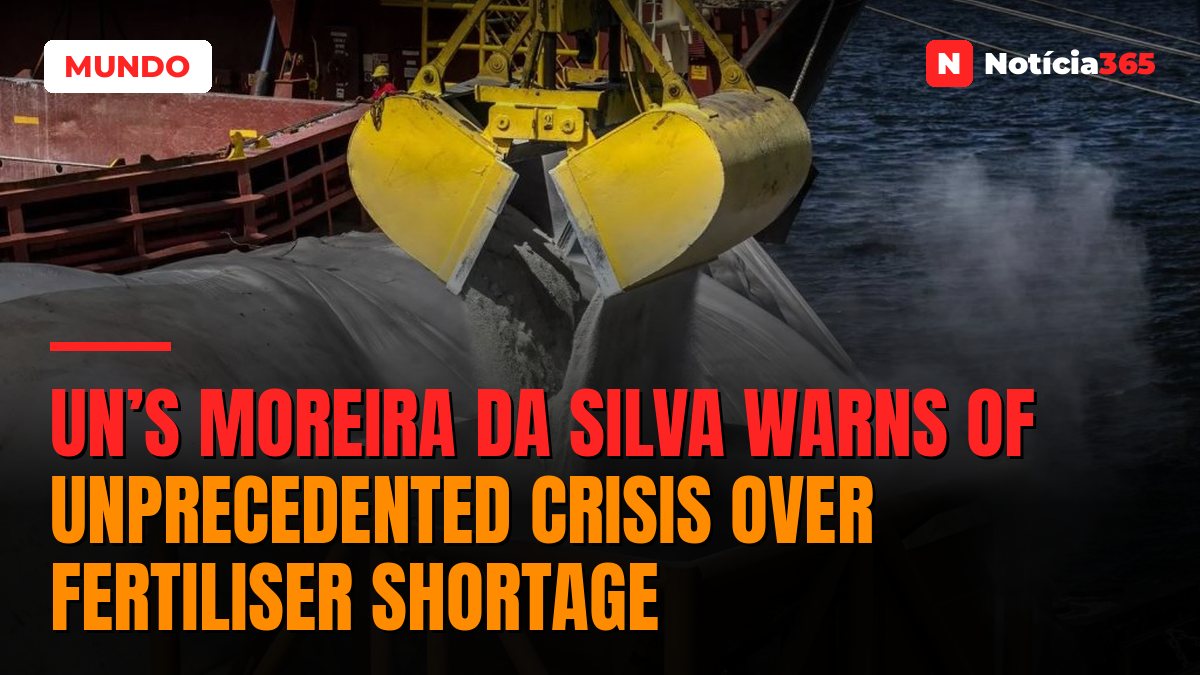

UN Under-Secretary-General Jorge Moreira da Silva warned on Thursday, 8 October, of the possibility of an “unprecedented humanitarian crisis” in the coming months due to a global fertiliser shortage caused by the conflict in the Persian Gulf.
“Countries that produce fertilisers have decided to shut their doors and prices have skyrocketed,” which could trigger an “unprecedented humanitarian crisis,” said Moreira da Silva, who also serves as Executive Director of the United Nations Office for Project Services (UNOPS), speaking at the 7th Lisbon Conference, dedicated to the Reconfiguration of the Global Order.
He explained that, unlike a food crisis whose effects are immediate, the fertiliser shortage is only expected to produce consequences “in the coming months.” According to Moreira da Silva, the crisis is already “at the door.”
“And what are my colleagues at the FAO [Food and Agriculture Organization of the United Nations] and the World Food Programme saying: we are going to have 45 million people pushed into hunger in the coming months,” he said.
Moreira da Silva, who leads a working group tasked with negotiating the passage of fertiliser-carrying vessels through the Strait of Hormuz, noted that around one third of these products originate in the Persian Gulf. With the conflict in Iran, which has since spread across the region, the distribution of fertilisers and other raw materials essential to agriculture has practically ground to a halt.
The countries most dependent on fertilisers from the Persian Gulf are among the poorest, including Somalia, Sudan, Mozambique, and Tanzania, the official said. The impact, however, extends to other markets, with the international fertiliser market having entered into “disruption.”
According to Moreira da Silva, the fertiliser shortage is already affecting agricultural productivity, particularly in African countries. Faced with the prospect of an imminent crisis, the United Nations is waiting for “political will to prevail” to allow the movement of the products.
The UN Under-Secretary-General added that proposals have already been presented and tested to inspect vessels crossing Hormuz, so as to allow at least the passage of ships carrying fertilisers. However, he stated that after seven months of talks and negotiations, some of the parties involved in the conflict have still not accepted the proposal.
The Strait of Hormuz is one of the main routes for global trade in fertilisers and energy raw materials such as oil and natural gas. In March, Iran’s Revolutionary Guard detained dozens of vessels in the Persian Gulf region, blocking the transport of approximately one million tonnes of fertilisers destined for markets including Europe, India, China, Indonesia, the United States, and Australia.
Source: Diário Económico
Original article: https://www.diarioeconomico.co.mz/?p=550853