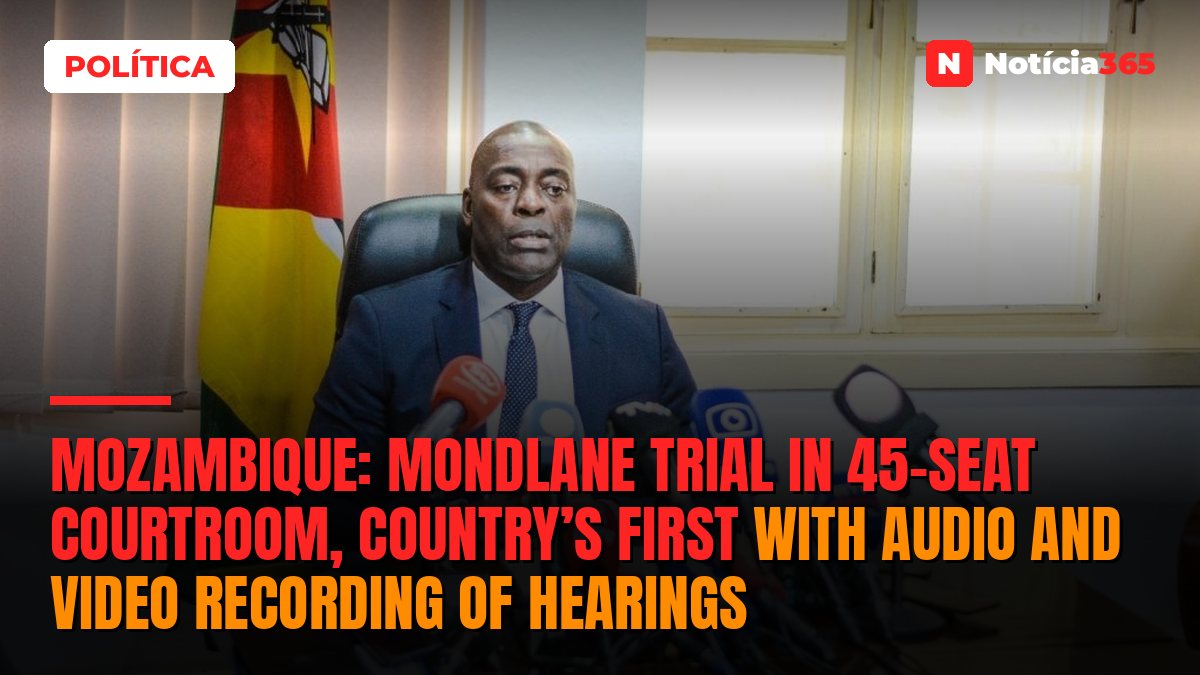
The trial of Venâncio Mondlane, in connection with the post-election demonstrations, begins on Tuesday, with five charges remaining, including terrorism. It will be the first trial in Mozambique to feature video and audio recording of court hearings, reducing the length of proceedings.
“It is the first trial, and I think we should make a point of recording that, in which we are using new technologies, this recording and transcription system. Image and sound recording, followed by transcription into a written document. And, as I said, this helps to significantly reduce the length of the trial, what is known as the expediting of proceedings,” Pedro Nhatitima, Supreme Court (TS) judge-counsellor and spokesperson, said today at a press conference in Maputo.
At a press conference called to brief journalists on how the court hearings would be conducted, judge-counsellor Nhatitima confirmed that the trial would begin on Tuesday, 17 November, in the criminal section of the Supreme Court in Maputo, with daily sessions from 10:00 to 15:30 local time. The charges brought by the Public Prosecutor’s Office (PGR) remain unchanged.
The case involves 12 prosecution witnesses and 20 defence witnesses, as well as four witnesses for the assisting party and two experts from mobile operators Vodacom and Tmcel.
The court will comprise five Supreme Court judge-counsellors, two deputy attorneys-general, one representative of the assisting party and two defence lawyers.
The criminal proceedings relate to the post-election demonstrations held between October 2024 and March 2025, called by then-presidential candidate Venâncio Mondlane, who has never recognised the official results of the last general elections, which gave Daniel Chapo victory as Mozambique’s fifth President.
More than 400 people died during the demonstrations in clashes with the police, while hundreds of businesses and public institutions were vandalised and looted.
The politician is standing trial before the Supreme Court because he is a member of the Council of State, which lifted his immunity. He faces charges of public glorification of crime, incitement to collective disobedience, public instigation to commit a crime, instigation of terrorism and incitement to terrorism.
Courtroom capacity: 45 seats
The courtroom has severe seating limitations, with a maximum capacity of 45 people.
Only ten media organisations will have permanently reserved seats at the trial, including the Lusa News Agency.
On a rotating basis and subject to prior registration, there will also be four places for national media outlets and one for foreign correspondents.
The media will only be allowed to take photographs inside the courtroom each day between 09:15 and 09:30 local time.
“Unfortunately, the Supreme Court is located here, and our courtroom does not have the capacity to accommodate a large number of people,” the spokesperson said.
He added that some streets adjacent to the Supreme Court would be closed to traffic during the trial for security reasons.
The Supreme Court will also permanently allocate one seat to the Government Information Office (GABINFO), two to the Bar Association, ten to members of the public – also subject to prior registration – and 15 seats to the defendant.
Two Mozambican non-governmental organisations, the Centre for Public Integrity (CIP) and the Centre for Democracy and Human Rights (CDD), will also each have one permanently reserved seat to follow the trial.
“We want the information to reach as many people as possible. Those who have permanently reserved seats are the ones we believe can, in some way, help us achieve this objective of getting the information out as widely as possible,” judge-counsellor Pedro Nhatitima explained.
Despite the expected acceleration of proceedings, the Supreme Court has not provided an estimated duration for the trial, saying only that it will be shorter than the high-profile hidden debts case, which began in August 2021, with the verdict delivered in December 2022.
“It is difficult to estimate how long it will take, because that varies somewhat depending on the witnesses who will be heard and how the defendant responds to questions. So, it is not possible to estimate the duration. The only thing I can assure you is that we will achieve a significant reduction in the time taken,” Nhatitima said, emphasising the benefits of introducing the new technological equipment.
“Because a great deal of time is lost during a trial hearing in drawing up the minutes and correcting errors. The system we have introduced allows those corrections to be made automatically. There will be no dictation for the minutes; instead, there will be voice transcription, followed by the signing of the document,” he added.
He also said that the installation of the equipment had been supported by the European Union, with a second system due to be installed in either Nampula or Sofala province.
“In the future, what we hope is that all courts will also be equipped with this technology, which is more reliable and therefore ensures greater speed in court hearings and trials,” Nhatitima concluded.