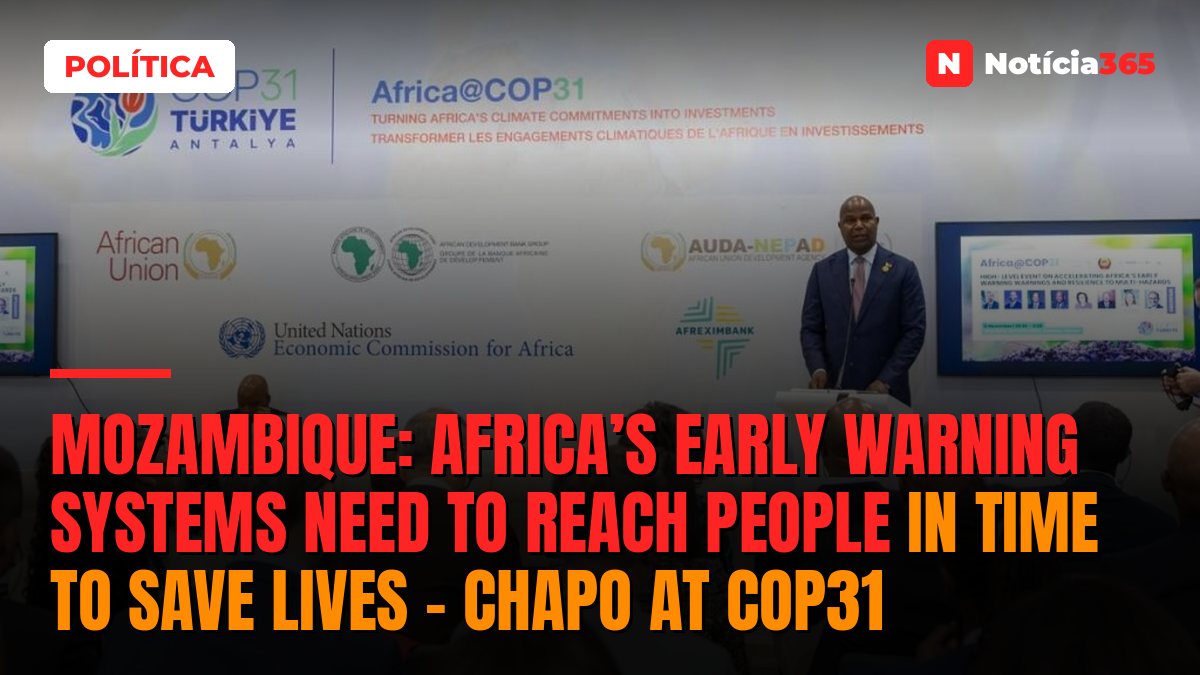
Mozambican President Daniel Chapo has said that an early warning system only truly fulfils its mission when information reaches those who need it in time to save lives.
“An early warning system only truly fulfils its mission when information reaches those who need it, is understood and enables action to be taken in time to save lives,” he said.
Speaking on Thursday in Antalya, Türkiye, at a high-level event on “Accelerating Africa’s Early Warning Systems and Resilience to Multi-Hazards”, co-organised by Mozambique and the African Union (AU) on the sidelines of COP31, Chapo stressed that “this is our greatest challenge in Africa”.
In his capacity as African Union Champion for Disaster Risk Management, the Head of State said that, to achieve this, warnings must reach everyone, particularly the groups most exposed and vulnerable across Africa.
“We are referring mainly to farmers; women and young people, who make up the majority of Africa’s population; people with disabilities; and communities living in remote areas,” he explained.
Daniel Chapo noted that the meeting was taking place at a time when Africa was facing an issue that could no longer be treated solely as an environmental or technical challenge.
According to the President, “continuing to treat this as merely an environmental challenge is to minimise the catastrophe that Africa is experiencing at this moment”.
He cited as examples the growing exposure of populations to climate risks and extreme weather events associated with the El Niño phenomenon.
Chapo recalled that United Nations Secretary-General António Guterres had referred to these issues, which once again demonstrate the urgency of “strengthening early warning systems and, above all, the capacity to turn information into decisions and decisions into actions that protect lives and livelihoods”.
In recent years, according to Chapo, the African continent has made important progress.
Indeed, 41 African countries now have early warning systems, and coverage of these services has more than doubled since 2022. “These are advances that we must recognise, but they must not obscure the challenges that remain.”
These include observation and forecasting infrastructure, communication “all the way to the last mile”, institutional coordination and the availability of sustainable funding.
Speaking specifically about Mozambique, Chapo said the country knew, in a particularly direct way, the meaning and cost of natural disasters.
“The droughts, floods, inundations and tropical cyclones that periodically hit our territory leave deep scars on communities and families, with loss of life, on our infrastructure, which we constantly have to rebuild, on production and on national development efforts,” he noted.
“Mozambique is a country that is always rebuilding,” the President stressed.
According to Daniel Chapo, this experience “has taught us a fundamental lesson: prevention is always more humane, more intelligent and economically more advantageous than rebuilding after a tragedy”.
He emphasised that investing in anticipating risks was, “for us in Mozambique, a strategic decision for development, social justice and safeguarding the future of our populations and communities in Mozambique and across Africa”.
He said that, based on this conviction, he had highlighted four priorities for action. The first was to raise prevention and early warnings to the level of national political priorities across the continent and worldwide, ensuring commitment from the highest levels of leadership to accelerate implementation of the Early Warnings for All initiative in all African Union Member States.
Strengthening national investment and mobilising predictable, sustainable and long-term international financing for resilient observation infrastructure, forecasting capacity, risk communication and anticipatory action was another of the priorities identified by Chapo.
The Head of State also referred to the need to deepen cooperation and partnerships among African Union Member States, Regional Economic Communities, continental institutions, the private sector and development partners, recognising that risks respect no borders and require coordinated responses. “International financing is extremely important because it is part of climate justice. Planet Earth is our home. Climate change is global. And natural disasters do not choose between rich and poor: they affect us all.”
Finally, Chapo highlighted the need to put people at the centre of these systems, ensuring that warnings are inclusive, understandable and accessible, and that they effectively reach the most remote communities, leaving no one behind.
My message to world leaders at #COP31:
We need an extraordinary acceleration of our #ClimateAction efforts.
Our planet is heating up.
The clock is winding down.
It’s make or bake time.
https://t.co/lQ1hVntd8Z https://t.co/rSthxnb3uz
— António Guterres (@antonioguterres) November 12, 2026
Source: AIM Moçambique