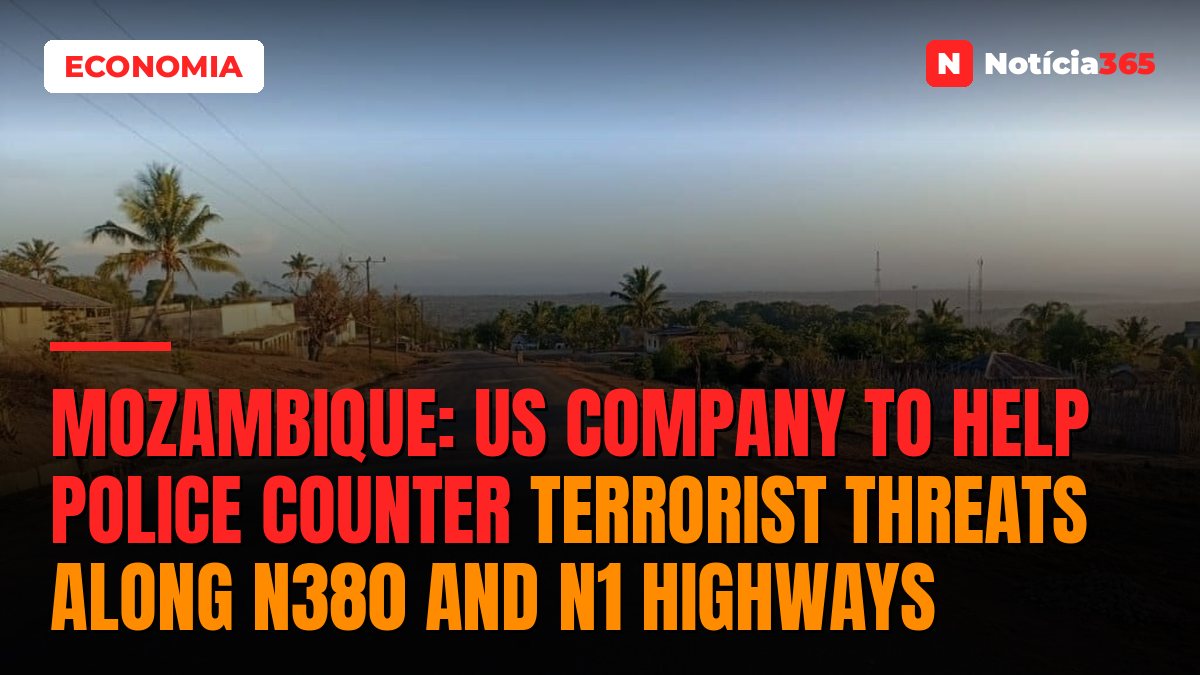
US security company Sincerus will support the Mozambique Republic Police (PRM) in countering terrorist threats along the N380 and N1 highways leading to Cabo Delgado, under a US Department of State-funded programme worth €4.6 million and running for 24 months.
The project, known as the “Strengthening Transit Security and Economic Protection in Mozambique” programme, was launched earlier this year by the US Department of State’s Bureau of Counterterrorism (CT). It provides for funding of up to US$4,933,399 (€4.6 million) and an implementation period of 24 months.
According to the official tender documentation seen by Lusa, the initiative aims to “strengthen the security of critical transit routes in northern Mozambique and protect U.S. economic interests” in a region described as being of “growing economic significance, with key transit routes that support international commerce”.
The programme is expected to enable “safer and more reliable movement for U.S. companies, personnel, and goods in Mozambique in support of U.S. economic opportunities and investment in the region”.
Gas-rich Cabo Delgado province has faced attacks by extremist groups since 2017, which have left more than 6,600 people dead and displaced over 1.3 million.
The tender is being awarded at a time when US company ExxonMobil is expected to make the final investment decision (FID) on its major natural gas project in Afungi later this year. The project is adjacent to another major LNG development led by TotalEnergies. Last year, the US Export-Import Bank (EXIM) approved a direct loan of up to US$4.7 billion to fund the export of U.S. goods, equipment and services for the TotalEnergies-led Mozambique LNG project in Cabo Delgado.
According to the terms of the “Strengthening Transit Security and Economic Protection in Mozambique” tender notice, the programme will “help the Police of the Republic of Mozambique (PRM) detect and disrupt terrorism threats along the N380 and N1 highways, which lead into Cabo Delgado and connect strategic economic zones in the north”.
The selected company will “provide specialized training and non-lethal equipment so law enforcement can respond more effectively to suspected terrorist activity”, as well as ongoing mentoring for Mozambican police units.
“Targeted mentorship for PRM units will reinforce training, address challenges in real time, and build trust within the units to ensure consistent application of new skills and procedures,” the tender reads.
The documentation also states that, “by increasing law enforcement presence, improving preparedness and response capabilities, and fostering collaboration, this initiative will reduce the risk of attacks and disruptions along these vital highways”.
The equipment envisaged includes communications systems, vehicles, protective equipment and other tools considered essential to strengthening the police’s operational capacity to protect transport corridors associated with Cabo Delgado’s energy sector.
The tender forms part of the US counterterrorism strategy and identifies “protecting US interests” through strengthening police forces’ capacity to neutralise terrorist groups as one of its intended outcomes.
Sincerus Global Solutions, selected to implement the programme and which has already begun recruiting staff in Pemba, Cabo Delgado, is also expected to provide an experienced mentor in Mozambique to work directly with PRM units, offering real-time operational guidance and supporting the practical application of the capabilities acquired.
According to the company, the mentor’s role will be “central to advancing the programme’s objectives of identifying, assessing and mitigating threats through improved intelligence practices and community engagement”.
In a second phase, dedicated to road security, Sincerus Global Solutions says the aim will be to strengthen the police’s capacity to “detect, deter and respond to terrorist threats” along the N1 and N380 roads.
Sincerus Global Solutions describes itself as a US company specialising in security, stabilisation, risk management and institutional capacity-building programmes in contexts of conflict and state fragility. It works with governments and security forces in various countries.