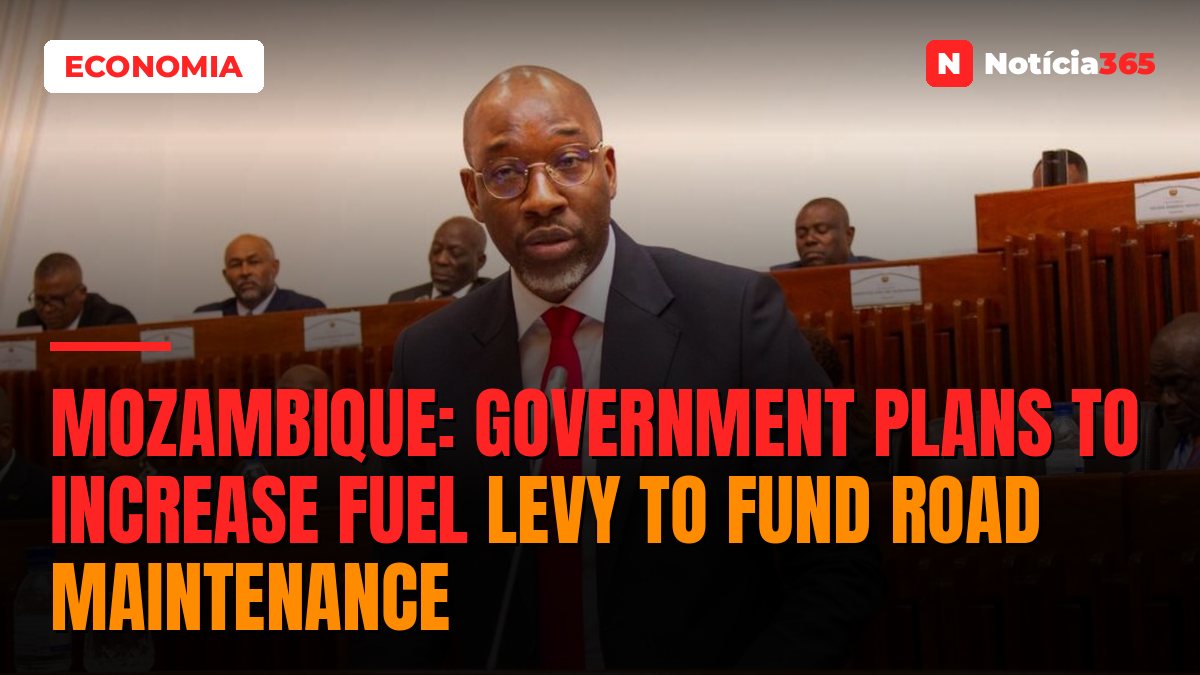
The Mozambican Government plans to increase the Fuel Levy applied to diesel and petrol to strengthen funding for the conservation and maintenance of the national road network, which is currently underfunded.
Transport and Logistics Minister João Matlombe, who has been briefing MPs and presenting legislative proposals in parliament since Wednesday, explained that the Government intends to adjust the Fuel Levy to the equivalent of US$0.15 per litre, approximately 10.625 meticais (€0.15), while introducing a mechanism for periodic adjustments indexed to inflation and exchange-rate movements.
“Currently, the levy amounts to around US$0.11 per litre of petrol and US$0.06 per litre of diesel, levels that are below those applied in most countries in the region,” the minister said.
According to the minister, the adjustment will bring Mozambique closer to the average applied in Southern African Development Community (SADC) countries, which ranges between US$0.15 and US$0.20 per litre.
According to projections presented to MPs, the revision of the levy would have an estimated impact of 2.92 meticais (€0.04) per litre of petrol and 6.36 meticais (€0.09) per litre of diesel.
The proposal comes after the Government increased fuel prices in May, in a measure justified by the effects of the conflict in the Middle East on international energy markets, with the price of diesel rising by 45.5% and petrol by 12.1%.
The package of reforms also includes increasing to 90% the share of Fuel Levy revenues earmarked for the Road Fund, through a revision of the current legal framework. According to João Jorge Matlombe, the combination of the two measures will increase annual revenue allocated to the sector to 20,857 million meticais (€293 million).
The additional resources would make it possible to finance the maintenance of a further 10,932 kilometres of roads, ensure around 330 kilometres of periodic maintenance annually and provide an annual allocation of four billion meticais (€56 million) for the rural roads programme.
The minister argued that the country was facing a progressive deterioration in road maintenance indicators. According to him, the proportion of surfaced roads in good or fair condition fell from 91% in 2015 to less than 60% in 2025, while the indicator for unsurfaced roads declined from 70% to 45%. He added that, in 2020, “routine maintenance programmes covered only 40% of the classified road network”.
João Matlombe also pointed to changes in the sector’s funding model, stating that “the share of Fuel Levy revenue allocated to the roads sector was adjusted from 70% to 40% in 2025”. This situation, he said, significantly reduced the resources available to the Road Fund. However, he assured MPs that the costs of road construction and maintenance contracts in Mozambique were aligned with regional standards.
Addressing MPs, the minister also linked the deterioration of the road network to extreme weather events, such as cyclones, which have hit the country in recent years. As an example, he cited the impact of Cyclone Freddy in 2023, with damage estimated at 18.384 billion meticais (€258 million), affecting 13,886 kilometres of roads, of which 5,448 kilometres were destroyed, as well as 47 damaged bridges.
“This amount was equivalent to almost three times the country’s annual maintenance budget for the classified road network,” he said.
The minister said that, over the past five years, “the resources formally secured to repair damage caused by climate events covered less than 10% of the needs actually assessed”. He therefore advocated the creation of a reserve account to respond to climate emergencies without compromising routine road maintenance.