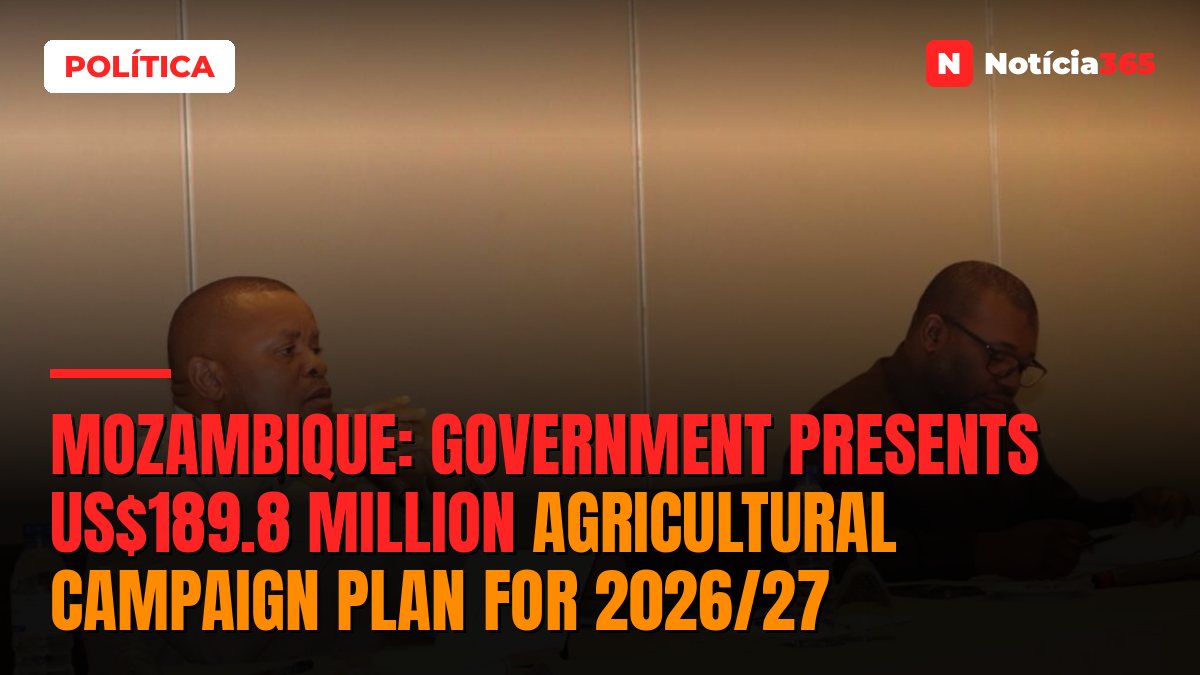
The Ministry of Agriculture, Environment and Fisheries presented the 2026/27 Agricultural Campaign Plan in Maputo on Monday, aimed at transforming the agricultural sector through a sustainable increase in production and productivity, the integration of value chains and the strengthening of producers’ competitiveness, promoting the transition from subsistence farming to a market-oriented commercial sector.
The plan was presented during an Agricultural Campaign preparation meeting chaired by Minister Roberto Mito Albino, attended in person by members of the Consultative Council, extended to include institutions under the Ministry’s supervision and Ministry officials, as well as, virtually, provincial directors, representatives of the District Economic Activities Services and other guests.
On the occasion, the Minister challenged managers of projects being implemented by the Ministry of Agriculture, Environment and Fisheries (MAAP) to ensure that their interventions converge, so as to contribute to meeting the targets set for the 2026/27 Agricultural Campaign, in line with the private-sector-centred operational model.
“The Plan is mandatory. We are no longer here to discuss it; we are here to implement it,” Albino stressed.
The Agricultural Transformation Programme, under the Support to the 2026/27 Campaign, is funded by the Government of Mozambique, the World Bank, the African Development Bank and the International Fund for Agricultural Development (IFAD), with an estimated budget of US$189.8 million.
The programme covers, in particular, the components of Agriculture, Livestock, Fisheries and Forestry, Promotion and Marketing, as well as Policies, with the aim of strengthening productive capacity, food security and the development of agricultural value chains.
Of the overall budget, around US$94.7 million will be allocated to the emergency response, through direct and free support to producers at risk due to the effects of the El Niño phenomenon. The assistance includes the provision of agricultural kits, silos, irrigation kits and animal feed supplements, with a view to ensuring food security and strengthening climate resilience.
The remaining US$95.1 million will be invested in the development and agribusiness support component, covering credit lines and institutional support in the areas of seeds, inputs, mechanisation, irrigation, livestock, fisheries, forestry and agricultural extension.
As part of the plan’s implementation, the provision of 905 motor cultivators, 251 tractors, 2,075 tonnes of seeds, 3,532 irrigation systems and 3,363 motor pumps and irrigation kits is planned, with coverage capacities of 2, 5 and 10 hectares, respectively, under the convergence of the various projects currently underway at the Ministry of Agriculture, Environment and Fisheries.
“Now we have to accelerate implementation, because it is this effort that will help us fulfil our mandate,” the Minister urged.
The 2026/27 Agricultural Campaign thus represents an opportunity to boost production and productivity, stimulate agribusiness and promote more resilient, competitive and market-oriented agriculture, he stressed.