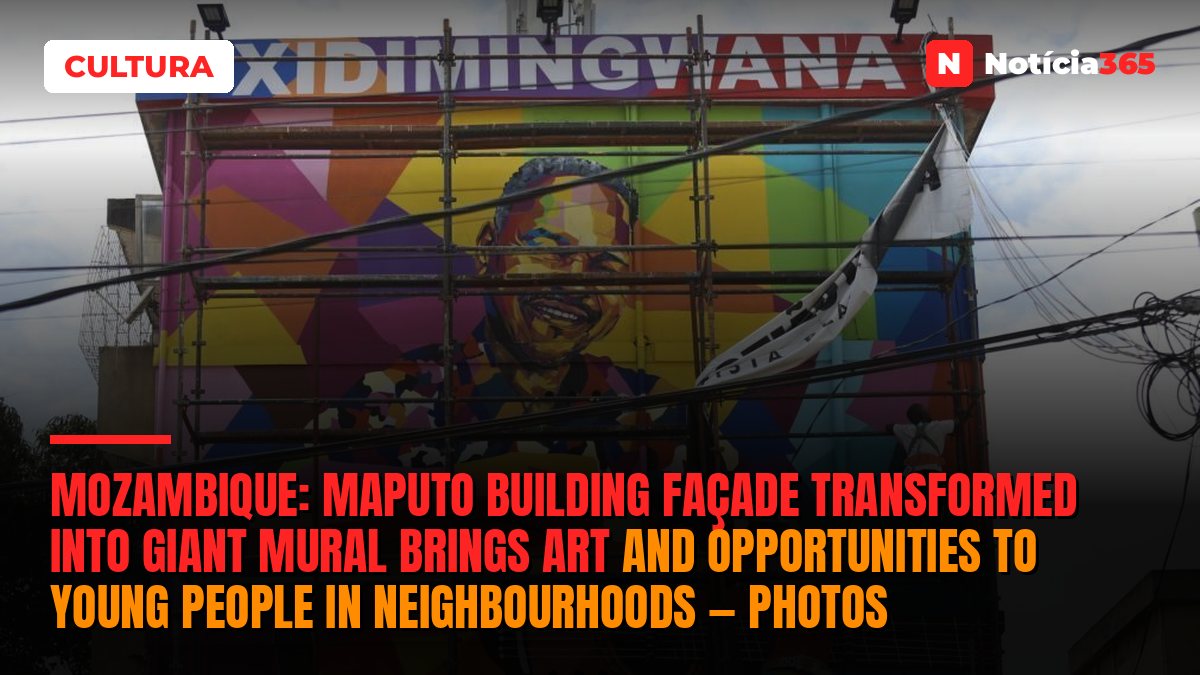
Nearly 20 metres high and visible from a distance, the mural painted by Sebastião Coana in central Maputo is a tribute to Mozambican culture, but also a way of creating opportunities for young people from neighbourhoods through art.
For weeks, residents, shopkeepers and motorists travelling along the busy Avenida de Malhangalene, one of the main thoroughfares in central Maputo, slowed down to follow the transformation of an entire building façade into a huge panel of colour.
Some watched the work progress in silence, others approached to ask questions, while some passed by every day simply to see what had changed since the previous day. At the top of the scaffolding was Sebastião Coana, a 39-year-old Mozambican visual artist, bringing to life the enormous portrait of Xidiminguana, an undisputed reference in Mozambican music, particularly marrabenta.
But while the paint was bringing the musician’s image to life, the artist was also seeking to leave another mark: the idea that art can transform lives and create opportunities for those who grow up far removed from the traditional cultural circuits.
“I have always dreamed of using art for the benefit of the society in which I live,” he told Lusa, adding that he had found in paintbrushes not only a profession, but also a way of giving back for the opportunities he had received throughout his life.
That conviction was born long before this mural.
Originally from Manhiça, about an hour’s journey from the capital, Coana moved to Maputo as a child, and it was at the public schools he attended that teachers began to notice the pupil who spent much of his time drawing.
“My teachers encouraged me a lot to keep drawing,” he says, recalling that, in a family with limited resources, art quickly ceased to be just a pastime.
For Coana, the first school competitions represented a rare opportunity to earn some money and meet basic everyday needs. “I remember that I used my first painting prize to buy physical education clothes and trainers for PE classes at school. I didn’t have any; I used to do it barefoot.”
While many classmates saw the competitions as an extracurricular activity, for the artist those prizes meant much more than school recognition.
“It was my only alternative for survival, to have food at home, to buy clothes and school materials. It was thanks to art,” he says, recalling a period when painting competitions helped him meet basic everyday needs.
From then on, he decided to pursue drawing and painting seriously. Still a teenager, he began taking part in cultural initiatives and looking for places to exhibit his work, but the road was far from easy.
When he decided to organise his first solo exhibition, he sent dozens of requests for support to companies and institutions, but the response was discouraging.
“I submitted more than 100 letters requesting support to hold my first solo painting exhibition, and they were all rejected,” he says, adding that he kept some of the replies. “I still have some of them. They served as motivation for me, so that I would have to keep moving forward.”
Today, Coana’s murals in Maputo are more than paintings on urban façades. In each project, the artist seeks to involve young people from the communities where he works, teaching them mural-painting techniques and guiding them throughout the creative process.

Mozambican visual artist Sebastião Coana during an interview with the Lusa news agency in Maputo, Mozambique, 23 October 2026. [Photo: Lusa/Lina Cebola]
According to the artist, the young people involved take part in every stage of the mural’s execution, from preparing the wall to the final finishing touches. The greatest satisfaction, he says, comes from seeing that the experience can open up new paths for some of the participants, just as art opened doors for him when he was still a student.
“I hope they will be able to put what they have learnt into practice in their communities and earn their bread through the arts,” he says.
The statement sums up a concern that runs through much of his work: that many talents are ultimately lost along the way because of a lack of opportunities, support or role models.
“It is possible to make art and earn a living from art while living in Mozambique,” he argues.
It is a philosophy he seeks to repeat in almost every mural he paints, both in Mozambique and abroad. More than leaving an image on a wall, Coana wants to leave skills and confidence in those who take part in the projects, particularly among young people seeking to develop their own talent.

Mural by Mozambican visual artist Sebastião Coana at Josina Machel Secondary School in Maputo, Mozambique. [Photo: Lusa/Lina Cebola]

Mural by Mozambican visual artist Sebastião Coana on a wall in downtown Maputo, Mozambique. [Photo: Lusa/Lina Cebola]
“I myself used to listen to Xidiminguana’s songs. Today, it is an honour to bring his music, his image, into a vibrant work of art.”
“Artists appear and pass on, and when we can have one art form paying tribute to another branch of the arts, it is a marriage that we can create,” he adds.
Among residents, the mural quickly became a new landmark, as Francisco Gundana can attest. A resident of the area since 1993, he sees an important message for younger generations in the colourful, enormous mural.
“It is an inspiration for young people,” he says.
“Young people have to show what they know and put it into practice. It is a very beautiful thing,” he adds, considering that the work conveys a positive message to younger generations.
While already planning new tributes to figures from Mozambican culture, science and the arts, Coana insists that the true legacy of the murals lies not merely in the paint applied to walls.
“Art can be a means of doing good for the planet,” he says.
And that is the idea he hopes to leave engraved in the memory of the young people who, for weeks, held paintbrushes alongside him and helped transform an ordinary wall into a work capable of telling stories, inspiring pride and nurturing dreams.

Visual artist Sebastião Coana poses for a photograph in front of the mural depicting musician Xidiminguana, which he is painting on Avenida de Malhangalene in Maputo, Mozambique, 23 October 2026. [Photo: Lusa/Lina Cebola]