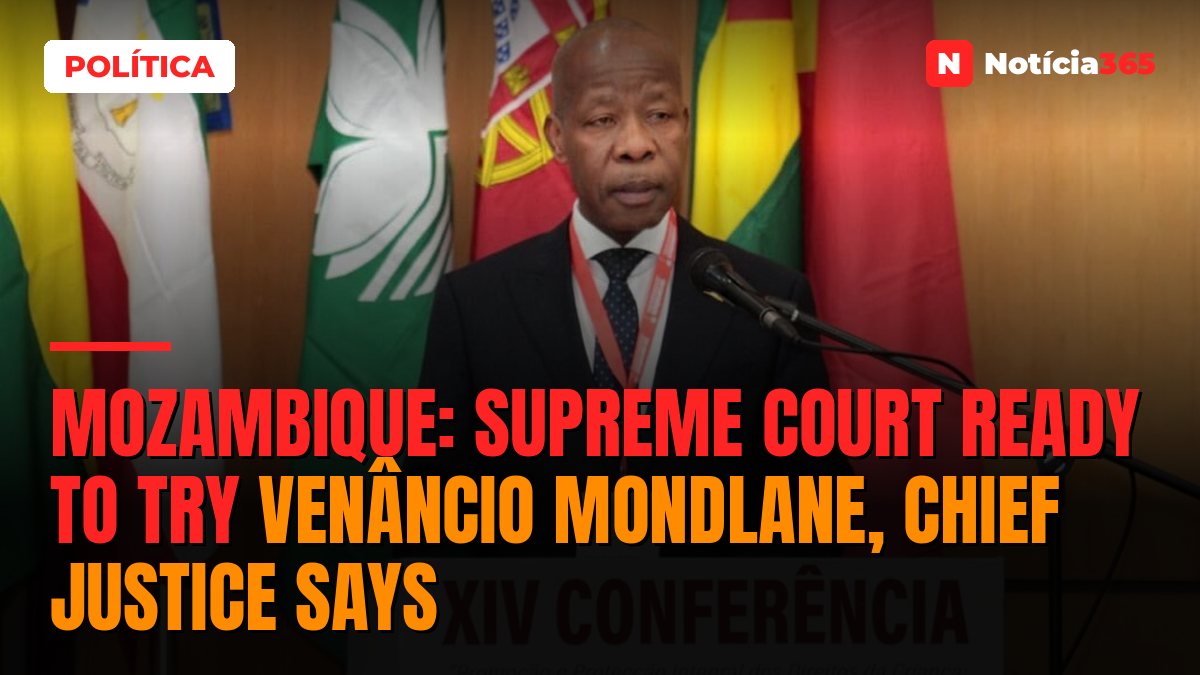
Mozambique’s Supreme Court president, Adelino Muchanga, said on Tuesday that the Supreme Court is “100%” ready to begin the trial of politician Venâncio Mondlane on 17 November, assuring that the judges would reach a decision “based on the facts”.
“The trial is conducted on the basis of the law, on the basis of the facts in the case file and on the basis of the judge’s conscience. That is all. Therefore, what is contained in the case file is what will guide the judges in their decision,” Muchanga told journalists on the sidelines of the 14th Conference of the Forum of Presidents of the Supreme Courts of Justice of Portuguese-speaking Countries and Territories, taking place in Maputo.
The case concerns criminal proceedings brought by the Public Prosecutor’s Office (PGR) in connection with the post-election demonstrations in Mozambique between October 2024 and March 2025, called by then presidential candidate Venâncio Mondlane, who has never recognised the official results of the last general elections. The politician faces more than 20 years in prison, accused of five crimes, including terrorism.
As the second most-voted candidate in the elections held on 9 October 2024, Venâncio Mondlane became a member of the Council of State, a consultative body to the President of the Republic, and is therefore being tried by the Supreme Court, which says it is ready for the case, already considered one of the most high-profile in the country’s history.
“We are. Because our constitutional responsibility is to judge. Therefore, we cannot say that we are not prepared. We are 100% ready. Just as we were in the past for other complex cases, which some questioned whether we had the capacity to judge or not. We do, we already did, and we will continue to do so,” Adelino Muchanga also said.
Venâncio Mondlane faces charges of public apology for crime, incitement to collective disobedience, public instigation to commit a crime, instigation of terrorism and incitement to terrorism.
Mondlane has never recognised the election results, which gave victory to Daniel Chapo, candidate of the Mozambique Liberation Front (Frelimo). He led a wave of post-election protests that lasted for around five months and caused more than 400 deaths, as well as looting and destruction.
The Mozambican Council of State suspended Mondlane’s immunity in June to allow the criminal proceedings to continue.
Mondlane described the decision as “null and void”, arguing that the Council of State “has no legal competence to suspend the immunity of its members”, and may only “decide on the suspension of a member for the purposes of pursuing criminal proceedings, and not on the removal of immunity”.