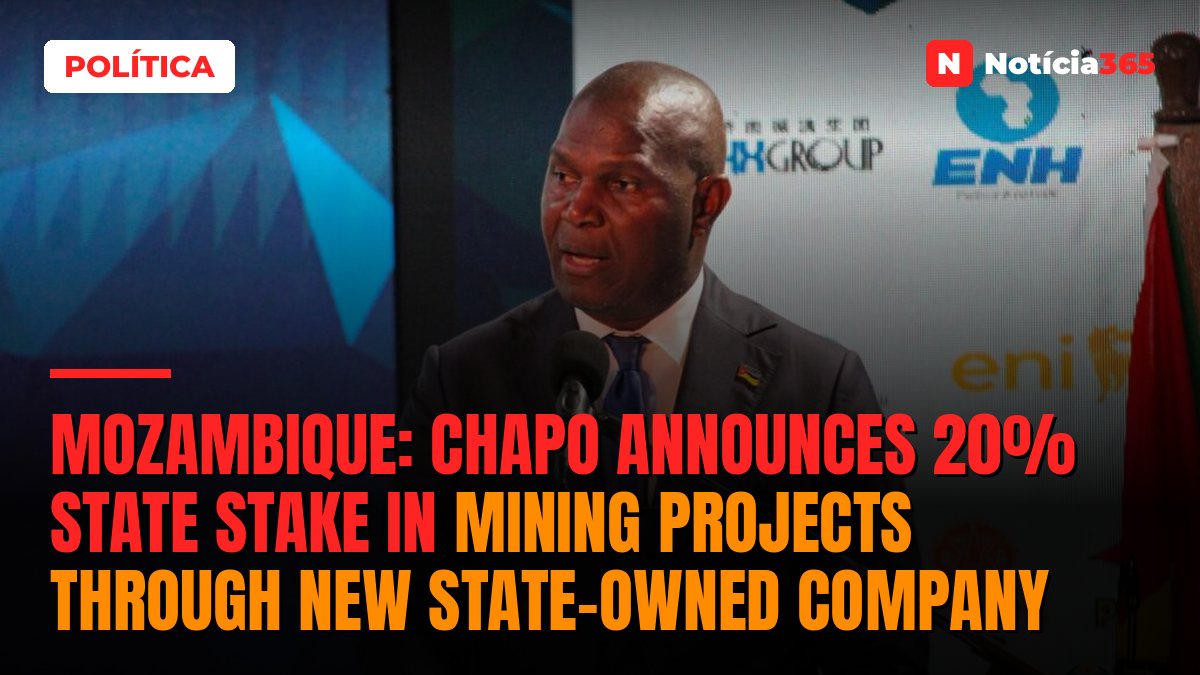
The future National Mining Company (Empresa Nacional de Minas) is expected to hold a 20% stake in Mozambique’s mining projects covered by the new model announced by President Daniel Chapo on Tuesday, 20 October, in Nacala-Porto. The measure forms part of the reforms presented by the government to increase national benefits from the exploitation of natural resources.
In his opening speech at the CAVAME-d 2026 conference, Chapo said that the creation of the state-owned Empresa Nacional de Minas, amendments to the Mining Law and the Petroleum Law, and the Local Content Law form part of the government’s new economic direction.
According to the President, the legal instruments were approved by the Assembly of the Republic, and their respective regulations were approved by the Council of Ministers last week.
Shareholding does not mean guaranteed revenue
The state’s presence in the capital of mining projects could allow it to participate directly in the economic results of the ventures, in addition to the taxes and fees levied on mining activities.
The model nevertheless requires management and financing capacity. An equity stake may entail financial responsibilities and exposure to investment risks.
A 20% stake also does not mean that the state automatically receives that proportion of the value of production. The benefits will depend on financial results, contractual terms and the obligations assumed by the state-owned company.
The implementation of the new regime should clarify the scope of the projects covered and the conditions governing state participation.
Government aims to change the destination of raw materials
Chapo linked the reforms to the establishment of mineral processing facilities in Mozambique.
The aim is to increase the added value of products before export and develop a network of national companies capable of supplying goods and services to the industry.
The President announced planned investments of US$4.2 billion in mineral processing projects, spread across different regions of the country.
The commitments are still dependent on financing, licensing and industrial implementation.
The government also intends to reduce administrative obstacles, improve the business environment and make the institutions responsible for investment more efficient.
The approval of new rules represents one stage of the reform. Its results will depend on the state’s ability to monitor projects, manage public stakes and ensure that mineral processing boosts domestic economic activity.
Source: Carta de Moçambique