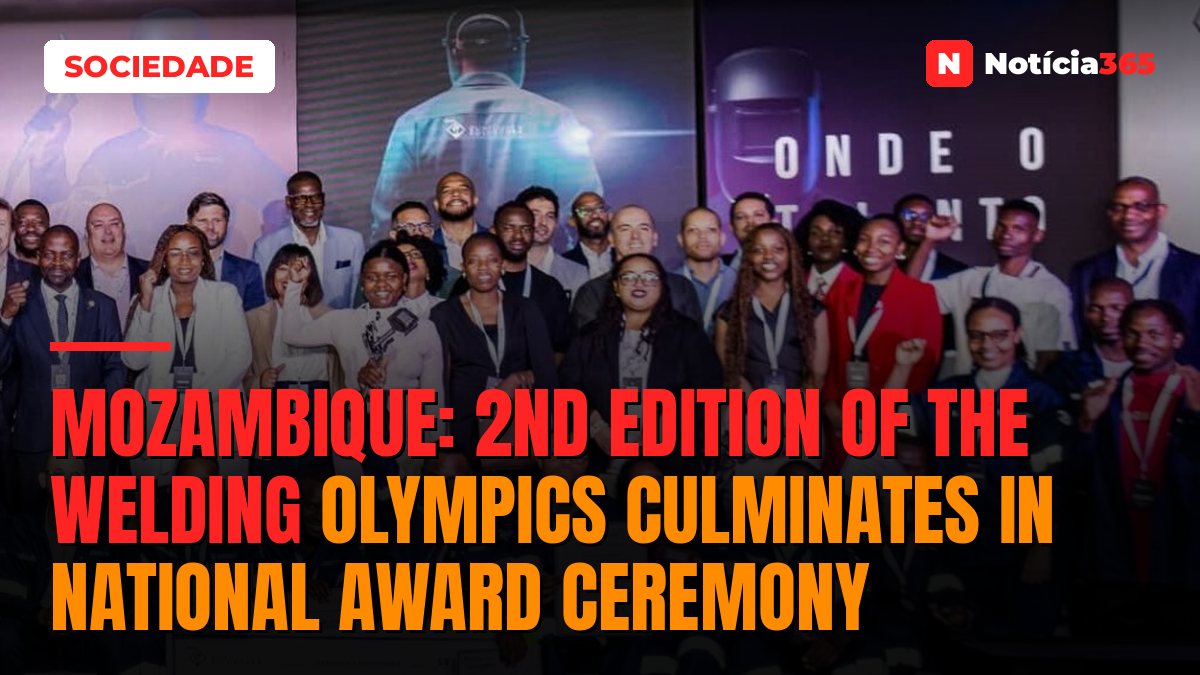
The 2nd Edition of the Welding Olympics culminated on October 8th with a national award ceremony where distinguished participants from Maputo and Cabo Delgado were recognized before nearly 150 guests, including government representatives, training institutes, corporations, partners, and sponsors, strengthening the bridge between vocational training and the demands of Mozambican industry.
The Welding Olympics serve as a strategic platform to elevate technical-vocational education and welding skills, connecting youth, trainers, and professionals directly with companies operating across the oil and gas, construction, and metalworking sectors.
In this 2nd edition, the initiative expanded its geographic reach through competitions held in Maputo and Cabo Delgado, involving 29 participants from 10 public and private institutions, including four women. The execution in Cabo Delgado received official recognition from the Provincial Government, reinforcing the national footprint of the project and its alignment with a strategic region for the country’s energy development.

Photo: Talento
Opening the event, the Secretary of State for Technical-Vocational Education, Leo Elias Jamal, highlighted the importance of viewing the competition as a bridge for recognizing and scaling national talent. Frederico P. Silva, CEO of Talento, reinforced the strategic value and dignity of technical professions, emphasizing that “welding is not informal odd-job work, nor will it be one of the professions disrupted by the rise of Artificial Intelligence.” He further outlined the vision to expand the event to Beira in 2027, integrate new technical disciplines, and launch a dedicated employment and exchange platform.

Photo: Talento
On the 2026 Welding Olympics stage, Arne Gibbs, General Manager of ExxonMobil Mozambique, announced a new phase of the Rovuma LNG project, unveiling technical training programs designed to boost local talent in operations and maintenance.

Photo: Talento
To deepen discussions on aligning workforce training with market demands, the event hosted the panel “From Qualification to Mobility: Technical Education as an Engine for Industrial Development.” The debate convened experts and industry leaders to discuss addressing the supply and demand gap in the sector, international certification, occupational safety, and curriculum alignment alongside ANEP. Highlighting this session, Neila Alafo (ExxonMobil) presented the objective of achieving an 85% workforce nationalization target across selected industrial projects, the initial opening of 50 technical vacancies, and the vision to establish Mozambique as an international-level training hub.
Top-ranked contestants secured access to a professional internship program as well as monetary awards sponsored by ABSA Bank (15,000 MT for Trainees and 25,000 MT for Trainers/Professionals). In the Northern Region, first-place honors went to Tabuche Rocha Saide (Trainees) and Pili Njala Amisse (Trainers/Professionals), with special recognition to the latter for securing top place in a technical professional category. In the Southern Region, first-place awards were presented to Joyceles Osvaldo Mabasso (Trainees) and Aquimo Nordine Zamane Daudo Ali (Trainers/Professionals).

Photo: Talento
The Inspirational Woman Award, a non-technical category sponsored in partnership with ideialab, was awarded to Luísa Suzete Macandza, acknowledging her career trajectory and dedication to the industrial sector.

Photo: Talento
The 2nd Edition of the Welding Olympics was organized by Talento, in institutional partnership with the German Cooperation, European Union, Government of Mozambique, GIZ, and ANEP; sponsored by ExxonMobil Mozambique, Eni, Baker Hughes, Oteka, Ascending, Banco Absa Moçambique, Daewoo E\&C, TRI-M, Transtrevo, FPB, and A.I.S; and supported by partners Viewpoint, AIMO, ACLM, WhireLab, ATTITUDE, MOZUP, AMS, CTA – Mozambique Local Content Bureau, ideialab, MHM, E\&M (Economia & Mercado), O Económico, DE Diário Económico, Club of Mozambique, Further Africa, and Xonguila.