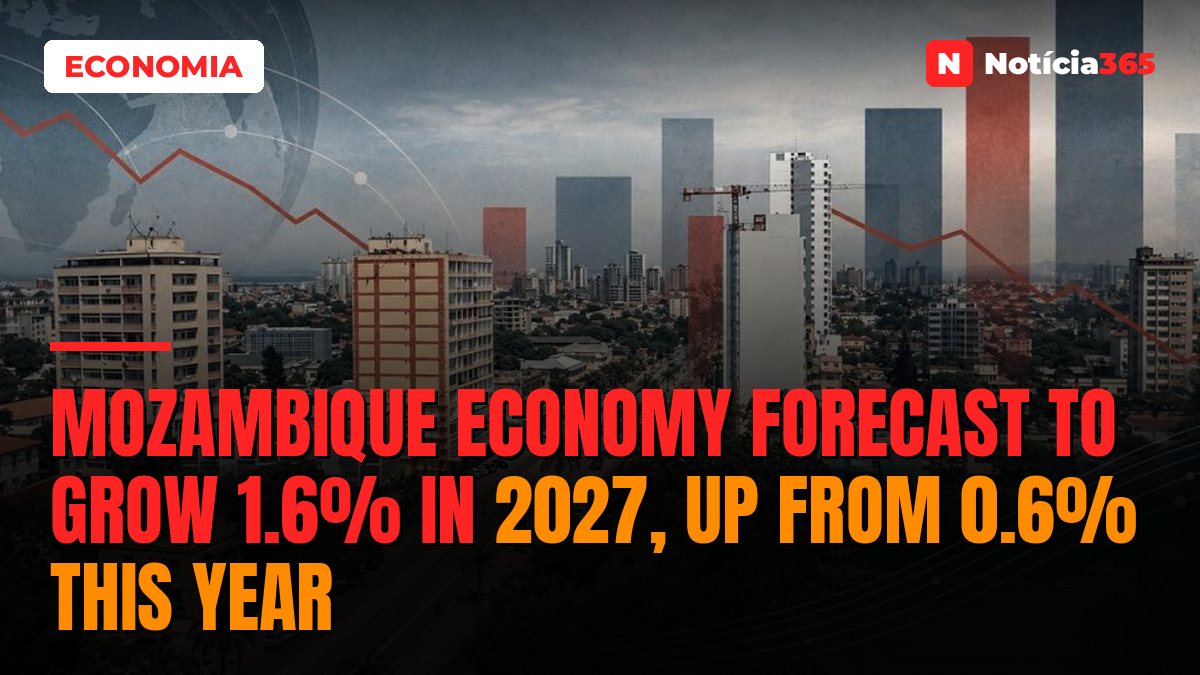

Mozambique’s economy is projected to grow 1.6% in 2027, up from the 0.6% forecast for this year, according to government projections contained in the draft Economic and Social Plan and State Budget (PESOE) for the coming year. The document also projects average annual inflation of 7% and a budget deficit equivalent to 4.6% of gross domestic product (GDP).
The proposal, approved by the Council of Ministers on 13 October, has been forwarded to the National Assembly for consideration and approval. According to the document, cited by Lusa, the government intends to pursue a fiscal policy oriented towards public finance sustainability, control of domestic debt, and the gradual recovery of economic activity. “In terms of fiscal management, the budget policy for 2027 will be guided by a prudent, credible and macro-fiscal disciplined approach,” the proposal states.
The projected acceleration follows the government’s downward revision of its 2026 outlook, acknowledging that floods earlier this year had an impact equivalent to 2% of GDP. “Supported by this framework, the macroeconomic outlook projects real GDP growth of 1.6% for 2027, alongside a trajectory of deceleration in average annual inflation to 7.0%,” the document adds.

The government plans to mobilise total resources of approximately 7.1 billion euros. State revenues are projected at around 5.9 billion euros, equivalent to 23.5% of GDP, while expenditure and financial operations are projected at approximately 7.1 billion euros, or 28.1% of GDP. The fiscal deficit is therefore expected to stand at approximately 1.2 billion euros. The government also intends to cap recourse to domestic credit at 1.9% of GDP, in order to reduce the pressure of public financing on the economy, and considers that the consolidation of macroeconomic stability will be decisive in attracting investment, stimulating business activity, and making public finance management more sustainable.
Economic Transformation Priorities
On economic transformation, the government’s priorities include increasing domestic production, diversifying the economy, and developing value chains through financing instruments designed to stimulate investment and job creation. Among the key initiatives planned for 2027 is the launch of the Mozambique Development Bank (BDM), which is expected to finance long-term strategic projects, particularly in energy, agriculture, industry, and tourism.
The document also identifies the Local Economic Development Fund (FDEL) and the Women’s Opportunities Promotion Fund (PRO-MULHER) as priority mechanisms to support small businesses, stimulate production, and generate income. The FDEL is allocated approximately 20.8 million euros, while PRO-MULHER is to receive around 6.9 million euros to finance productive activities.
According to the proposal, combining these instruments with the attraction of foreign direct investment and business environment reforms should help reduce financing access difficulties for the private sector, particularly for micro, small, and medium-sized enterprises.
Agriculture and Fisheries Targets
Agriculture, regarded as strategic for food security and employment creation, carries targets including the production of 17,600 tonnes of certified seeds and assistance to more than 1.48 million farmers. The plan also envisages the distribution of 155,000 sets of agricultural equipment and inputs along with 100,000 multipurpose silos, as well as measures to increase the productive capacity of rural communities.
In the fisheries sector, the plan provides for support to 8,845 fishermen, training for 2,646 fish farmers, the delivery of 170 motorised vessels, the provision of 500 floating cages, and the financing of 54 fishing projects.
Source: Diário Económico
Original article: https://www.diarioeconomico.co.mz/2026/10/16/economia/economia-devera-crescer-16-em-2027-preve-governo/