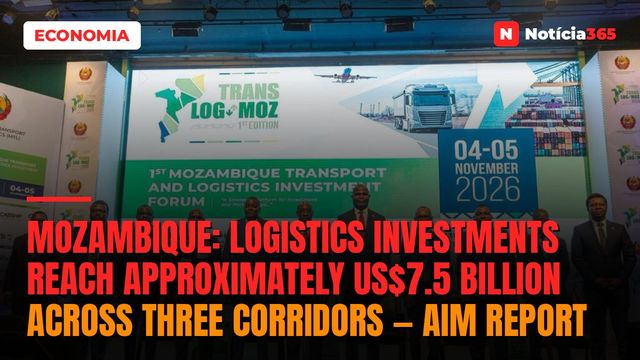
Trans African Concessions (TRAC), the concessionaire of National Road N4 linking South Africa to Mozambique, used an appearance at the TRANS-LOG MOZ 2026 forum in Maputo on Thursday to hold up the road’s private financing model as a blueprint for modernising and maintaining logistics corridors without recourse to sovereign debt. The company argued that an appropriate distribution of risk among the state, investors and road users is essential to ensure the sustainability of similar projects.
The position was presented by TRAC executive director Alex Van Niekerke on the second and final day of the Mozambique Transport and Logistics Investment Forum and Exhibition (TRANS-LOG MOZ 2026).
Van Niekerke explained that the N4 concession, launched in 1997 for a period of 30 years, made it possible to mobilise private sector resources for the construction, upgrading, maintenance and operation of the road. “It was entirely financed by the private sector, through equity investors and debt financing,” he said, adding that the project was subsequently refinanced on the basis of the assets and revenues generated by the infrastructure itself.
According to Van Niekerke, one of the principal advantages of this model was the transfer of construction, traffic and revenue risks to the concessionaire and its financiers, preventing those liabilities from falling directly on the public resources of Mozambique and South Africa. He noted that the concessionaire absorbed those risks even during periods of economic and social disruption, including the Covid-19 pandemic, which demonstrates, in his view, the importance of a contractual framework capable of ensuring operational continuity.
The N4 experience illustrates, according to TRAC, the potential of public-private partnerships to develop strategic infrastructure at a time when governments face financial constraints in meeting investment needs. Van Niekerke also highlighted the corridor’s contribution to economic activity linked to the Port of Maputo, particularly in the mining, agricultural and logistics sectors, as well as its role in generating tax revenues, creating employment and supporting communities located along the route.
Van Niekerke nonetheless cautioned that the viability of concessions depends on balancing the interests of governments, financiers and road users, particularly with regard to toll tariffs and the allocation of financial risks. “High toll tariffs lead to public rejection of the principle of paying tolls,” he said, arguing that prices must remain aligned with user expectations and allow the corridor to stay competitive against other transport routes in the region.
The executive director further stressed that investors assess projects over a long-term horizon, frequently between 20 and 30 years, making regulatory stability, policy predictability and adequate risk management mechanisms essential.
The intervention took place during the panel “Financing Projects: Brownfield Assets and Greenfield Projects”, moderated by João Guirengane of Standard Bank Mozambique. Representatives of the International Finance Corporation (IFC), the U.S. International Development Finance Corporation (DFC), Africa50 and Opaia also participated. The debate focused on financing mechanisms and the distribution of risks associated with the development of logistics infrastructure.
About the event
The inaugural edition of TRANS-LOG MOZ 2026 concluded on Thursday after two days of discussions in Maputo. The event brought together government officials from Southern African countries, investors, financial institutions and economic operators to discuss infrastructure financing, the modernisation of logistics corridors, the reduction of transport costs and the strengthening of regional trade integration.
Source: Diário Económico
Original article: https://www.diarioeconomico.co.mz/?p=558645
The post TRAC Backs PPPs to Modernise Logistics Corridors Without Sovereign Debt appeared first on 360 Mozambique.