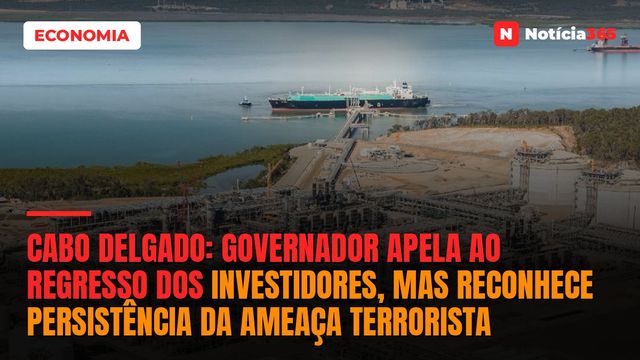
The governor of Cabo Delgado, Valige Tauabo, on Wednesday called on investors to return to the province, saying security conditions are improving, while acknowledging that the terrorist threat persists and that nine years of conflict have set back the region’s development.
Speaking on the sidelines of the Conference on Value Addition Based on Available Mineral and Energy Resources, held in Nacala-Porto, Nampula province, Tauabo highlighted the resilience of local communities but conceded the profound economic and social impact of sustained violence.
“Cabo Delgado has fallen significantly behind,” he said, quoted by Lusa, referring to the consequences of the insurgency that began in October 2017. According to the governor, insecurity has driven away investors, undermined development projects, and continues to fuel fear among residents and caution among economic operators seeking to resume activities.
Tauabo argued for the restoration of confidence among both domestic and foreign business actors, contending that improved security conditions could attract new investment and support economic recovery.
“We want to encourage all those who believe that development is possible and that we can aspire to security,” he said.
The governor stated that no district or locality in the province is currently under the control of terrorist groups, though he acknowledged that insurgent movements persist in remote areas of northern and central Cabo Delgado.
In his assessment, the operations of the Defence and Security Forces, supported by foreign troops, have helped reduce attacks, allowed for the gradual return of displaced populations, and enabled the partial restoration of infrastructure and public services. He cautioned, however, that these gains require sustained community vigilance.
“Once again, we want to say that the movement of extremists still persists,” he warned, stressing that relative calm in some areas does not signal the end of the threat.
The conflict, linked to extremist groups affiliated with Islamic State, has killed more than 6,600 people and displaced over 1.2 million since 2017, according to international organisations. The violence has destroyed infrastructure, halted economic activity, and restricted access to essential services.
In a report published in September, the United Nations Office for the Coordination of Humanitarian Affairs (OCHA) estimated that approximately 1.38 million people were living with the consequences of displacement in Cabo Delgado, including around 662,000 internally displaced persons and 722,000 people who had returned to their areas of origin.
The report also recorded more than 400 conflict-related incidents in the first half of 2026, a 10% increase compared with the same period in 2025, and cautioned that the return of families does not necessarily indicate a recovery of security conditions or livelihoods.
The conference at which Tauabo spoke is running from 19 to 24 October in Nacala-Porto, bringing together representatives from multiple sectors to discuss how mineral and energy resources can be transformed into development opportunities.
Source: Diário Económico
Original article: https://www.diarioeconomico.co.mz/2026/10/21/economia/investimento/cabo-delgado-governador-apela-ao-regresso-dos-investidores-mas-reconhece-persistencia-da-ameaca-terrorista/
The post Cabo Delgado Governor Urges Investors Back as Insurgent Threat Persists appeared first on 360 Mozambique.