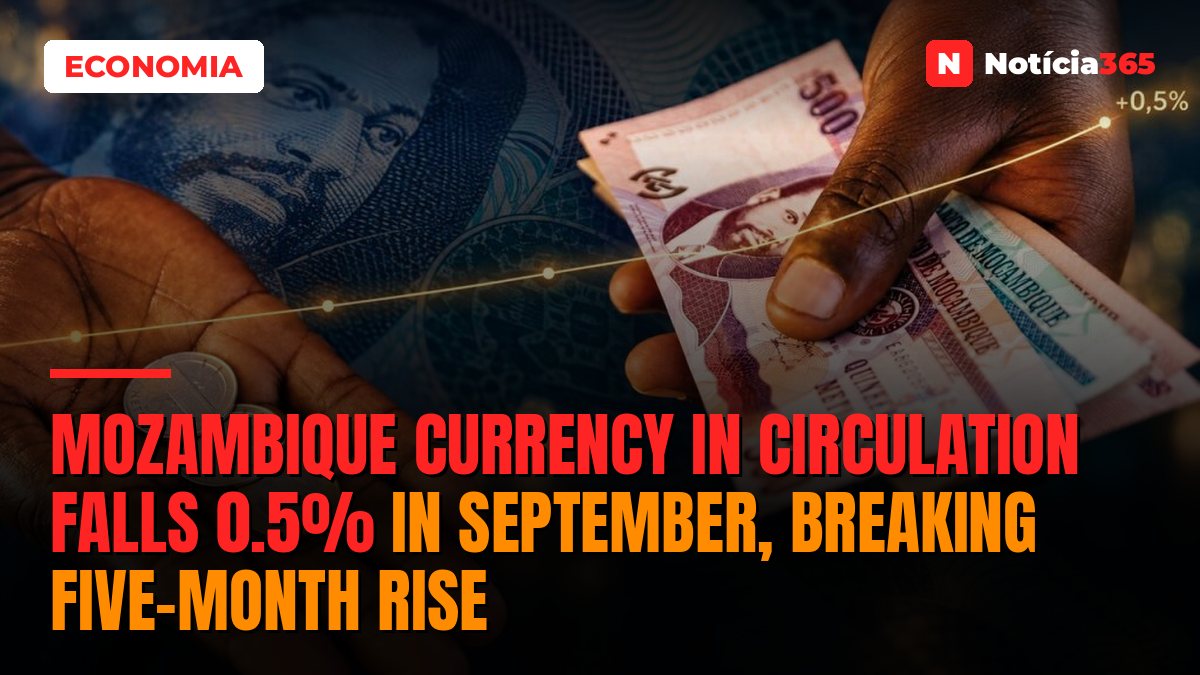

Currency in circulation in Mozambique fell 0.5% in September 2026, dropping to approximately 78.29 billion meticais from 78.68 billion meticais the previous month, according to data from the Bank of Mozambique (BdM). The decline, of roughly 394 million meticais, ended five consecutive months of growth.
According to the central bank’s October Monthly Statistical Information Summary, physical cash in circulation had reached its highest level in 12 months in August, following a month-on-month increase of 2.3%.
The upward trend began in April, when the indicator rose to 70.80 billion meticais after retreating to 67.38 billion meticais in March. It then climbed to 73.13 billion meticais in May, 76.50 billion meticais in June, 76.91 billion meticais in July, and 78.68 billion meticais in August.

Despite the September decline, currency in circulation remains approximately 16.2% above its March level, representing a cumulative increase of around 10.91 billion meticais. Compared with December 2025, when it stood at 74.95 billion meticais, the September figure represents growth of approximately 4.5%, or 3.34 billion meticais.
These developments are occurring against a backdrop of monetary policy measures adopted by the Bank of Mozambique to control liquidity in the financial system and preserve price stability. At its meeting on 25 May, the Monetary Policy Committee (CPMO) raised the mandatory reserve requirement on liabilities denominated in domestic currency from 29% to 39%, while maintaining the coefficient applied to foreign-currency liabilities at 29.5%.
The measure was intended to reinforce liquidity absorption within the banking system during a period marked by concerns over inflation dynamics and other macroeconomic risks. The central bank kept its benchmark interest rate, the MIMO rate, unchanged at 9.25%, citing the need to preserve monetary conditions consistent with price stability.
At the meeting of 29 July, the then-governor of the Bank of Mozambique, Rogério Zandamela, justified the decision to hold the reference rate by pointing to the “reduction of liquidity in domestic currency in the banking system, resulting from the increase in the mandatory reserve requirement in May”.
Currency in circulation refers to the total stock of banknotes and coins held outside the central bank and is one of the indicators used to track the evolution of physical money in the economy.
Movements in this indicator do not, in themselves, represent an equivalent change in total financial system liquidity, which also depends on other components such as bank deposits.
Source: Diário Económico
Original article: https://www.diarioeconomico.co.mz/2026/11/13/economia/financas/bdm-numerario-em-circulacao-recua-em-setembro-e-interrompe-cinco-meses-de-subida/