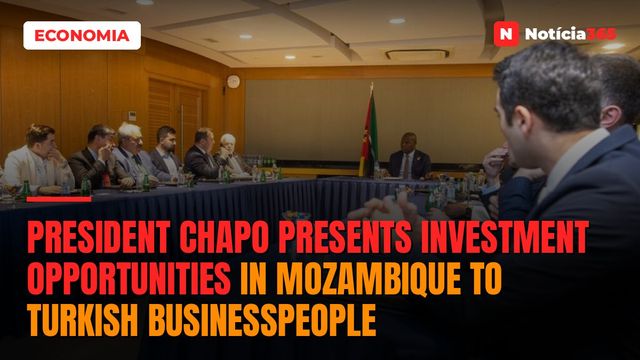

President Daniel Chapo has invited Turkish businesses to invest in Mozambique, presenting opportunities across infrastructure, energy, transport, logistics, agriculture, tourism and industry. At a meeting held on Thursday, 12 November, in Antalya, Turkey, Chapo acknowledged that the country has projects and a development strategy in place but faces financial constraints in bringing planned investments to fruition.
The meeting took place on the sidelines of the 31st United Nations Climate Change Conference (COP31), where Chapo highlighted ongoing reforms, Mozambique’s geographical location and the potential of its natural resources as factors capable of attracting foreign investment.
In the hydrocarbons sector, the President presented the four major natural gas projects in the Rovuma Basin: Coral Sul, Coral Norte, Mozambique LNG — led by TotalEnergies — and Rovuma LNG, led by ExxonMobil.

Chapo underscored the development of Coral Norte, which is expected to come on stream in 2028, and the resumption of activities at Mozambique LNG, suspended in 2021 due to insecurity in Cabo Delgado. Regarding the ExxonMobil project, he expressed hope that a final investment decision would be taken before the end of 2026.
The President argued, however, that natural gas revenues should contribute to diversifying the Mozambican economy, channelling proceeds into sectors such as agriculture, transport, tourism, logistics and the blue economy, as well as into the production of electricity, fertilisers and ammonia.
On energy, Chapo highlighted Mozambique’s potential to expand electricity supply to neighbouring countries, including South Africa, Zimbabwe, Botswana, Malawi and Eswatini.
Among the investments outlined, he pointed to the second phase of the Cahora Bassa Hydroelectric Dam (HCB), the construction of the Mphanda Nkuwa hydroelectric plant, and a gas-fired power station with an estimated capacity of 450 megawatts in Inhambane province, linked to a transmission line running to Maputo and South Africa.
Chapo also highlighted the Maputo, Beira and Nacala corridors as strategic infrastructure for the transport and movement of goods. In this context, he advocated expanding road and rail networks, building pipelines and developing special economic and industrial zones with a view to accelerating industrialisation and creating jobs, particularly for young people.
In agriculture, he pointed to the availability of water resources and arable land as opportunities to attract investment in agro-industrial production and processing, combining food security with increased exports.
On tourism, Chapo highlighted the potential of Inhambane province and the intention to consolidate Vilankulo as a reference tourist destination through new investment in infrastructure and services. Opportunities presented included airport projects for Vilankulo, Pemba and the city of Inhambane.
The digitalisation of the public administration was also identified as an area for investment, with emphasis on the installation of data centres and the use of Artificial Intelligence (AI) in modernising public services.
Chapo further described health and education as fundamental sectors for sustainable development and human capital development.
To facilitate investments, the President presented Turkish business leaders with three partnership modalities available under Mozambican legislation: Public-Private Partnerships (PPP), Build-Operate-Transfer arrangements (BOT), and concessions.
Chapo called on the Turkish private sector to participate in delivering the projects, seeking to strengthen economic cooperation and attract financing for the diversification of the Mozambican economy.
Source: Diário Económico
Original article: https://www.diarioeconomico.co.mz/2026/11/13/economia/investimento/governo-procura-capital-turco-para-financiar-projectos-e-diversificar-a-economia/