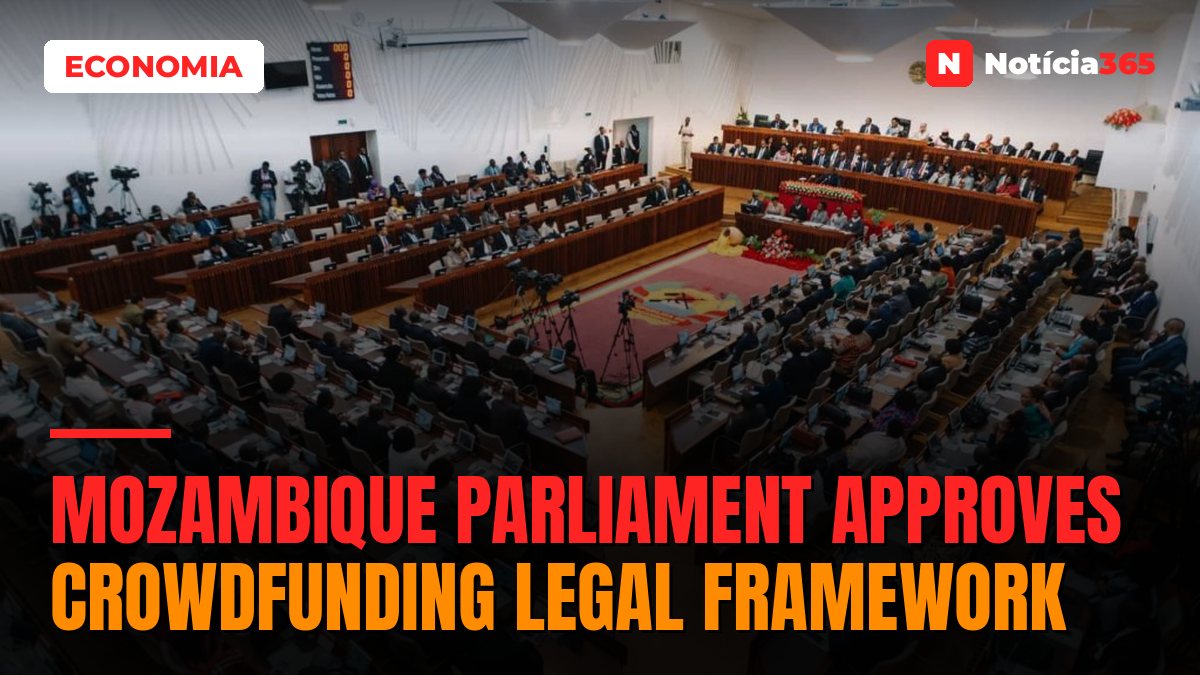

Mozambique’s Assembly of the Republic approved, in general terms, on Wednesday 11 November, a draft law establishing the Legal Regime for Collaborative Financing, designed to diversify funding sources and facilitate access to capital, particularly for micro, small and medium enterprises (MSMEs).
According to newspaper O País, the government initiative creates a legal framework for the mobilisation of resources through digital platforms, allowing companies and project promoters to raise financing from a large number of investors and funders as an alternative to traditional credit mechanisms.
In presenting the proposal, the Minister of Public Works, Housing and Water Resources, Fernando Rafael, representing Finance Minister Carla Loveira, explained that the instrument covers four financing modalities: equity, loan, donation, and reward.

The minister highlighted that the regime establishes rules for the operation of platforms, including mandatory registration of managing entities, investor protection, operational transparency, prevention of conflicts of interest, and the security of mobilised funds.
Under the investor protection provisions, the proposal sets out maximum investment limits — to be defined by subsequent regulation — taking into account the characteristics and risks associated with this form of financing.
Platforms will also be required to make clear and precise information available on each operation, including the risks, costs, and charges involved, so that participants can make informed decisions.
The proposal further stipulates that amounts raised must be deposited with banking institutions, as a means of guaranteeing the security of resources and reinforcing user confidence.
During the parliamentary debate, the Frelimo (Frente de Libertação de Moçambique) parliamentary group considered that the initiative would establish clear rules for the operation of digital platforms and lend greater credibility to the activity.
The Podemos (Povo Optimista para o Desenvolvimento de Moçambique) party underscored the importance of the Bank of Mozambique’s role in regulating and supervising the sector, advocating for mechanisms that ensure the protection of funds and the transparency of operations.
Renamo (Resistência Nacional Moçambicana) expressed reservations about the proposal, arguing that certain key aspects of the regime’s implementation would remain dependent on subsequent regulation by the Bank of Mozambique.
The MDM (Movimento Democrático de Moçambique) argued in turn that the success of the future law should be measured by concrete economic outcomes, specifically the number of companies financed, jobs created, and opportunities generated for youth and women.
With the general approval secured, the proposal advances to the next stages of the legislative process, during which the mechanisms for regulation, implementation, and oversight of collaborative financing in the country are expected to be elaborated further.
Source: Diário Económico
Original article: https://www.diarioeconomico.co.mz/2026/11/12/economia/parlamento-aprova-novas-regras-para-financiamento-de-empresas/