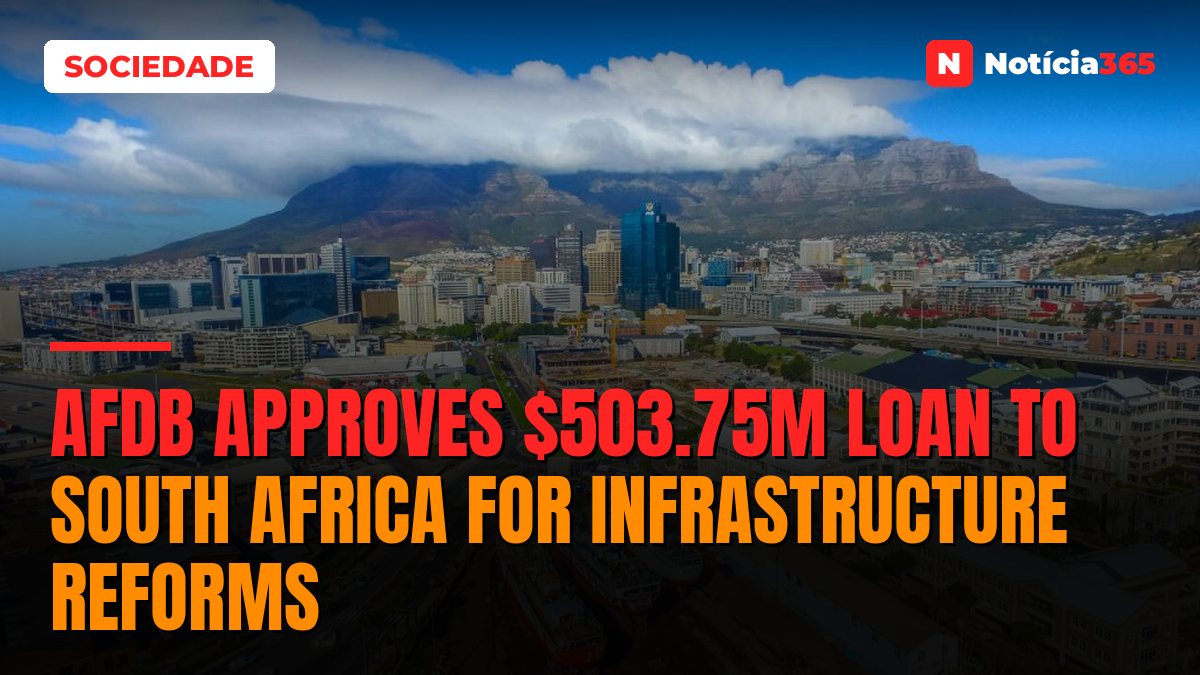

The Board of Directors of the African Development Bank (AfDB) has approved a loan of $503.75 million to South Africa to support reforms aimed at opening the electricity, freight transport, and water supply sectors to competition and private investment.
The financing forms part of the Infrastructure Governance Reform Programme and extends the budget support the AfDB has provided to South Africa since 2023, with cumulative disbursements now exceeding $1.2 billion.
Of that total, $300 million was made available in 2023 through the Energy Governance and Climate Resilience Support Programme, designed to support the restructuring of the electricity sector, the financial sustainability of Eskom, and the establishment of the National Transmission Company South Africa (NTCSA).

The programme also sought to strengthen private sector participation in renewable energy, against a backdrop of structural changes in the functioning of South Africa’s electricity market.
In 2025, the AfDB approved a further $474.5 million under the Infrastructure Governance and Green Growth Programme, aimed at deepening electricity market reforms, promoting the integration of renewable energy, and improving distribution efficiency.
That operation also encompassed transport sector reforms and social protection measures linked to the just energy transition, reinforcing the country’s broader infrastructure modernisation strategy.
The new programme will be implemented within a coordinated development partner framework led by the South African National Treasury, with the objective of ensuring greater alignment between financing, institutional reforms, and investment execution.
“This operation is directly aligned with the Bank’s High 5 priorities,” said Kennedy Mbekeani, AfDB Director General for Southern Africa.
According to Mbekeani, the programme is expected to mobilise private capital for the electricity transmission sector and for investment in rolling stock, strengthen institutions responsible for infrastructure financing, and support job creation.
Reforms open energy and transport sectors to competition
In the electricity sector, one of the principal reforms envisages changing the operating model of Eskom, the dominant state-owned utility, moving away from its role as the sole buyer and seller of electricity and allowing greater participation by other operators.
South Africa’s National Energy Regulator (NERSA) has already granted a market operator licence to the entity performing that function within NTCSA, Eskom’s transmission subsidiary. NERSA also approved rules for the allocation of grid connection capacity.
These rules establish the criteria for network access and the order of priority for the allocation of available capacity. A Market and Competition Monitoring Unit has also been created to oversee the new model’s operation.
The target is for the wholesale market to account for 10% of total electricity transactions by December 2027.
In freight rail, the Transnet Rail Infrastructure Manager has begun allocating train path rights across a network spanning 21,232 kilometres, while the Department of Transport has granted access licences to private operators.
In August 2025, at least 11 usage rights were awarded across six rail corridors, in an unprecedented move for South Africa’s freight rail sector.
The objective is for at least six new private operators to be licensed in the rail and port sectors by December 2027, and for the annual volume of freight transported by rail to increase from 161 million to 180 million tonnes.
In the port sector, South Africa signed its first terminal concession contract in December 2025, covering a 25-year agreement involving International Container Terminal Services and the Durban Container Terminal Pier 2.
This facility handles approximately 46% of the country’s container traffic and is expected to increase its annual capacity from 2 million to 2.8 million twenty-foot equivalent units (TEUs) by 2028.
In parallel, annual investment in rail rolling stock is projected to triple, reaching 6 billion rand, equivalent to approximately $360 million.
The AfDB reaffirmed its commitment to supporting the implementation of structural reforms across the energy, transport, and water sectors, with the aim of improving service efficiency and stimulating private investment.
Among the expected outcomes are a reduction in truck queues at the port of Durban, greater reliability in water supply, and more competitive electricity prices.
Source: Diário Económico
Original article: https://www.diarioeconomico.co.mz/2026/11/12/mundo/africa/africa-do-sul-bad-aprova-emprestimo-de-mais-de-500-m-para-reformas-em-infra-estruturas/