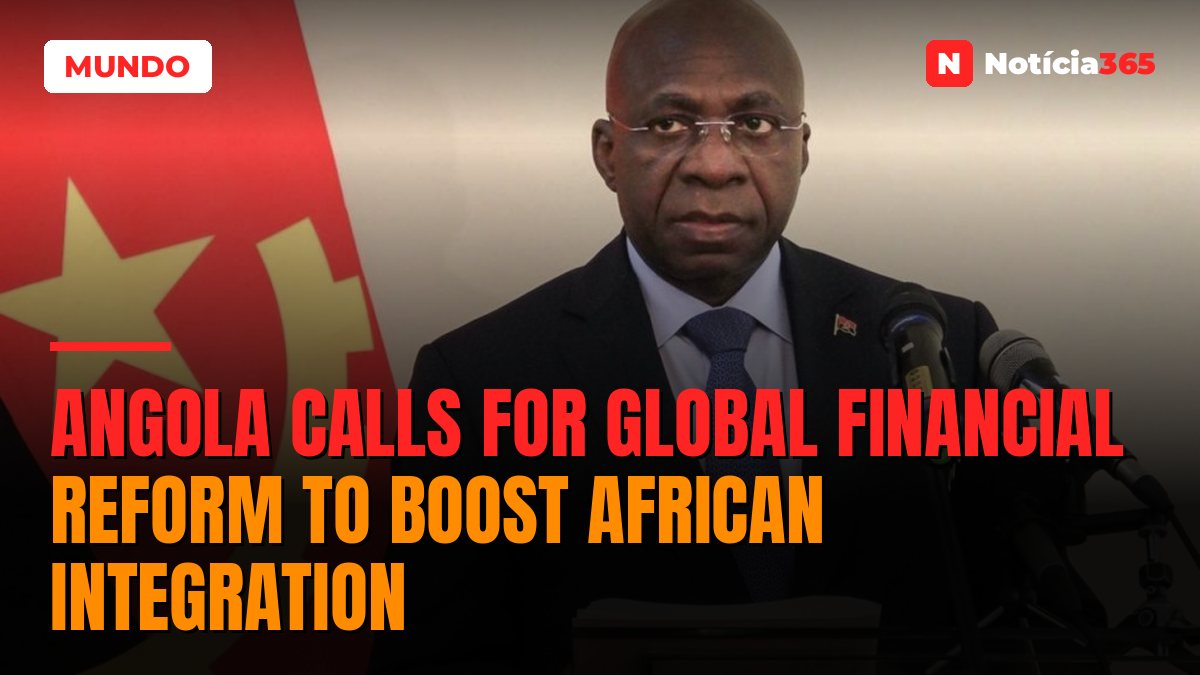

Angola’s Minister of Foreign Affairs, Téte António, has called for a reform of the international financial architecture, greater mobilisation of development banks, and increased infrastructure investment as essential conditions for accelerating economic integration across the African continent.
According to Lusa, the position was set out during the Brazil-Africa Forum 2026, held on 11 and 12 November in São Paulo, Brazil, in a session dedicated to ‘South-South Cooperation and Global Partnerships for Sustainable Prosperity’.
‘Africa has projects and investment opportunities. However, difficulties persist relating to the cost of capital and the conditions of access to financial resources,’ said the head of Angolan diplomacy.
The intervention was delivered on the day Angola marked the 51st anniversary of its independence, on 11 November. Téte António identified three priorities for the country and for the African Union: development financing, peace and security, and a more equitable international representation.
In this context, the minister called for the creation of financial instruments better suited to the needs of African economies, highlighting concessional financing, guarantees, and local-currency financing mechanisms as means of facilitating access to capital and supporting development projects.
Téte António also underscored the importance of infrastructure for the realisation of the African Continental Free Trade Area, advocating for the development of transport and logistics corridors capable of linking countries, bringing markets closer together, and strengthening productive capacities.
‘Without infrastructure, there is no effective integration,’ the minister said, arguing that physical connectivity is an essential condition for deepening trade and regional economic integration.
Speaking before an audience of business leaders, government officials, and international investors, Téte António pointed to the Lobito Corridor as a strategic infrastructure asset for African regional integration.
The minister noted that the corridor’s regional articulation could include a connection to the TAZARA railway line, which links the port of Dar es Salaam in Tanzania to Zambia. According to the minister, such a connection ‘could bring the Atlantic and Indian coasts closer together and expand opportunities for trade and industrialisation’, reinforcing the economic potential of regional corridors.
‘We want the corridors to be more than transit routes: we want them to be spaces where wealth is created, remains, and benefits communities,’ he said, adding that cooperation should be assessed by its concrete results — namely the infrastructure built, the energy made available, the jobs created, and the strengthening of productive capacities.
Téte António further argued that international cooperation must help Africa move beyond its role as a supplier of raw materials and advance towards industrial transformation, innovation, and value creation. To that end, he considered investment in training and in creating opportunities for young people to be fundamental.
On the subject of relations with Brazil, the head of Angolan diplomacy argued that the historical, cultural, and linguistic ties between the two countries should underpin a more diversified economic relationship, based on the two-way flow of investment, knowledge, and opportunities.
Among the priority areas he identified were: strengthening trade between Mercosur and the African Continental Free Trade Area, development financing, energy transition and industrialisation, food security, and the consolidation of the South Atlantic as a space of peace and prosperity.
Téte António welcomed the admission of the African Union into the Group of Twenty (G20) and Brazil’s presidency of the Zone of Peace and Cooperation of the South Atlantic, calling for ‘a more inclusive, effective, and representative multilateralism’.
The minister also stressed that ‘Africa’s strategic autonomy requires the capacity to define priorities, choose partners, and negotiate mutually advantageous relationships’.
Source: Diário Económico
Original article: https://www.diarioeconomico.co.mz/2026/11/12/mundo/angola/angola-governo-defende-reforma-financeira-global-para-acelerar-desenvolvimento-de-africa/