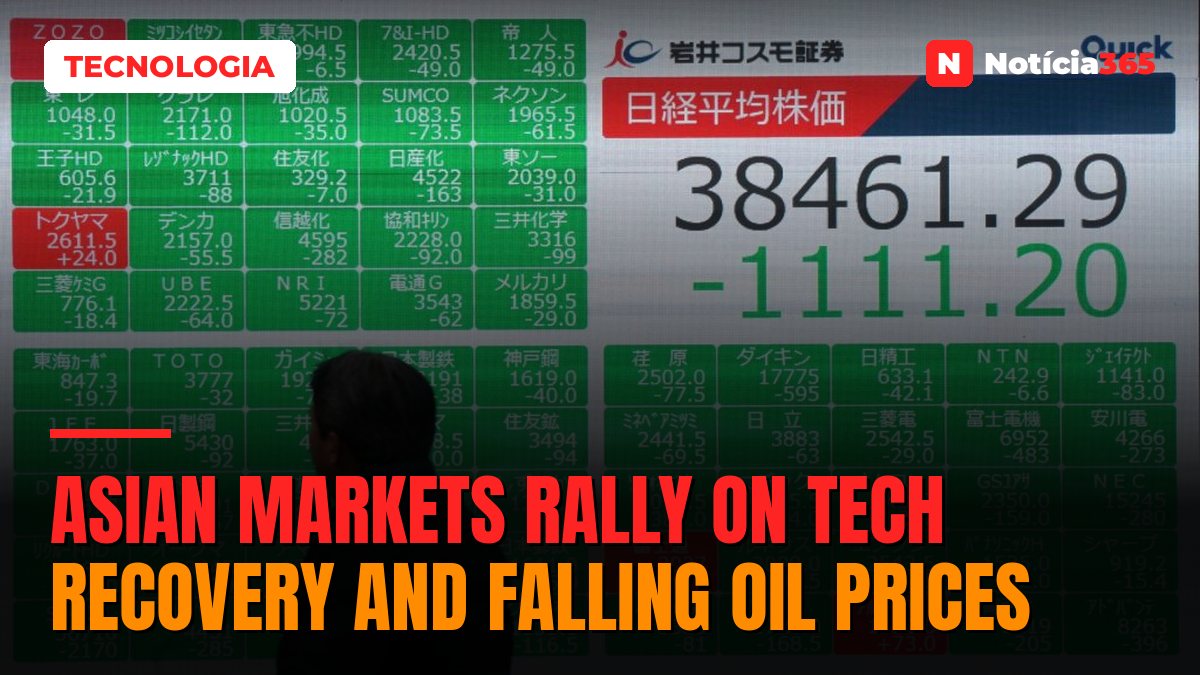

Asia's major stock markets closed higher on Tuesday, driven by a rebound in technology stocks and a decline in international oil prices. South Korea's bourse led regional gains with an advance of more than 4%, as investors returned to buying shares linked to artificial intelligence after steep losses in prior sessions.
The MSCI Asia Pacific index, which tracks leading listed companies across the region, rose by around 2%, extending a recovery that began on Monday. In South Korea, the Kospi stood out with a gain of 4.39%, closing at 5,239.13 points after three consecutive sessions of losses. The performance was supported by a rebound in semiconductor manufacturers, as selling pressure on technology stocks eased.
Japan's market followed the positive trend, with the Nikkei 225 advancing 2.87%, while Australia's ASX 200 posted gains of 1.10%. In China, moves were more modest, with the Shanghai Composite edging up 0.08%, while Hong Kong's Hang Seng was up close to 0.4%.

The recovery reflects renewed demand for companies involved in the development of artificial intelligence technologies, following a sharp wave of selling that had raised doubts about elevated valuations and the ability of investments in the sector to generate sustainable returns. Among the standout names was Taiwan Semiconductor Manufacturing Company (TSMC), one of the world's largest chipmakers and a key supplier to technology groups including Nvidia and Apple, which benefited from investor interest amid revenue growth and strong demand for advanced processors.
Beyond the technology rebound, the decline in international oil prices helped improve market sentiment by easing concerns related to inflation and energy costs. Brent crude, the international benchmark, retreated to near $91 per barrel after United States President Donald Trump signalled that new strikes against Iran were unlikely if diplomatic negotiations moved forward.
Those remarks fuelled expectations of a reduction in Middle East tensions — a region of strategic importance to global energy supply — and helped diminish fears of further disruptions to oil supply. The fall in crude prices is particularly significant for several Asian economies that are heavily dependent on energy imports, as it can help lower production costs and ease inflationary pressures.
Quoted by Bloomberg, Dilin Wu, strategist at Pepperstone Group, said the sharp decline in oil prices provided some relief to financial markets, primarily by reducing inflation expectations. The strategist cautioned, however, that it remains too early to determine whether the recovery will be sustained, given lingering doubts about the scale of artificial intelligence investment and the financial returns it will generate.
The performance of Asian markets also follows a recovery on Wall Street, where major US indices closed higher on Monday, led by technology stocks. Despite the optimism, investors remain focused on upcoming US inflation data, which could influence the Federal Reserve's next decisions on interest rates.
The sustainability of the recovery will therefore depend on the trajectory of geopolitical tensions, energy prices, and investor confidence in the growth prospects of technology companies — particularly those operating in the artificial intelligence sector.
Source: Diário Económico
Original article: https://www.diarioeconomico.co.mz/2026/11/10/mercados/mercados-mercados/mercados-asiaticos-fecham-em-alta-com-recuperacao-tecnologica-e-queda-do-petroleo/