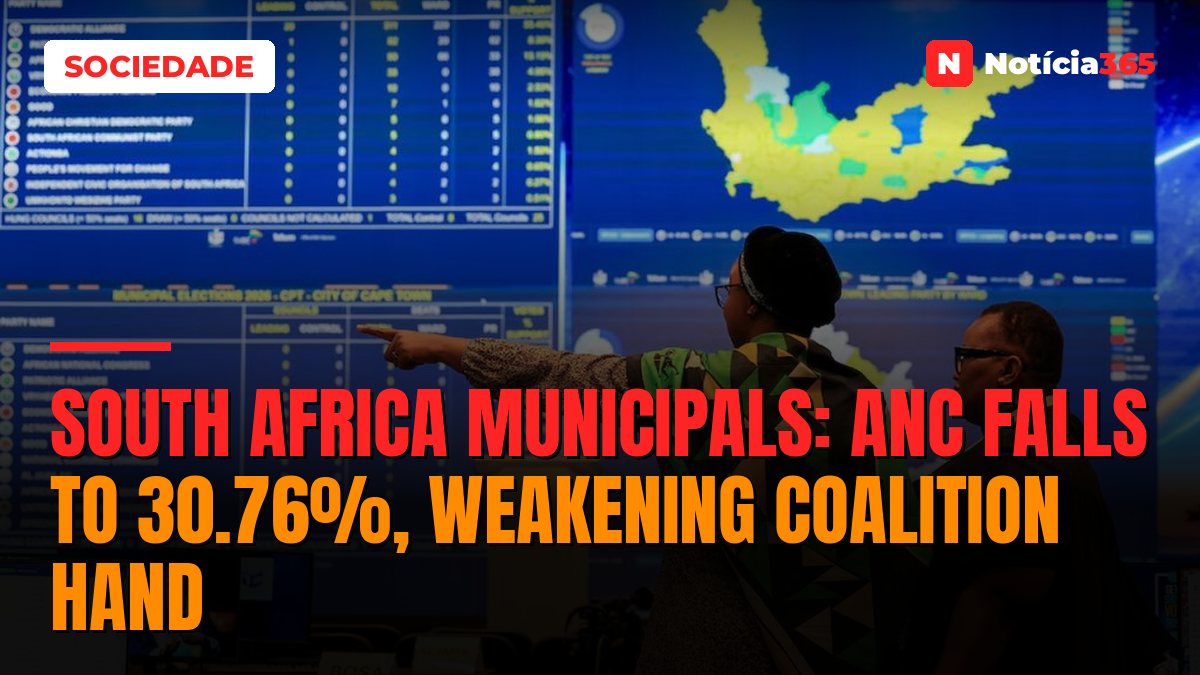

The African National Congress (ANC) secured 30.76% of the vote in last week’s South African municipal elections, down sharply from 45.59% in the 2021 polls, according to results released on Sunday 8 November. The decline significantly weakens the ruling party’s hand in negotiations to form municipal governments, against a backdrop of growing electoral fragmentation.
The Democratic Alliance (DA), the ANC’s main rival, captured 24.64% of the vote, while uMkhonto weSizwe — the party of former president Jacob Zuma — came third with 9.76%. The remaining votes were spread across hundreds of smaller parties.
According to Reuters, the result marks a fresh setback for the former liberation movement, whose share of the local election vote has fallen steadily over the past 15 years. The erosion of support is largely attributed to failures in the delivery of basic services, including water supply and electricity.
In many cities, including Johannesburg — South Africa’s main economic hub — no single party crossed the 50% threshold. The ANC and the DA will therefore need to align with each other or negotiate with smaller formations to build municipal majorities. The number of municipalities requiring coalition arrangements more than doubled compared with 2021, reflecting a deepening fragmentation of the electorate.
ANC Secretary-General Fikile Mbalula described the result as “catastrophic” for the party of Nelson Mandela, but insisted the organisation would not beg for posts in coalition talks. “When the people tell us that we have fallen short of their expectations… the honest response is not to argue with them but to go back home and put our house in order,” he said on Saturday, 7 November.
Following the announcement of results, President Cyril Ramaphosa expressed pride in the multiparty character of South Africa’s democracy. “We celebrate the enduring strength of our democracy and the sovereign right of South African people to choose their representatives,” he said in brief remarks.
Parties have 14 days to negotiate before municipal councils are constituted. Ramaphosa urged political formations to approach the talks with humility, stressing that “the interests of our people must not be smothered by parties or their representatives seeking to settle political scores or nurse petty disputes.”
In Johannesburg, the DA — which advocates business-friendly policies — received approximately 35% of the vote against 20% for the ANC. The outcome could give veteran DA leader Helen Zille a strong chance of assuming the mayoralty, subject to coalition agreements. During the campaign, she focused her platform on repairing potholes and fixing water pipe leaks.
Analysts say the most viable path to stable governance in cities such as Johannesburg would be a partnership between the ANC and the DA, mirroring the arrangement the two parties have maintained at the national government level for the past two years. However, the two formations hold significant ideological differences on key issues, including policies to redress racial inequality.
ActionSA, which came third in Johannesburg with 16% of the vote, ruled out supporting the DA if Helen Zille remains its candidate for the city’s mayoralty. The position was communicated to Reuters on Sunday by party leader Herman Mashaba.
Source: Diário Económico
Original article: https://www.diarioeconomico.co.mz/2026/11/09/mundo/africa/eleicoes-africa-do-sul-anc-cai-para-3076-nas-municipais-e-perde-forca-para-negociar-coligacoes/