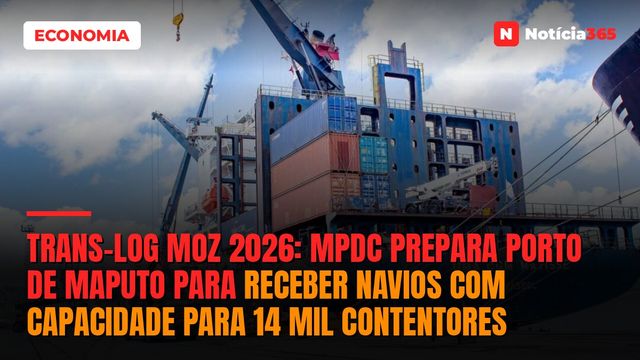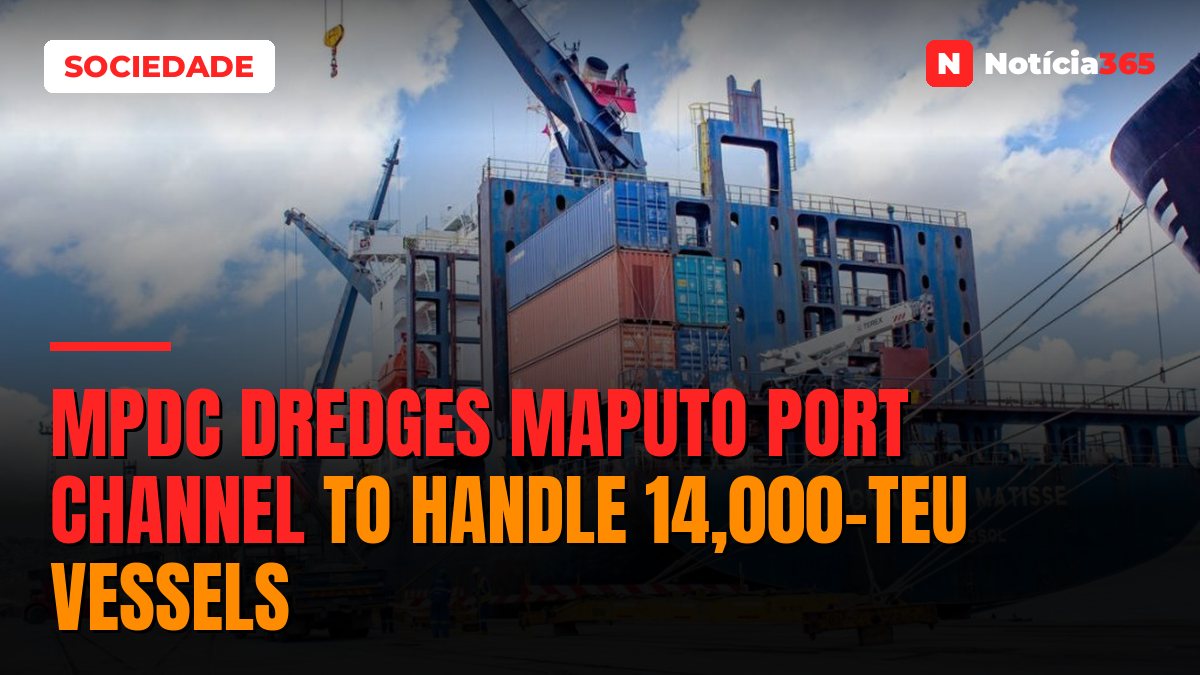

The Maputo Port Development Company (MPDC) is executing a project to deepen and widen the port’s access channel, with the aim of enabling vessels with a capacity of up to 14,000 TEU (twenty-foot equivalent units) to call at the port. The intervention is designed to accommodate larger vessels in line with the expansion of port terminals, reinforcing Maputo Port’s competitiveness in the regional market.
The information was presented on Thursday (5 November) by MPDC’s executive director of projects, Paulo Mata, during the second and final day of the Mozambique Transport and Logistics Investment Forum and Exhibition (TRANS-LOG MOZ 2026), held in Maputo.
Paulo Mata explained that the dredging project stems from the need to adapt the channel to accommodate expansion investments at the container terminal and the Matola coal terminal, both of which are set to receive larger vessels.
According to Paulo Mata, the container terminal expansion envisages the operation of vessels measuring 366 metres in length with a capacity of 14,000 TEU — dimensions that require modifications to the access channel. “In the current channel, it is not possible to have this vessel transit the channel,” he said. “For this reason, we had to look at the channel’s geometry to ensure safe navigation,” he added.
Paulo Mata explained that the current access channel at Maputo Port stretches approximately 74 kilometres, with a width of 110 metres on straight sections and 150 metres on bends. Under the new project, these widths are set to increase to 190 metres on straight sections and 295 metres on bends, improving navigation conditions.
The intervention also includes the introduction of manoeuvring zones and the repositioning of navigation buoys, in order to align maritime signalling with the channel’s new specifications.
Paulo Mata revealed that the project formally commenced on 12 October 2026, with construction works beginning three days later, on 15 October. At the time of the presentation, the project had recorded approximately 2% completion, with a total construction period of 12 months projected.
According to Paulo Mata, MPDC expects the channel to be “navigable for both vessel classes” by September 2027.
Paulo Mata highlighted that the deepening and widening of the channel represent a strategic investment to sustain the growth of port operations and meet the freight transport demand of exporters using the Maputo Corridor.
As a reference for the progress achieved over the past two decades, Paulo Mata noted that Maputo Port handled around 5 million tonnes in 2003, the year the concession commenced, and reached approximately 32 million tonnes in 2025. He attributed this evolution to investments in the modernisation of port infrastructure, including previous dredging works that increased the channel’s depth and allowed vessels of different sizes to be received.
Paulo Mata argued that investment decisions must take regional competition into account, at a time when other ports in the region are also undertaking modernisation investments, given that exporters assess costs, operational turnaround times, and service efficiency before selecting a port for their cargo. “I will not say here that we will be better, but at the end of the day, it is the client who will make that comparison,” he said.
The presentation took place during a session on structural projects under way in logistics corridors, moderated by Fernando Sebastião Ouana of the Ministry of Transport and Logistics. Also participating were Rowan Diviani of GTL, who presented the Nacala Grain Terminal project, and engineer Simão Munguambe of ITRANSMAR, who addressed investments in maritime signalling.
About the event
The inaugural edition of TRANS-LOG MOZ 2026 took place on 4 and 5 November in Maputo, bringing together government officials from Southern African countries, investors, financial institutions, and economic operators. Over the two days, the event promoted discussions on infrastructure financing, the modernisation of logistics corridors, the reduction of transport costs, and the strengthening of regional trade integration.
Source: Diário Económico
Original article: https://www.diarioeconomico.co.mz/2026/11/06/negocios/logistica/trans-log-moz-2026-mpdc-prepara-porto-de-maputo-para-receber-navios-com-capacidade-para-14-mil-contentores/