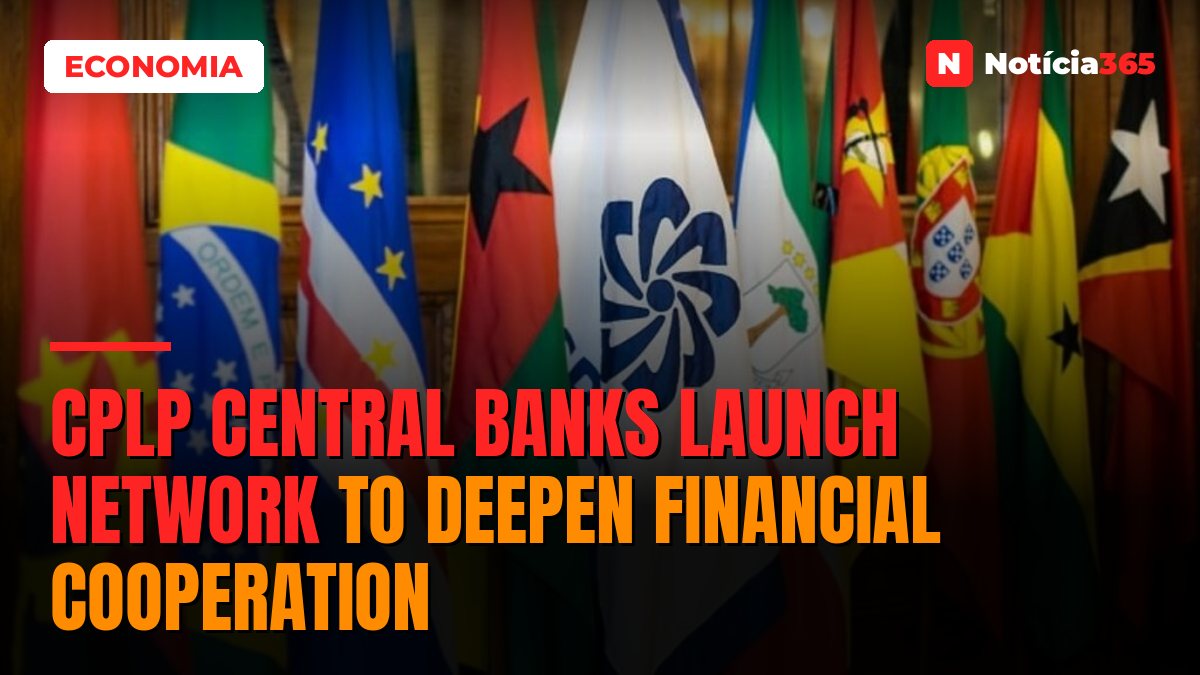

The Network of Central Banks of Portuguese-Speaking Countries was officially launched on Wednesday, 4 November, in Luanda, with the aim of strengthening institutional and technical cooperation among the monetary authorities of Lusophone nations. The initiative seeks to promote the sharing of expertise and the development of joint solutions in areas including macroeconomic policy, financial inclusion, digitalisation, and payment systems.
The creation of the network was formalised through the signing of a memorandum of understanding, announced by the Governor of the Banco Nacional de Angola (BNA), Tiago Dias. According to Dias, working groups have been established to address matters of common interest, designed to foster permanent collaboration among specialists from the various central banks.
“It is a set of working groups that will be constituted so that the specialists of our central banks find a permanent space for interaction,” Dias said.

Following the official launch, the network held its first meeting, during which the organisational structure, chairmanship, and mandates of the different working groups were approved. The initiative envisages an annual rotating presidency, with the Banco de Portugal set to assume the first mandate in 2027.
The Governor of the Banco de Portugal, Álvaro Santos Pereira, described the creation of the network as historic, highlighting its potential to intensify cooperation and information-sharing in areas such as payment systems, statistics, financial literacy, crisis management, and economic analysis.
Santos Pereira also underscored the importance of the initiative against an international backdrop marked by geopolitical tensions and growing economic fragmentation, arguing for deeper cooperation among Portuguese-speaking countries.
Santos Pereira welcomed Angola’s role in hosting the inaugural meeting, which coincided with celebrations marking the 50th anniversary of the Banco Nacional de Angola, observed on Thursday, 5 November.
He further highlighted the economic reforms carried out in Angola in recent years and the dynamism of the non-oil sector, suggesting that the evolution of the Angolan economy could create new opportunities for foreign investors.
“I hope there will be more investments and that, whether in the financial system or in other sectors, this will happen,” he said.
Also on Wednesday, the governors of the central banks of Portuguese-speaking countries reviewed the international economic environment, its possible impact on their respective economies, and opportunities to deepen cooperation, particularly through the exchange of knowledge and best practices.
The network brings together the monetary authorities of Portuguese-speaking countries, seeking to consolidate permanent mechanisms for dialogue and technical collaboration. The Comunidade dos Países de Língua Portuguesa (CPLP) comprises Angola, Brazil, Cabo Verde, Guinea-Bissau, Equatorial Guinea, Mozambique, Portugal, São Tomé and Príncipe, and Timor-Leste.
Source: Diário Económico
Original article: https://www.diarioeconomico.co.mz/?p=558512