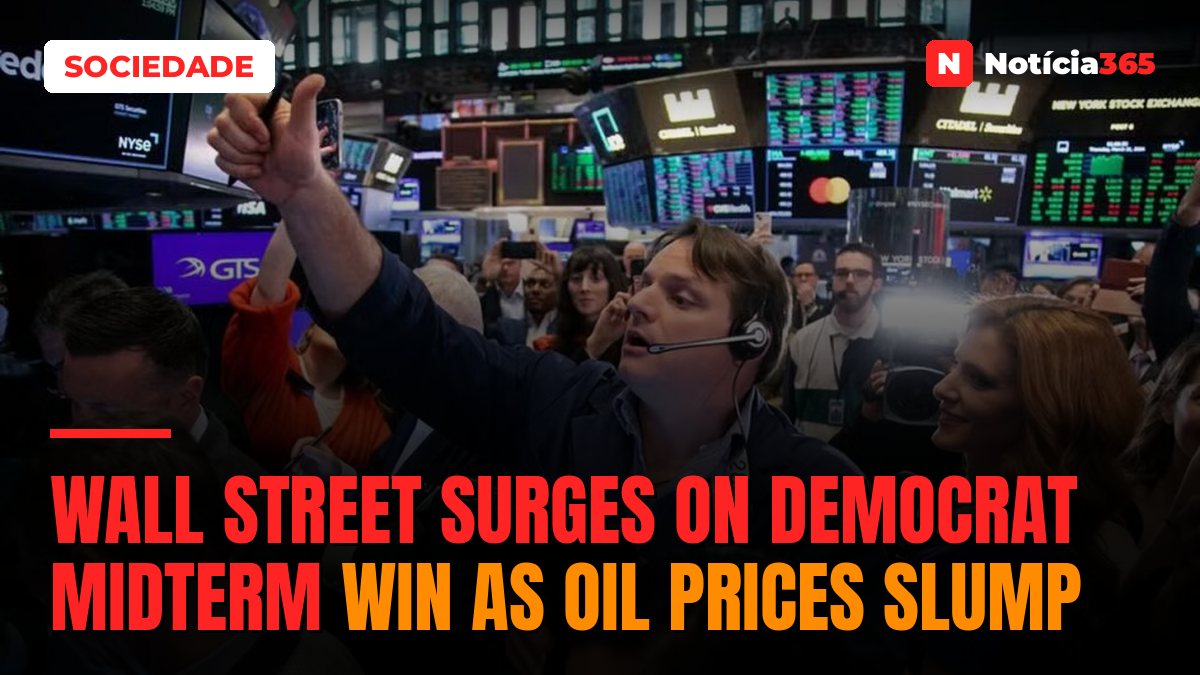

US equities recorded their best session since August on Wednesday, 4 November, driven by a sweeping Democratic Party victory in the midterm elections and a sharp drop in oil prices, as investors anticipated an easing of geopolitical tensions in the Middle East.
The S&P 500 advanced 1.58% to 7,688.62 points, the Dow Jones Industrial Average jumped 3.03% to 53,356.12 points, and the Nasdaq Composite gained 1.44% to 25,736.51 points.
The Democratic victory, which secures control of the House of Representatives with 231 seats and the Senate with 54 seats, returns Washington to a divided government scenario under President Donald Trump’s administration. Historically, markets tend to welcome political gridlock, as it limits the scope for sweeping legislative change.

“The return to divided government suggests that gridlock limits political risk,” said George Brown, senior economist at Schroders. However, Brown flagged new pressure points, particularly the debt ceiling. “A last-minute compromise could increase the deficit by around 1% of GDP, which may lead investors to demand a higher term premium on Treasury bonds,” he added.
Tech Sector Split: Apple Climbs, Tesla and Nvidia Retreat
The technology sector delivered a mixed performance. Apple, Amazon, and Microsoft each rose more than 5% during the session, with investors betting that a Democrat-controlled Congress will push for cuts in artificial intelligence (AI) investment.
By contrast, assets linked to Elon Musk came under pressure. Tesla and SpaceX fell 3.34% and 3.81%, respectively, on fears of tighter AI regulation and increased political scrutiny of the billionaire’s business empire, given his close alliance with Trump. Intel and Nvidia also declined, losing 3.77% and 3.17%, respectively.
Oil Slumps on Calls to End Iran War
In commodity markets, oil prices recorded a historic decline. West Texas Intermediate (WTI) fell 8.14% to $88.27 per barrel, while North Sea Brent slid 8.47% to $94.82 per barrel.
Brent’s sharp drop, at one point falling as much as 9% to $94.50, came after US Vice President JD Vance attributed the Republican Party’s defeat in the midterm elections to the war with Iran.
Oil markets had not reacted sharply to the US election result for most of the day, with Brent trading in a range of $103 to $104 per barrel — broadly in line with previous sessions.
The steep sell-off began around 4:30 pm local time, when the US Vice President published a lengthy post on social media reflecting on the Republican defeat, in which he acknowledged that the war with Iran had influenced the electoral outcome.
“The war is the reason for our defeat,” Vance wrote in a lengthy message on the social network X, adding: “Everyone knows why we lost. Any frank conversation about the path forward must, from now on, start there.”
“If you want to argue that it was worth it, that losing the Senate for the next six years was worth it, then make that case. Argue it was a cost worth paying. Agree or disagree, at least that is honest,” the Vice President added.
The sell-off was further catalysed by Democratic congressional leaders Hakeem Jeffries and Chuck Schumer, who on Wednesday called for an immediate end to the war with Iran. “The American people do not know why we are fighting in Iran,” Schumer said, holding President Trump responsible for the lack of clarity. Investors interpreted this shift in congressional power as a brake on further military escalation.
Despite the change in Washington, Thomas Mucha, geopolitical strategist at Wellington Management, struck a cautious note: “This decisive victory changes Washington. But I do not think it is likely to fundamentally alter the course of US foreign policy.”
On the economic data front, the US Final Services PMI came in at 56.1 in October, below the preliminary reading of 57.9 and September’s 58.8. The Final Composite PMI also disappointed, registering 55.9.
The ISM report showed that business activity and new orders cooled, although employment improved. The prices paid index fell to 73.0, though cost pressures persist, with fuel prices rising for a ninth consecutive month and memory component shortages continuing to weigh on the sector.
With the Democratic victory secured, markets are now watching to see whether Trump will attempt to circumvent congressional constraints through executive authority.
Source: Diário Económico
Original article: https://www.diarioeconomico.co.mz/2026/11/05/mercados/wall-street-dispara-com-vitoria-democrata-nas-intercalares-e-petroleo-desaba/