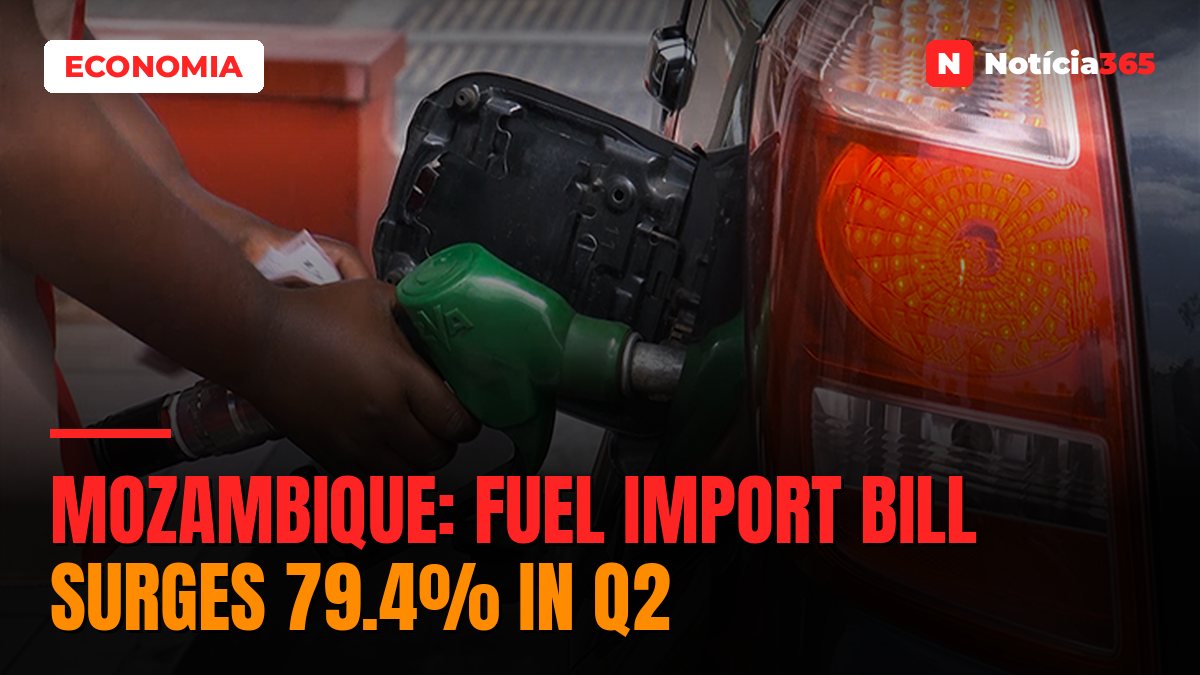
Mozambique spent US$660.6 million (€568.6 million) on fuel imports in the first half of the year, a period marked by supply difficulties and foreign exchange constraints, with the import bill surging by 79.4% from March to June.
Statistical data from the Bank of Mozambique indicate that fuel imports amounted to US$236.4 million (€203.5 million) in the first quarter and US$424.2 million (€365.1 million) in the second.
This represented a 79.4% increase in Mozambique’s fuel import bill from the first to the second quarter, a period marked by fuel supply difficulties in several regions of the country and constraints on access to foreign currency to finance imports.
In April and May, long queues formed at filling stations, some petrol stations were temporarily closed, and supply difficulties affected transport operators, businesses and consumers.
Over the same six-month period, Mozambique imported intermediate goods worth a total of US$1,198.7 million (€1,031.5 million), with fuels accounting for around 55% of this import category.
On 7 May, the Government decided to increase fuel prices, with the price of diesel rising by 45.5% and petrol by 12.1%. The measure was justified by the impact of the conflict in the Middle East on international energy markets.
Diesel continued to account for the largest share of the country’s fuel import bill, with purchases from abroad valued at US$455.6 million (€392 million) over the six-month period. This was followed by petrol, at US$166.7 million (€143.4 million), and aviation fuel (jet fuel), at US$38.4 million (€33 million).
In the second quarter alone, fuel imports reached US$424.2 million (€365.1 million), almost double the US$236.4 million (€203.5 million) recorded in the first quarter. The increase was driven mainly by purchases of diesel, which rose from US$164.9 million to US$290.7 million, and petrol, which increased from US$56.4 million to US$110.3 million.
In March, the Government explained that around 80% of the fuel imported by Mozambique originated in the Middle East and was transported through the Strait of Hormuz, one of the world’s main routes for the transport of oil and petroleum products. Meanwhile, the central bank has acknowledged that some companies in the sector are experiencing difficulties accessing foreign currency to finance imports.
In response to supply constraints, the Government approved an emergency mechanism in August to mobilise up to US$50 million (€43.1 million), through state-owned oil company Petromoc, to guarantee fuel imports and domestic supplies in crisis situations.
The measure, approved by the Council of Ministers on 3 August, allows the use of an account held by the Ministry of Finance and domiciled at the Bank of Mozambique to ensure payments to foreign creditors associated with fuel imports.
The legislation also provides that, “exceptionally, and whenever justified”, the Minister of Finance, in coordination with the minister responsible for the fuel sector, may authorise the use of up to US$40 million (€34.5 million) to ensure the import of liquid fuels for the domestic market.
In the justification accompanying the resolution, the Government explained that the mechanism had been created to “ensure the import of liquid fuels for the domestic market in the event of a crisis”.