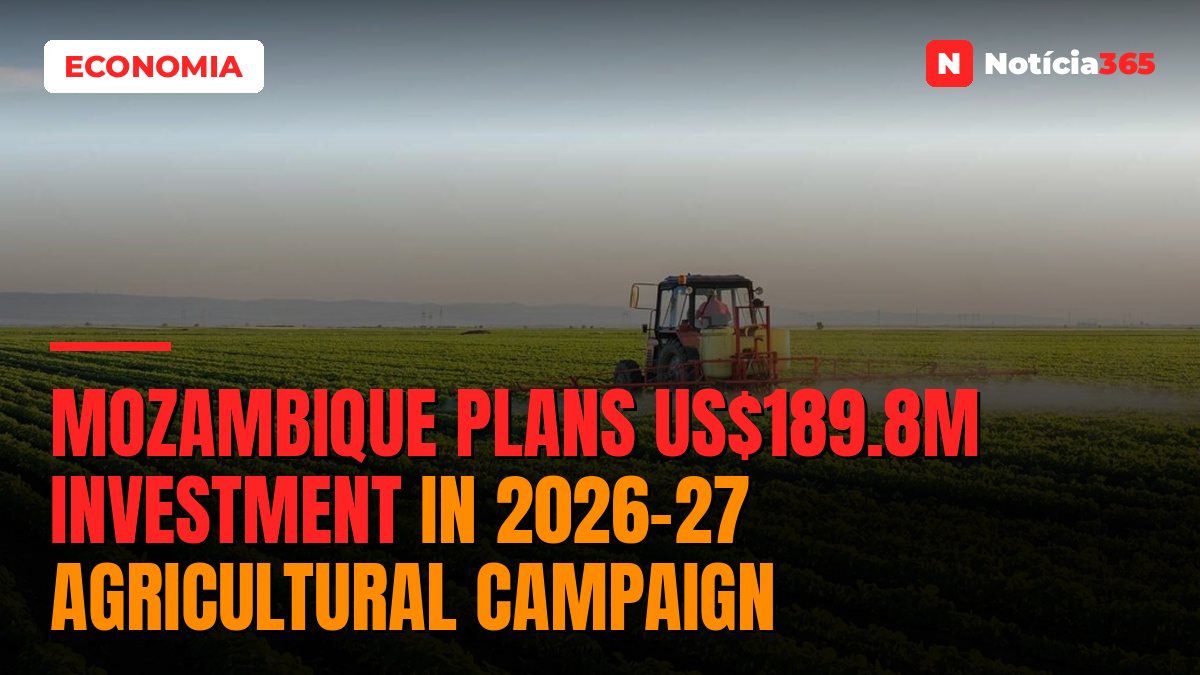

Mozambique’s government plans to mobilise US$189.8 million to finance the 2026-27 agricultural campaign, with US$94.7 million earmarked for emergency support to farmers affected by extreme weather events and the remaining US$95.1 million directed towards agribusiness development. The financing will draw on contributions from the government and international partners, including the World Bank, the African Development Bank (AfDB), and the International Fund for Agricultural Development (IFAD).
The plan was presented on Monday, 2 November, in Maputo, during a preparatory meeting for the agricultural campaign chaired by Roberto Mito Albino, Minister of Agriculture, Environment and Fisheries.
According to a communiqué from the Ministry of Agriculture, Environment and Fisheries (MAAP), published by Club of Mozambique, the resources will be applied to increasing production and productivity, strengthening value chains, and promoting the transition from subsistence farming to commercially oriented agricultural activity.

Of the total budget, US$94.7 million will be channelled towards measures addressing the effects of the El Niño climate phenomenon, through the provision of direct and free assistance to producers identified as being at risk.
The support package will include the distribution of agricultural kits, silos, irrigation equipment, and animal feed supplements, with the aim of bolstering food security and strengthening farmers’ capacity to cope with the effects of climate change.
The remaining US$95.1 million will be allocated to agribusiness development through the creation of credit lines and institutional support mechanisms covering seeds, agricultural inputs, mechanisation, irrigation, livestock, fisheries, forestry, and agricultural extension services.
As part of the plan’s implementation, the government intends to make available 905 motor cultivators, 251 tractors, 2,075 tonnes of seeds, 3,532 irrigation systems, and 3,363 motor pumps and irrigation kits with coverage capacities of two, five, and ten hectares.
The programme also encompasses the promotion and commercialisation of agricultural output, seeking to strengthen private sector participation in value chain development and to improve producers’ access to markets.
During the presentation, Roberto Mito Albino urged those responsible for ongoing projects within the Ministry to coordinate their respective interventions and accelerate the implementation of planned measures, in order to ensure that the targets set for the campaign are met.
Through this investment, the government aims to strengthen the productive capacity of the agricultural sector, stimulate business activity, and advance a more competitive and climate-resilient model of farming.
Source: Diário Económico
Original article: https://www.diarioeconomico.co.mz/?p=557567