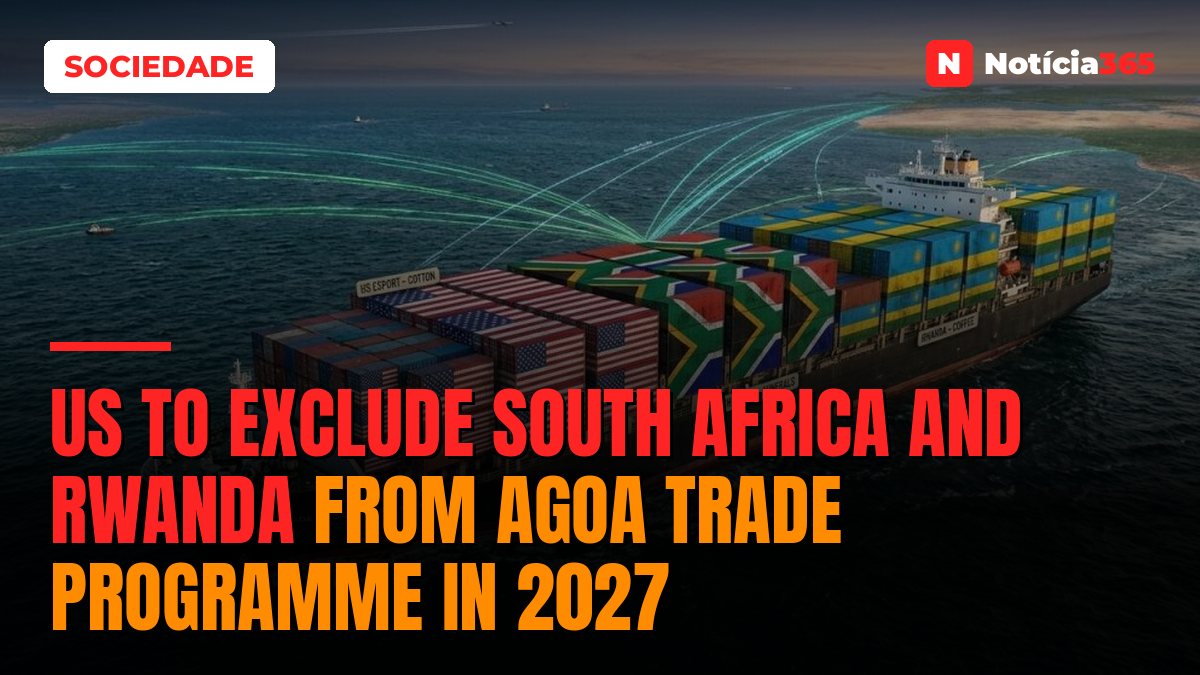

The United States announced on Monday, 2 November, its intention to remove South Africa and Rwanda from the African Growth and Opportunity Act (AGOA) preferential trade programme with effect from 1 January 2027. The move could affect South African exports of automotive components, citrus fruit and wine, as well as Rwandan exports including coffee and minerals.
The announcement was made by US Trade Representative Jamieson Greer, after President Donald Trump notified Congress and the governments of both countries of his intention to withdraw their eligibility under AGOA, which grants thousands of sub-Saharan African products duty-free access to the US market.
The decision follows a review of the programme’s eligibility criteria. According to Greer, Washington considers that both the South African and Rwandan governments have adopted practices incompatible with AGOA’s requirements, including barriers to US trade and investment and policies that, in the Trump administration’s assessment, threaten US national security and foreign policy interests.
In South Africa’s case, Washington also raised concerns related to corruption. In Rwanda’s case, the administration cited issues relating to human rights, the rule of law, political pluralism and workers’ rights.
Established in 2000, AGOA is one of the principal instruments of US commercial policy towards sub-Saharan Africa. South Africa is its largest beneficiary, having exported approximately US$1.7 billion in goods to the United States under the programme in 2025.
Although goods covered by AGOA account for roughly 10% of South Africa’s total sales to the US and around 1% of the country’s overall exports, the loss of preferential benefits could weigh on sectors that are particularly dependent on access to the US market, notably the automotive industry and agriculture.
The decision comes against a backdrop of deteriorating relations between Washington and Pretoria. The Trump administration has accused the South African government of discriminating against the white population — allegations rejected by President Cyril Ramaphosa’s administration. Washington has also criticised South Africa’s foreign policy, in particular its case against Israel at the International Court of Justice alleging violations of the Genocide Convention in Gaza. Israel has denied the accusations.
Regarding Rwanda, the exclusion comes amid tension with Washington over the conflict in eastern Democratic Republic of Congo (DRC), where the US has accused Kigali of supporting the M23 rebel movement — an allegation denied by the Rwandan government.
Rwanda had already been partially suspended from AGOA since 2018, when it lost trade benefits applicable to clothing exports following its decision to impose tariffs on imports of second-hand American clothing. More recently, Washington imposed sanctions on Rwandan entities linked to the alleged support for Congolese rebels.
The decision drew criticism in Congress. Democratic Representative Richard Neal, the most senior member of his party on the House Ways and Means Committee, said the exclusion of South Africa reflected a trade policy driven by grievances and called on the administration to provide a more detailed justification, including the conditions South Africa would need to meet to regain its benefits.
In response, the South African government said it would continue to support the sectors potentially affected and to pursue trade and investment opportunities with the United States, while accelerating the diversification of its export markets.
President Cyril Ramaphosa has advocated deepening trade ties with other partners, including China, as part of a strategy to reduce South Africa’s dependence on US trade preferences.
Source: Diário Económico
Original article: https://www.diarioeconomico.co.mz/?p=557487