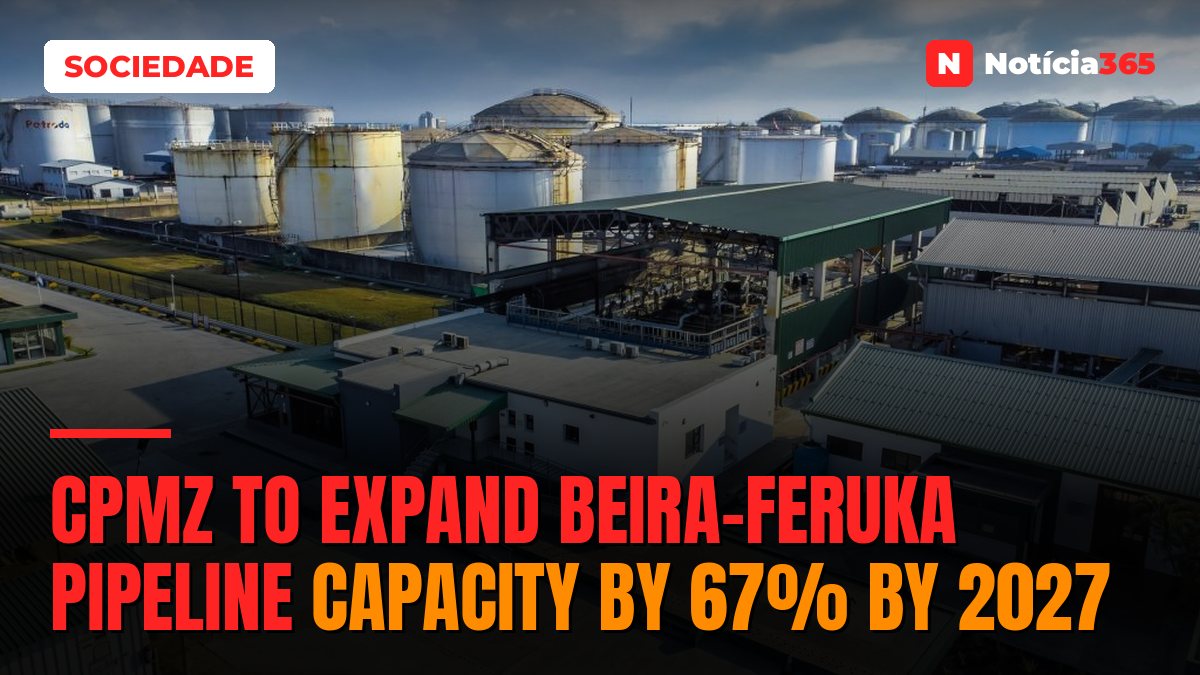

The Companhia do Pipeline Moçambique-Zimbabwe (CPMZ) is investing in the expansion of the Beira-Feruka pipeline, with the aim of increasing annual fuel transport capacity from the current three million to five million cubic metres by December 2027. The project, which involves the installation of two new pumping stations, is designed to meet growing demand for petroleum products in Southern Africa and to reinforce the strategic role of the Beira Corridor in regional energy supply.
The information was contained in a statement issued by CPMZ following the Beira Corridor Forum 2026, held on 27 October in Livingstone, Zambia. The forum brought together government representatives, regulators, investors, financial institutions, and energy infrastructure operators.
The meeting focused on strengthening regional cooperation, the need for coordinated infrastructure investment, and the diversification of fuel supply routes, given the importance of the Beira Corridor for markets including Zambia, Zimbabwe, Malawi, Botswana, and the Katanga region of the Democratic Republic of Congo (DRC).
According to the company, the pipeline expansion will increase transport capacity by approximately 67%, creating conditions to meet growing regional fuel demand and improve supply security for countries that depend on the infrastructure.
At the forum, CPMZ Managing Director Patrick Dias da Cunha highlighted the importance of partnerships with the governments of Mozambique and Zimbabwe in developing an integrated regional energy supply route.
"Our strong partnerships with the governments of Mozambique and Zimbabwe have been fundamental to CPMZ's success and to our shared vision of transforming the Beira Corridor into an integrated regional energy supply route," Dias da Cunha said, as quoted in the company's statement.
Dias da Cunha added that strengthening infrastructure and cooperation with regional partners would position Harare as a fuel distribution hub for neighbouring markets, including Zambia, Malawi, Botswana, and the DRC.
He further stressed that the company's priority is to ensure that investments translate into concrete economic benefits for the countries and communities that depend on a regular and reliable fuel supply.
Regional demand growth projections reinforce the case for expanding logistical capacity. According to forecasts presented by S&P Global Energy at the forum, fuel demand in the Beira Corridor supply zone could increase by approximately 35% over the next decade, equivalent to an additional four million cubic metres.
The estimate was presented by Daniel Evans, Vice President at S&P Global Energy, in a presentation titled "Supply Security in a Volatile Environment: Supporting Fuel Demand Growth in Southern Africa."
According to Evans, Africa remains the only region in the world where S&P Global Energy projects fuel demand growth over the coming decades across all scenarios analysed, underscoring the need for long-term investment in energy infrastructure, supply source diversification, and regional logistics.
Ephraim Kabunda Munshifwa, Permanent Secretary at Zambia's Ministry of Energy, highlighted the importance of ensuring efficient fuel supply to sustain development across the country's mining, agricultural, industrial, and transport sectors.
"A stronger Beira Corridor can broaden our fuel supply options, improve reliability, and support the competitiveness of our industries," he said, adding that increased pipeline capacity must be accompanied by coordinated investment in storage, transport, and efficient border procedures.
Kabunda Munshifwa also advocated for deeper cooperation between Mozambique, Zimbabwe, and Zambia, underpinned by transparent regulatory frameworks, greater logistical efficiency, and commercially sustainable investments.
During the forum, Osam Iyahen, representative of the Africa Finance Corporation (AFC), argued that the success of African economic corridors should not be measured solely by the transport capacity of the infrastructure, but also by the economic opportunities they are able to generate.
"The future of Africa's economic corridors will depend as much on the partnerships that connect our infrastructure as on the infrastructure itself," he said, calling for greater cross-border coordination, integrated planning, and investment in complementary logistics and industrial facilities.
Representing Mozambique, Chinguane Mabote, Secretary of State at the Ministry of Transport and Logistics, urged that forum discussions be converted into concrete commitments, stressing that pipeline expansion must be accompanied by improvements in port capacity, storage, and distribution.
"The value of this meeting will be measured not only by the quality of the discussions, but also by our ability to follow through on the opportunities identified and the recommendations put forward," he said.
Mabote further stressed that the competitiveness of the Beira Corridor depends on reducing logistics costs, cutting waiting times, and delivering reliable services, and called for greater coordination between Mozambique, Zimbabwe, Zambia, and other regional partners.
The Beira Corridor Forum 2026 concluded with a call for stronger strategic partnerships, coordinated infrastructure investment, and the implementation of measures to consolidate the corridor as one of the primary fuel supply alternatives for Southern African markets.
The expansion of the Beira-Feruka pipeline stands as one of the key initiatives underway to increase regional petroleum product transport capacity, at a time when demand growth projections are posing new challenges to energy security and logistics chain competitiveness.
Source: Diário Económico
Original article: https://www.diarioeconomico.co.mz/2026/11/02/negocios/infra-estruturas/cpmz-investe-na-expansao-do-oleoduto-beira-feruka-para-responder-a-procura-regional/