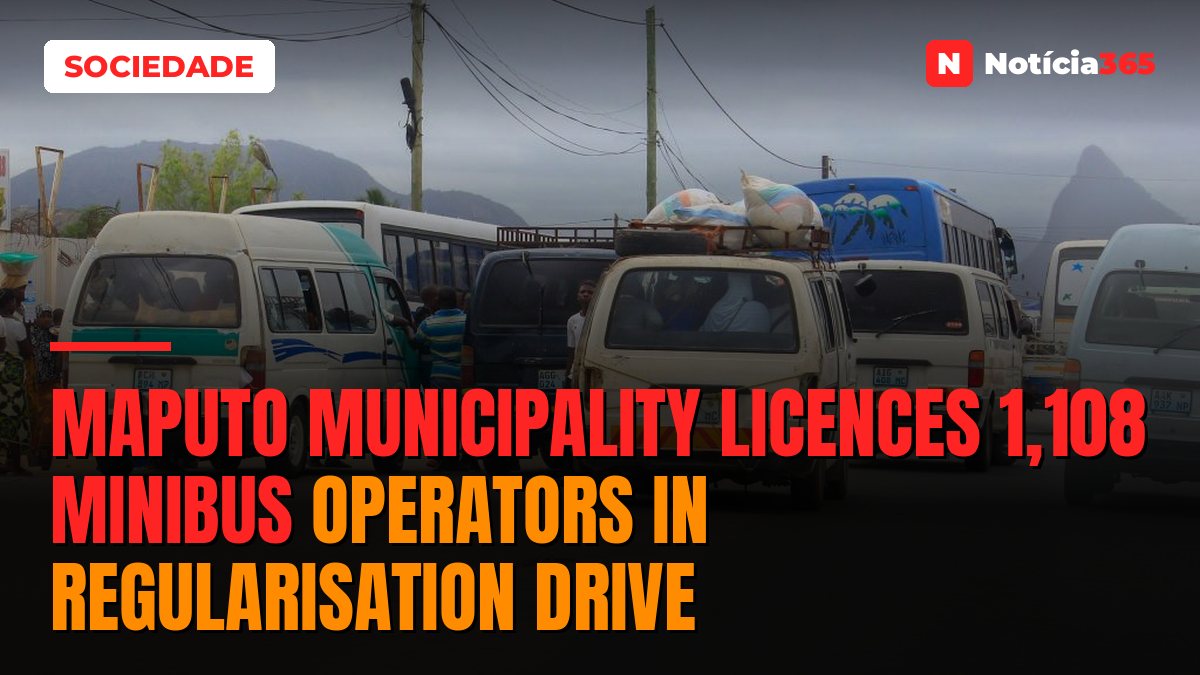

Maputo’s Municipal Council has licensed 1,108 semi-collective passenger transport operators through a regularisation campaign targeting an estimated universe of 2,500 formal and informal operators. The result represents approximately 44% of the operators identified by the municipality, in an initiative that also sought to facilitate access to professional driving licences and improve conditions in the public transport sector.
The campaign was announced in May, when the municipality committed to financing the training required to obtain professional driving licences, with the aim of reducing barriers to regularisation for operators.
At the time, the president of the municipality, Rasaque Manhique, announced that the process would run for 30 days, with the objective of improving service quality and strengthening passenger safety. Regularisation would also allow operators to meet the conditions required to benefit from subsidies announced by the government following the rise in fuel prices.
In an interview with Diário Económico, Nora Aloi, director of Mobility, Transport and Traffic at the Maputo Municipal Council, clarified that the 2,500 figure is an estimate, not an exact count of operators in an irregular situation.
“We have around 2,500 transport operators operating within the Maputo Municipal Council. This is an estimated number of formal and informal operators,” she explained.
According to Aloi, the campaign resulted in the licensing of 1,108 operators and the receipt of 243 applications from drivers interested in training to obtain a professional service driving licence. Of these, 120 were covered in the first phase, with a second phase planned for the remaining 123.
“We managed to reach almost half of what we estimated we would license,” said Nora Aloi, acknowledging that uptake was low in the initial weeks and only increased in the final stage of the campaign.
Training is provided free of charge by the Driving School of the Maputo Municipal Public Transport Company (EMTPM), with the municipality bearing the associated training costs and expenses related to external entities.
Lack of Trust and Financial Difficulties
The president of the Mozambican Road Transporters Federation (FEMATRO), Paulo Muthisse, attributed the weak initial uptake in part to a lack of confidence among professionals that the initiative would materialise.
“People did not come because they did not believe it was real,” he told Diário Económico.
Muthisse also criticised the municipality’s initial engagement with the federation, alleging that the organisation was not involved in mobilising transport associations.
“The municipality did not contact the federation so that the federation could coordinate with the associations,” he said, adding that regularisation should be one of the priorities of FEMATRO’s new leadership.
Nora Aloi, however, rejected the suggestion of coordination failures, asserting that the municipality had worked with the associations from the outset and had established a multi-sectoral team to oversee the campaign.
For FEMATRO, the cost of documentation remains one of the main obstacles to regularisation. Paulo Muthisse estimates that expenses can range between 8,000 and 10,000 meticais, depending on each driver’s situation and the category of licence required.
“The biggest constraint is the lack of money, because getting a driving licence voluntarily costs a lot of money,” he said.
On the municipality’s side, Nora Aloi identified additional problems, including a lack of authenticated documents, irregularities in vehicle documentation, and licensing applications submitted using the same driving licence. Some applications were also submitted without the required professional qualification.
Licence Does Not Guarantee Full Regularisation
Despite the challenges, the municipality considers the campaign to have contributed to improved organisation of the semi-collective transport sector, notably through an increase in licensed operators and the identification of routes on vehicles.
“We are already on the ground implementing this — we have noted an increase in licensed operators,” said Nora Aloi.
Aloi also pointed to improvements in compliance with municipal requirements and in relations between transport crews and passengers, though she did not present comparative indicators to measure the campaign’s impact on road safety or service quality.
The director further clarified that obtaining a municipal licence does not mean an operator is fully regularised, as other obligations must still be met, including the submission of insurance and required documentation.
The municipality also acknowledges that it does not have precise data on the number of informal transport operators still in operation, which complicates a full assessment of the campaign’s results.
The municipality intends, therefore, to maintain enforcement and awareness actions targeting operators who have not yet regularised their situation.
“We appeal to them to approach the Maputo Municipal Council to regularise their activity, obtain a licence, and also secure a professional service driving licence,” Nora Aloi concluded.
Source: Diário Económico
Original article: https://www.diarioeconomico.co.mz/?p=556564