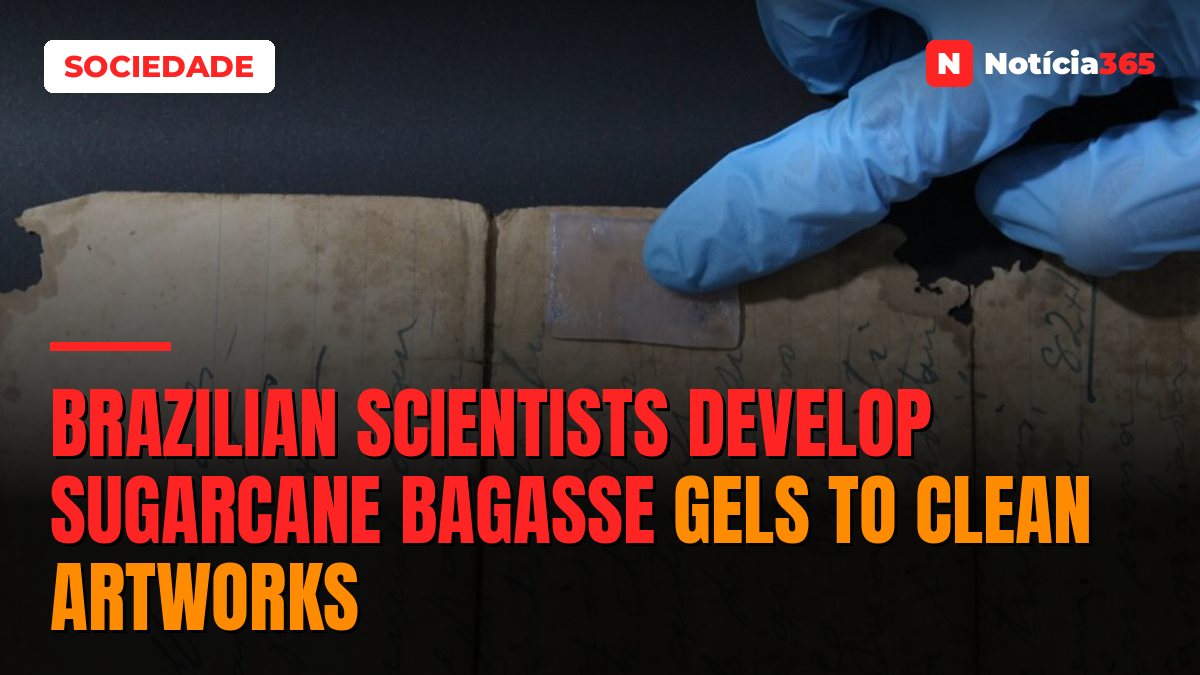

A group of scientists from the State University of Campinas (Unicamp) and the Federal University of Minas Gerais (UFMG) in Brazil has developed gels based on nanocellulose extracted from sugarcane bagasse to control the application of liquids in the cleaning and conservation of artworks. The technology reduces the penetration of water and solvents into material layers, helping to preserve paintings, ancient documents, and textile pieces.
The solution addresses challenges faced by conservation and restoration professionals, who must rigorously control the amount of liquid applied to delicate surfaces. When used directly, water and solvents can penetrate layers that should be preserved, damaging original materials. Rapid evaporation can also reduce cleaning effectiveness and increase the exposure of professionals to potentially toxic substances.
The gels developed by the researchers function as structures capable of storing and releasing liquids in a controlled manner. Rather than performing cleaning directly, they act as supports for liquid application, limiting penetration and reducing evaporation during the procedure.

The research involves Camila Rezende, a professor at Unicamp's Institute of Chemistry, and Camilla Camargos, a professor at UFMG with a background in the conservation and restoration of movable cultural heritage. The work resulted in a patent application filed with Brazil's National Institute of Industrial Property (INPI), with strategic support from Unicamp's Inova innovation agency. Ownership is shared between the two universities.
The formulation uses nanocellulose extracted from sugarcane bagasse, combined with other biopolymers. Two main systems were developed: one based on gelatin and another based on alginate, a polysaccharide derived from algae. The combination of components produces resistant and flexible structures capable of retaining liquids and releasing them gradually.
To achieve these characteristics, the researchers adjusted the cross-linking process, which establishes bonds between polymer chains and influences the porosity of the material. Controlling this structure determines the volume of liquid the gel can store and the rate at which it is released during cleaning.
The work began to take shape in 2020, during a research period Camargos spent at the University of Florence in Italy. At the time, she was working with nanocellulose and lignin nanoparticles to develop protective coatings for cultural heritage objects made of paper, wood, and fabric. An experiment led to the unexpected formation of a continuous, rigid gel, which sparked interest in adapting the material for artwork conservation.
The initial formulations presented limitations in strength and handling, prompting the team to refine the composition to improve flexibility, control liquid retention, and prevent the release of residues onto treated surfaces.
The technology may also find applications in the conservation of other delicate materials, particularly where it is necessary to limit liquid use or act only on specific layers. Among the next challenges are increasing gel flexibility and adapting formulations to surfaces with reliefs, undulations, and small grooves.
Source: Diário Económico
Original article: https://www.diarioeconomico.co.mz/?p=554574