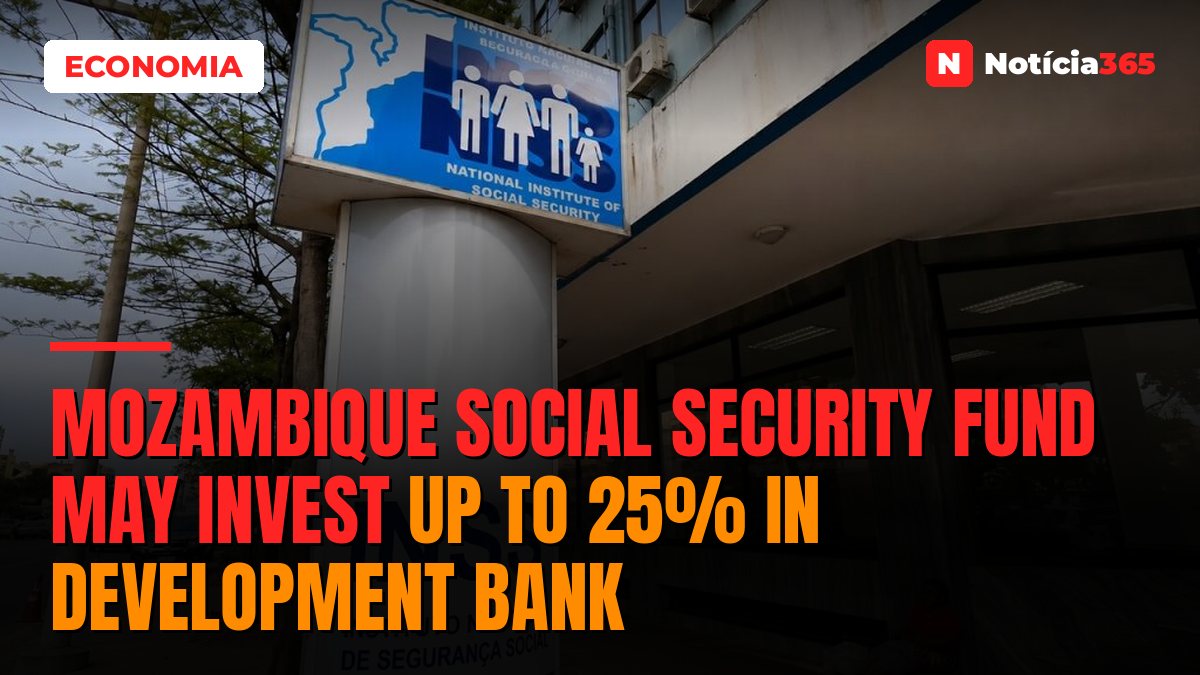

Mozambique’s National Social Security Institute (INSS) may allocate up to 25% of the investment portfolio of its Mandatory Social Security funds to the Mozambique Development Bank (BDM). The regulation stipulates that allocations will be gradual and contingent on the financial position of the funds, liquidity requirements, and a formal decision by the institute’s Board of Directors.
The measure is set out in Decree No. 59/2026, of 17 September, which regulates the law establishing the BDM. The 25% ceiling represents the maximum permitted exposure to the bank and does not constitute an obligation to deploy the full amount.
The value of each allocation is to be determined on the basis of the most recent actuarial study, treasury requirements, asset and liability management, and the INSS investment policy. The financial instruments employed must specify remuneration, maturities, guarantees, repayment conditions, and monitoring mechanisms, with remuneration required to be commensurate with the risk assumed.
The institute may suspend, reduce, or revise its allocations whenever actuarial, financial, liquidity, or risk studies identify threats to solvency, profitability, portfolio diversification, or the capacity to meet obligations to beneficiaries. In such circumstances, reimbursement must occur within 30 days.
Beyond social security resources, the BDM will receive a share of public revenues derived from the extractive sector, to be fixed annually in the State Budget Law. These amounts are earmarked exclusively for financing structural projects and strategic infrastructure and may not be applied to current expenditure.
The bank’s share capital is set at 32 billion meticais, equivalent to approximately 444.4 million euros, subscribed by the state. Its realisation may be phased over five years in annual tranches of 6.4 billion meticais, in accordance with a plan approved by the Council of Ministers.
The state may divest up to 49% of the capital to other entities, including development finance institutions, multilateral banks, and similar national or international institutions.
The regulation also provides for the mobilisation of resources from indirect public administration bodies and state-owned enterprises. For the first year of operation, Article 44 mandates the channelling of ‘at least up to 25%’ of their respective financial investment portfolios and deposits. In subsequent years, a minimum of 20% is established. The Bank of Mozambique is excluded from this obligation.
The BDM’s mandate will be to mobilise medium- and long-term financing to support strategic projects across sectors including agriculture, agro-industry, manufacturing, energy, infrastructure, logistics, tourism, the digital economy, and mining.
Financing is to prioritise initiatives that contribute to economic diversification, export growth, import substitution, job creation, and technology transfer. Project eligibility will also depend on demonstrated technical, environmental, and economic-financial viability.
In terms of governance, the chair of the Board of Directors will be appointed by the President of the Republic, while the remaining executive and non-executive directors will be selected through a public competitive process.
The creation of the bank was announced by Daniel Chapo at his inauguration in January 2025 as a response to the difficulties in financing long-term projects. The government expects the institution to be fully operational by 2027, playing a complementary role to the commercial banking sector.
Source: Diário Económico
Original article: https://www.diarioeconomico.co.mz/?p=554229