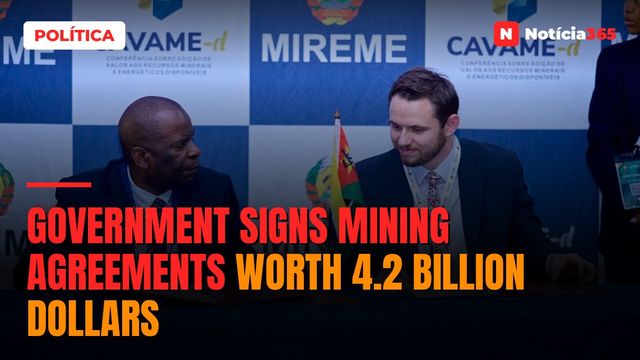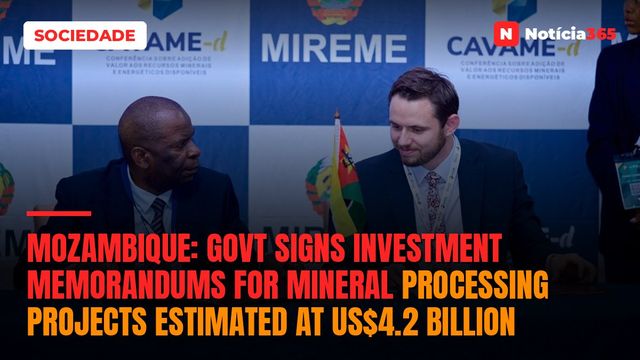

Mozambique’s Ministry of Mineral Resources and Energy (MIREME) has signed 12 memoranda of understanding, valued at a combined $4.2 billion, for the establishment of mineral processing industries in the country. The agreements form part of a broader push to promote local transformation of raw materials and job creation, according to the Lusa news agency.
The memoranda were signed in Nacala, in Nampula province, during the Conference on Value Addition Based on Available Mineral and Energy Resources, organised by the government. They cover processing projects for graphite, precious stones, silica, copper, titanium, zircon, iron and quartz.
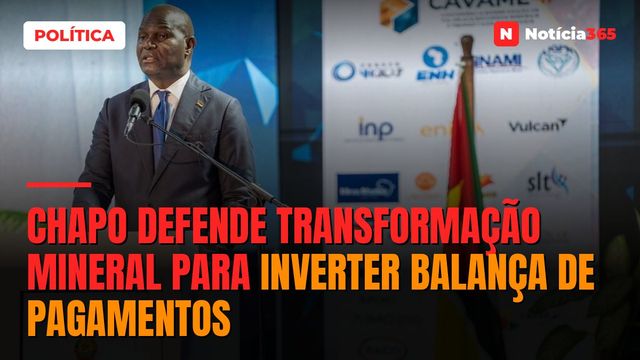
At the opening of the conference, President Daniel Chapo said the agreements, concluded with both domestic and foreign companies, represent a commitment to the country’s industrialisation and to delivering on government promises.

“Our objective and our vision is that the investments we are mobilising today — $4.2 billion — happen in Mozambique. This will generate income for the Mozambican people, employment through industrialisation, particularly for young people and women, and above all, it will reverse our balance of payments,” he said.
The head of state argued that the memoranda must evolve into concrete, bankable projects capable of generating income and wages for Mozambicans.
“Our objective and our vision is that the investments we are mobilising today — $4.2 billion — happen in Mozambique. This will generate income for the Mozambican people, employment through industrialisation, particularly for young people and women, and above all, it will reverse our balance of payments” — Daniel Chapo
Projects Span Multiple Provinces
Among the planned investments are spherical graphite factories in the Nacala-a-Velha district, precious stone cutting and polishing units in Manica, and a glass manufacturing plant linked to silica sand extraction in Maputo province.
The agreements also include a copper processing unit in Moatize, Tete province, four units for processing graphite, titanium and zircon in Nacala, and iron smelting projects in Manica.
Plans also envisage the construction of a national-scale quartz processing industrial unit, as well as the development of strategies to increase the value added from the country’s mineral resource output.
For Daniel Chapo, the local transformation of raw materials should expand industrial activity, create employment and strengthen the participation of Mozambican companies in natural resource value chains.
Nacala Set to Receive Two Industrial Parks
The president also announced that the government intends to build two industrial parks in Nacala, leveraging the region’s status as a special economic zone. The initiative is expected to proceed under the name Nacala Park Management Company.
According to Daniel Chapo, the parks should offer investors serviced land, water, energy, roads and security — conditions he described as essential for the establishment and operation of industrial units.
The head of state also stressed the need to develop domestic suppliers through local content requirements and to strengthen the participation of small and medium-sized enterprises (SMEs), many of which are owned by young Mozambicans and women.
“We must increase local processing, develop national suppliers through local content, and above all, invest in small and medium-sized enterprises, the majority of which belong to young Mozambicans and women,” he said, describing this direction as an agenda of economic sovereignty.
“We must increase local processing, develop national suppliers through local content, and above all, invest in small and medium-sized enterprises, the majority of which belong to young Mozambicans and women” — Daniel Chapo
Second Phase of Niassa Graphite Plant
Daniel Chapo also referred to the graphite processing plant inaugurated in January this year in Niassa province, a Chinese-funded investment valued at approximately $200 million.
The facility transforms ore locally for higher value-added industrial applications. The president announced that the second phase of the project is expected to begin, and reiterated that the government continues to support the investor in creating improved conditions for the business.
According to the head of state, expanding national processing capacity forms part of the country’s effort to move beyond dependence on the extraction and export of unprocessed raw materials.
President Pledges to Fight Bureaucracy and Corruption
The president renewed his commitment to combating corruption, bureaucracy and what he described as the “complicómetro” — a term used locally to denote excessive red tape — identifying these as obstacles to the entry and execution of development projects.
Daniel Chapo urged business leaders to report cases of corruption and to communicate the constraints they face in the country. He also argued that companies operating or seeking to invest in Mozambique must develop the capabilities needed to meet international production standards and compete in other markets.
He called on companies to proactively and transparently disclose supply opportunities, to promote training, and to establish lasting business partnerships. He called on financial institutions to provide solutions tailored to the needs of SMEs, to facilitate their participation in industrial projects and supply chains.
The success of the 12 memoranda will ultimately depend on their translation into executable projects capable of mobilising investment, developing domestic suppliers and scaling up mineral resource processing in Mozambique.
The realisation of the 12 memoranda will thus hinge on the conversion of announced commitments into actionable projects with the capacity to mobilise investment, build national supply chains and broaden mineral processing across Mozambique.
Source: Diário Económico
Original article: https://www.diarioeconomico.co.mz/?p=554081