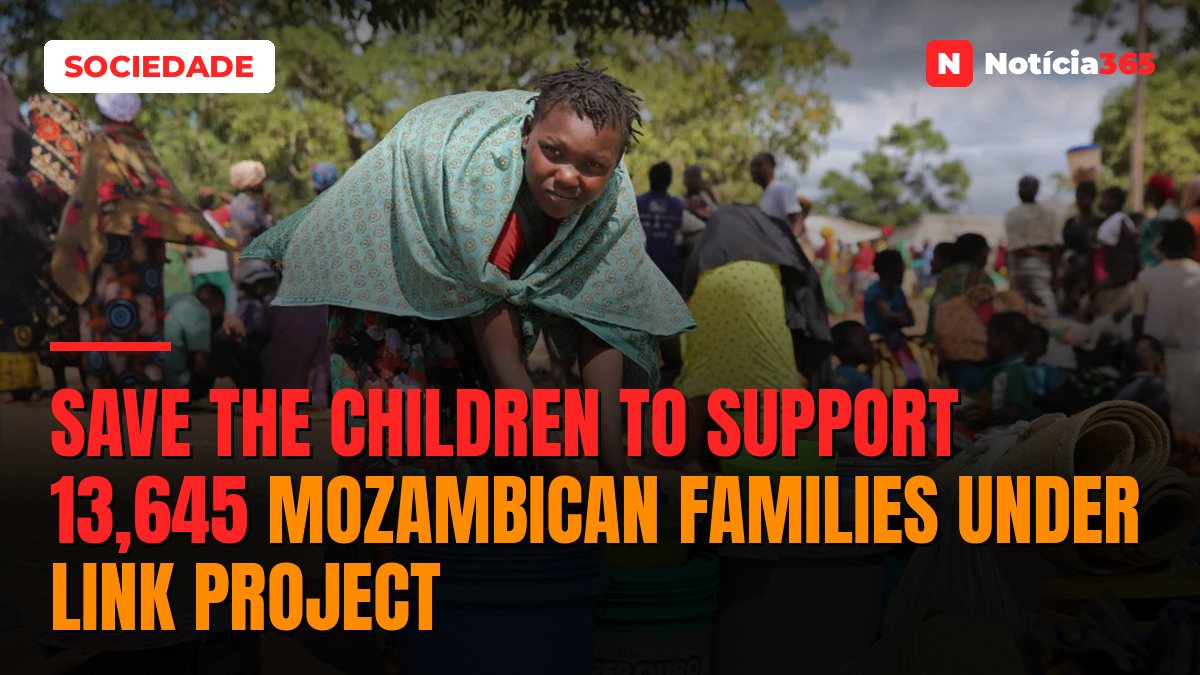

The non-governmental organisation Save the Children plans to support 13,645 Mozambican families in income generation, social protection and climate change adaptation by 2029, through the LINK project being implemented across nine districts in the provinces of Gaza, Manica and Tete.
The initiative, presented on Friday (16) in Maputo, aims to strengthen the economic capacity of vulnerable households and reduce the impact of extreme climate events on their livelihoods, according to Lusa. Save the Children’s projects director, Lionel Langa, said the programme was designed to complement the government-run Productive Social Action Programme (PASP), with the objective of promoting socioeconomic inclusion and improving living conditions for the most vulnerable communities.
Of the total projected beneficiaries, 3,645 families will be directly covered through PASP, while a further ten thousand are expected to benefit from community-level interventions aimed at strengthening climate adaptation capacity. “Our focus is to ensure that families benefiting from PASP have access to opportunities to generate income and to guarantee that they are more resilient to the climate events to which they are exposed,” Langa said.

Langa explained that the project is concentrated primarily in semi-arid zones, where recurring droughts and floods have disrupted agricultural production and undermined household income sources. “In areas so susceptible to drought, we also see the occurrence of flooding, which is why we are called to a much sharper intervention to ensure that we genuinely strengthen the resilience of our communities,” he added.
Save the Children’s country director, Ilaria Manunza, warned that the growing exposure of families to climate shocks — including those linked to the El Niño phenomenon — demands social protection mechanisms capable of anticipating risks and reducing their economic and social impacts.
Manunza noted that crop losses caused by drought or the destruction of homes by cyclones can worsen food insecurity, jeopardise children’s education and deepen household vulnerability. “When a family loses its harvest to drought or sees its home destroyed by a cyclone, children are among the most affected. Their nutrition deteriorates,” she observed.
Manunza further highlighted that the LINK project, funded by the Green Climate Fund, seeks to promote an integrated approach encompassing social protection, climate adaptation, disaster risk management and local economic development. She also advocated for community involvement in shaping solutions, with particular attention to the participation of women, youth, children and persons with disabilities.
Gertrudes Jonas, a representative of the Ministry of Labour, Gender and Social Action, said the initiative could help improve understanding of the impacts of climate change and strengthen public social protection policies.
The LINK project is set to run until 2029, covering communities across nine districts in Gaza, Manica and Tete provinces, with interventions focused on improving living conditions, diversifying income sources and reducing household vulnerability to extreme climate events.
Source: Diário Económico
Original article: https://www.diarioeconomico.co.mz/2026/10/19/desenvolvimento-2/save-the-children-quer-reforcar-rendimento-de-mais-de-13-mil-familias-ate-2029/