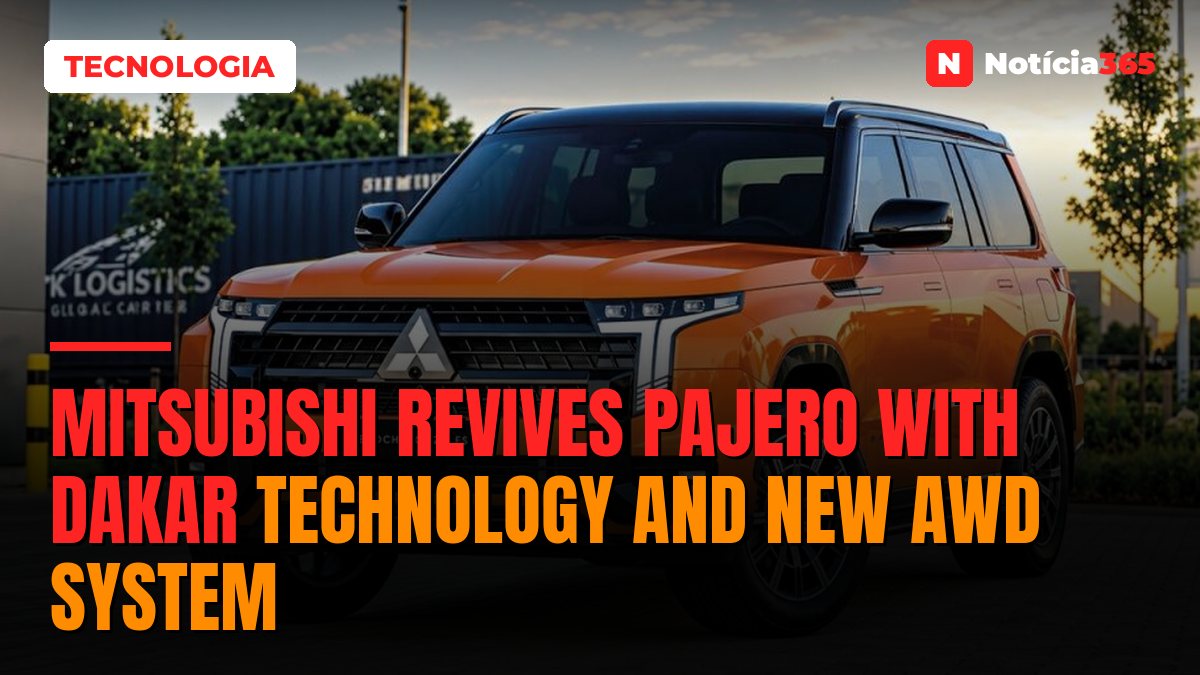

Mitsubishi has unveiled the new-generation Pajero, marking the return of one of the most iconic models in Japanese automotive history. After a five-year absence, the legendary off-roader is back with a proposition that seeks to combine ruggedness with new technologies and a more contemporary approach to comfort and off-road driving.
The new Pajero revisits the philosophy that helped build the model’s reputation since its debut in 1982. The manufacturer has opted for a ladder-frame chassis — a configuration associated with durability and performance in demanding terrain. The platform is derived from that used by the Triton/L200 pick-up truck, though modified to accommodate a dedicated body and exclusive front and rear suspension tuning.
Among the headline features is the Super-All Wheel Control (S-AWC) four-wheel-drive system, a technology that manages torque distribution across the wheels while coordinating multiple electronic systems to improve stability and traction. The solution is designed to allow the Pajero to perform equally well on urban roads and long-distance journeys as on deteriorated surfaces and off-road tracks.

The triple-gauge cluster goes digital
Inside, Mitsubishi has reinstated one of the most distinctive elements of previous generations: the three gauges positioned at the top of the dashboard — now rendered in digital format. The system displays information including altitude, compass heading, outside temperature, longitudinal and lateral inclination, and torque distribution between the wheels, providing the driver with data that is particularly useful when navigating difficult terrain.
One of the main new features is the presence of the Super-All Wheel Control (S-AWC) four-wheel-drive system.
The design also seeks to establish a bridge between past and future. The new generation arrives with a straight-lined body, a raised front end, and a lighting signature that reinforces the model’s visual identity. The design team aimed to create a vehicle immediately recognisable as a Pajero, yet sufficiently distinct to signal the beginning of a new chapter.
Mitsubishi has also maintained a strong connection to the model’s motorsport heritage. The Pajero built an international reputation at the Dakar Rally, where it claimed 12 victories — seven of them consecutive. That legacy helps explain the emphasis placed on durability, off-road capability, and the technology developed to handle varied driving conditions.
On the powertrain side, the SUV is equipped with the same 2.4-litre twin-turbocharged diesel engine that powers the L200, producing 204 horsepower and 470 Nm of torque in the pick-up’s most powerful configuration, with the possible introduction of electric variants also under consideration. Confirmation of specifications, however, will depend on the strategy Mitsubishi defines for each individual market.
With the return of the Pajero, Mitsubishi reclaims a historic nameplate and seeks to reposition it as the flagship of its passenger vehicle line-up. More than simply reviving a model discontinued in 2021, the manufacturer aims to preserve the essence of one of its most enduring symbols, adapting it to the demands of a new era in the automotive industry.
Source: Diário Económico
Original article: https://www.diarioeconomico.co.mz/?p=553034