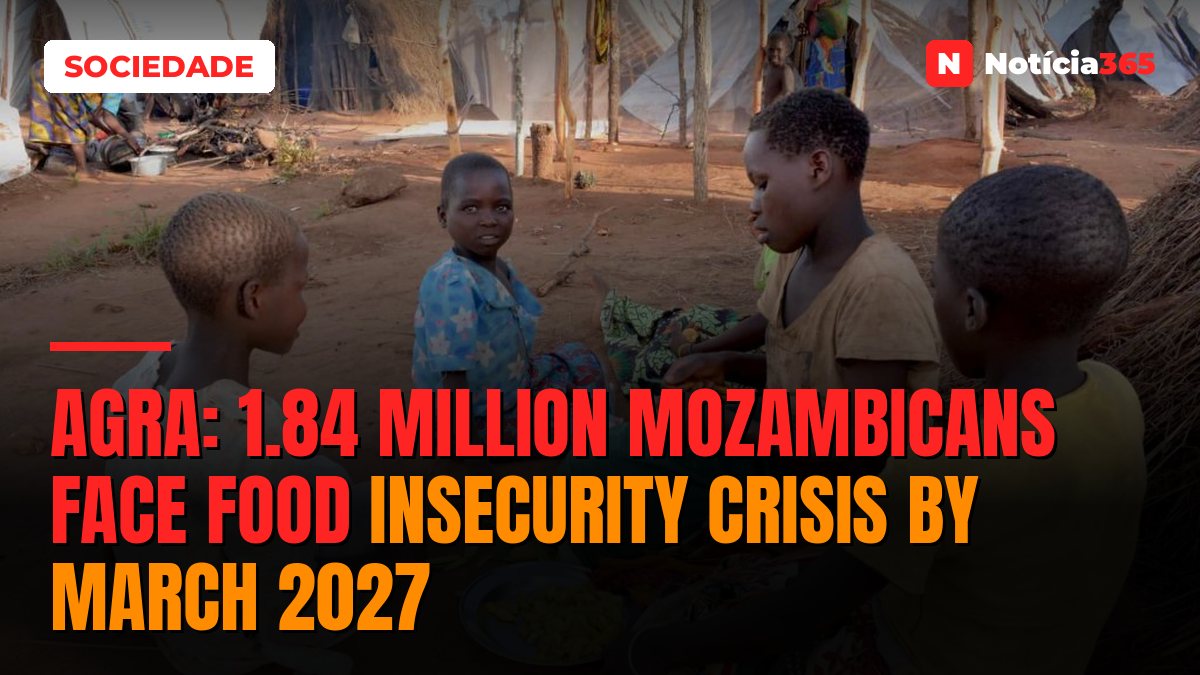

Approximately 1.84 million people could face crisis-level or worse acute food insecurity in Mozambique between October 2026 and March 2027, according to data released by AGRA. The projection represents 22% of the population assessed across 46 districts, based on the Integrated Food Security Phase Classification (IPC).
The estimate marks a deterioration from the July–September 2026 period, when around 1.19 million people in the assessed districts were already experiencing acute food insecurity. Of those, approximately 81,000 were in emergency conditions. In the coming months, the number of people at emergency level could rise to 254,000.
The 73rd edition of AGRA’s Food Security Monitor, cited on Friday, 16 October, by Lusa, warns of a fragile situation across the country, particularly in regions affected by armed conflict.
In areas of Cabo Delgado and northern Nampula affected by violence, the report projects that crisis conditions will persist through January 2027. Attacks, population displacement, and disruptions to markets and livelihoods continue to restrict households’ access to food.
Across much of central and southern Mozambique, stressed food security conditions — corresponding to IPC Phase 2 — are expected to predominate, although some areas may deteriorate into crisis during the lean season as food reserves and purchasing power decline.
The forecast of a strong El Niño event represents an additional risk. The possibility of delayed and below-average rainfall could compromise crop yields, pasture conditions, water availability, and agricultural employment opportunities.
In Mozambican markets, prices for maize and rice remained below their September 2025 levels, despite edging slightly higher compared to August. Maize recorded a year-on-year decline of 15.6%, while rice fell 27.6% over the same period.
Fertiliser prices, however, continued to trade above year-ago levels, maintaining pressure on agricultural production costs. The price of NPK — a compound fertiliser containing nitrogen, phosphorus, and potassium — rose 22.3%, while urea climbed 41.5%.
Source: Diário Económico
Original article: https://www.diarioeconomico.co.mz/2026/10/16/economia/desenvolvimento/agra-inseguranca-alimentar-podera-afectar-184-milhao-de-mocambicanos-ate-marco-de-2027/