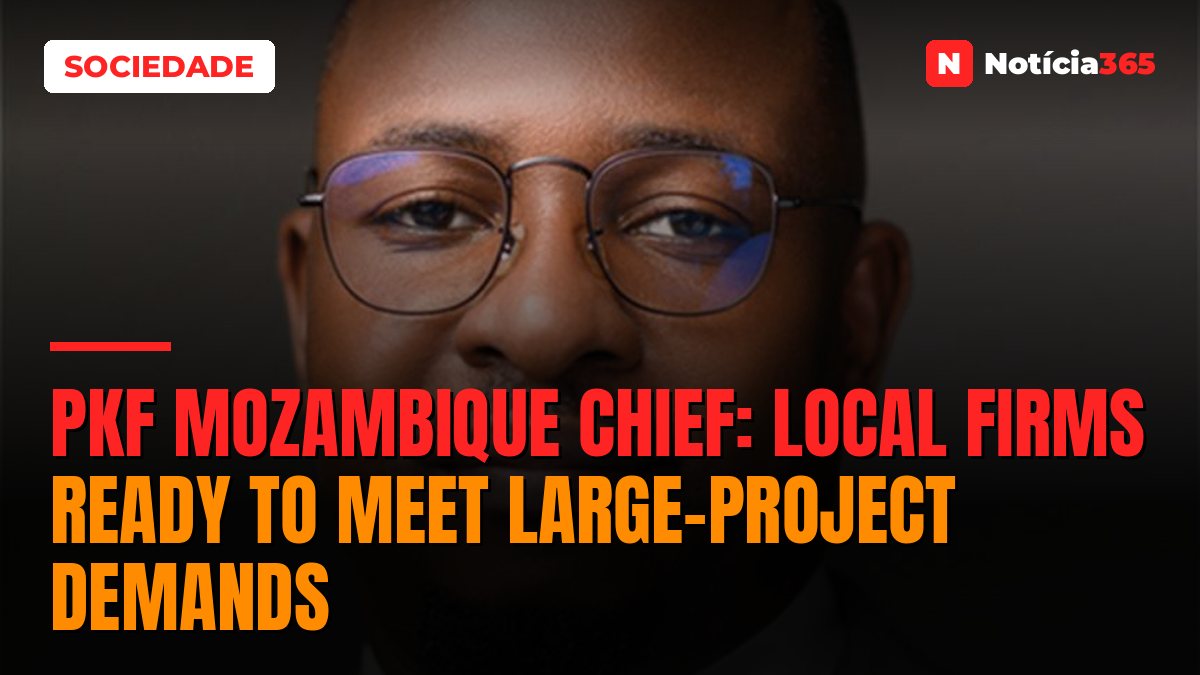

Ildefonso Uchoane, Country Leader Partner at PKF Mozambique, is committed to strengthening local talent and positioning the firm to meet the demands of the country’s major investment projects. In this interview, he addresses audit, investment, taxation, and the growing role of artificial intelligence.
Large-scale investments are beginning to generate new opportunities for Mozambican companies, while simultaneously raising the bar in audit, financial management, and tax compliance. For Ildefonso Uchoane, Country Leader Partner at PKF Mozambique, that demand is already reflected in the volume and nature of requests the firm is receiving.
Leading a team composed entirely of Mozambican professionals, Uchoane aims to establish PKF as a national benchmark in advisory services and to create meaningful career advancement opportunities for local talent. He identifies significant growth potential in external audit, tax services, accounting, and corporate finance.

In this interview with E&M magazine, he discusses SME readiness to access financing, the impact of fiscal unpredictability on investment decisions, and the application of artificial intelligence in audit work. He argues that technology can help identify risks and process larger volumes of information, but that professional judgement remains indispensable.
What kind of PKF Mozambique do you intend to build during your tenure as Country Leader Partner?
I intend to build a PKF Mozambique that places increasing value on local human resources, creating conditions for professionals to take on prominent roles in the national advisory market. I also want to consolidate the firm as a reference in the provision of consulting services in Mozambique.
“Despite the challenges inherent in a still-maturing economy, I believe national companies are prepared.”
In which areas do you see the greatest growth potential in the coming years?
I see the greatest potential in external audit and related services, taxation, outsourced accounting and payroll processing, and corporate finance.
Is the return of large investments in energy and infrastructure generating new advisory needs?
Without a doubt. The resumption of large-scale investments has brought new demands for companies servicing these industries. There is growing demand for credible firms with international experience and recognition to carry out external audits, provide statutory account certification, and deliver accounting and tax compliance services. These needs are particularly relevant as the Mozambique LNG project in Area 1 of the Rovuma Basin enters its implementation phase.
In PKF’s case, this demand began to take shape with production operations at Pande and Temane, and intensified with the start of production at the Coral Sul project in Area 4 of the Rovuma Basin in 2022.
We have also received enquiries from domestic and foreign entities interested in establishing operations in the country or in obtaining ongoing support for activities related to electricity generation from hydroelectric, solar, and wind sources. Mozambique’s positioning as a regional energy hub has been an important driver of this dynamic.
Are Mozambican companies prepared to meet the governance, quality, and transparency standards required by large projects?
Despite the challenges inherent in a still-maturing economy, I believe they are. We observe growing concern among our clients and other companies about rigorous compliance with internal rules and regulatory requirements.
That concern encompasses governance, quality, and transparency, but also business ethics and obligations related to anti-money laundering and counter-terrorism financing.
What financial and tax management shortcomings do you most frequently encounter among SMEs?
On the financial management side, the most common weaknesses are inadequate segregation of duties, the absence of strategic planning, and deficiencies in internal control systems.
On the tax side, it is important for companies to prepare annual tax plans, meet their obligations on time, and organise their documentation before becoming subject to an inspection by the Tax Authority. This includes, where applicable, a transfer pricing file.
How can PKF help a Mozambican company prepare to access financing or receive a foreign investor?
The first step is to gain a detailed understanding of the company’s needs and the requirements of potential financiers or investors. Our accounting and tax teams help to organise accounting and fiscal information so that it can be analysed according to applicable standards. Among the most frequently requested are the International Financial Reporting Standards, or IFRS, and the sector-specific standards applied in the insurance industry.
Our advisory and corporate finance teams then support the company in analysing available tax benefits, exemptions, and other matters related to its activities. Where necessary, we also engage our legal partners to clarify the legal framework applicable to the company and the intended transaction.
What changes are artificial intelligence and data analytics introducing to audit work?
At PKF, these technologies are playing an increasingly significant role. Since the beginning of this year, through our office in Portugal, we have had a dedicated artificial intelligence unit working in coordination with the audit team to identify new applications throughout the audit process.
These tools allow us to analyse larger volumes of information, support data collection and processing, identify patterns and potential risk areas, and make certain procedures more efficient.
But technology is a support instrument for the auditor. Critical thinking, professional scepticism, and the ability to interpret and challenge information remain fundamental. The value lies in combining the processing capacity of technology with the experience and judgement of the auditor.
To what extent does fiscal instability and unpredictability affect investment decisions in Mozambique?
It affects them significantly. It forces organisations to dedicate additional resources to reviewing their strategic plans, from project conception and development through to implementation and business operation.
The recent reopening of the national economy shows there are efforts under way to make Mozambique a more attractive investment destination. I believe it is necessary to continue that work to reduce the obstacles that still deter investors.
How does PKF’s international network translate into concrete advantages for a client in Mozambique?
It translates above all into the ability to respond with flexibility and speed. We maintain close relationships with network offices in Lisbon, London, Johannesburg, Cape Town, Durban, India, Dubai, and Angola.
Our proximity to the South African offices allows us to find timely solutions for clients’ specialised needs. The relationship with Lisbon helps us mobilise different capabilities simultaneously. We can also draw on the experience of other network offices to address issues that require knowledge of multiple markets.
What does it mean to you to lead a firm composed exclusively of Mozambican professionals?
It is a source of pride and of gratitude towards the PKF network, which believed in my leadership to run the Mozambique operation.
I know it is uncommon to find local professionals leading the offices of multinational consulting networks in Portuguese-speaking African countries. That trust increases my responsibility to ensure service quality, develop our team, and uphold respect for colleagues, competitors, regulators, and the ethical principles of the profession.
You often say that “consulting is a career, not a job.” What commitment do you expect from PKF professionals?
My colleagues are already well acquainted with that phrase. I expect them to seek a genuine understanding of client needs and to maintain a commitment to the quality of their work. PKF exists because clients trust the services we provide.
The phrase is also a piece of advice for those just starting out: in consulting, it is important to prioritise the building of a solid professional reputation rather than seeking immediate financial gains. Over time, opportunities can emerge as a consequence of that reputation.
Source: Diário Económico
Original article: https://www.diarioeconomico.co.mz/?p=551396