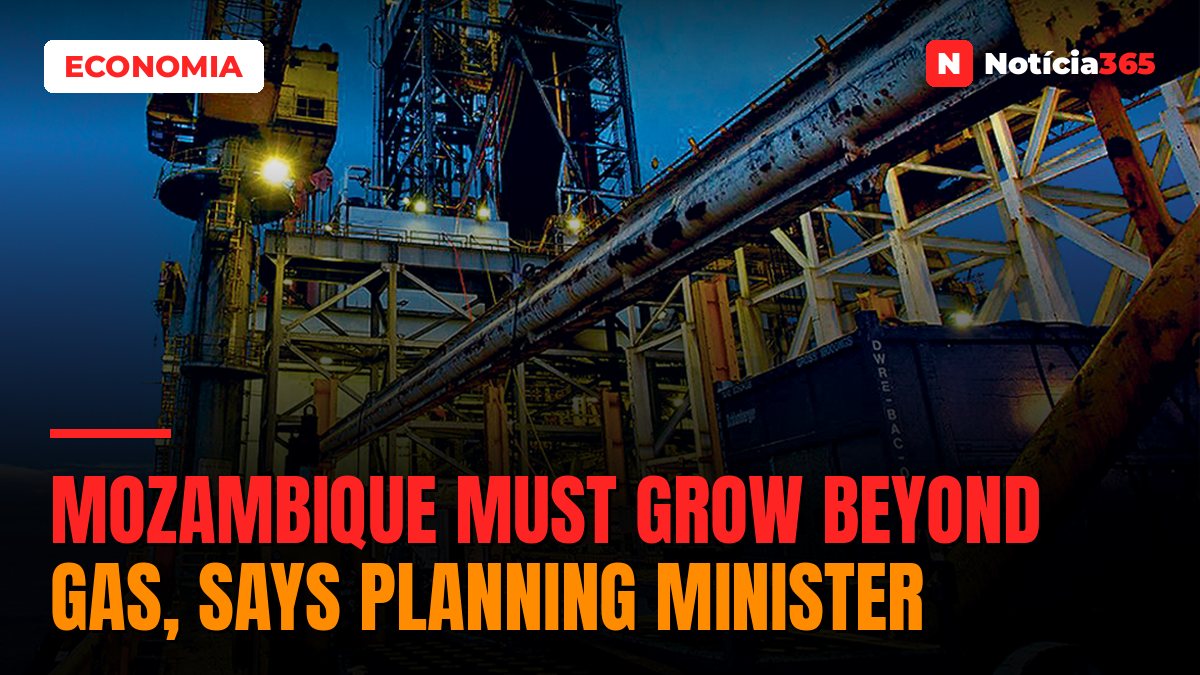

Mozambique's Minister of Planning and Development, Salim Valá, argued on Wednesday, 14 October, that the country must accelerate economic growth through agriculture, industry and tourism, as it 'cannot wait for natural gas' to drive development.
Speaking at the 23rd Session of the Development Observatory in Maputo, Salim Valá recalled the government's forecast of 1.6% economic growth in 2027, with an acceleration to 9.5% in 2029 driven by the launch of large-scale liquefied natural gas production projects. He nonetheless warned that the country cannot rely on those investments to resolve its development challenges.
'Mozambique cannot wait for natural gas,' he stressed, underscoring that the economy must grow from sectors that already employ the majority of Mozambicans.

'We must grow, starting now, the economy where most Mozambicans work: agriculture, small and medium-sized enterprises, agro-industry, tourism, the infrastructure so urgently needed to improve the business environment, transport logistics, digitalisation and services,' he said. For Salim Valá, the priority lies in 'building and strengthening an increasingly diversified economy that transforms its structure and becomes more self-reliant.'
The position was advanced in the context of the proposed Economic and Social Plan and State Budget (PESOE) for 2027, approved on Tuesday by the Council of Ministers. The plan projects revenues of 427.8 billion meticais (€5.9 billion), equivalent to 23.5% of gross domestic product, while expenditure and financial operations are expected to reach approximately 511 billion meticais (€7.1 billion), representing 28.1% of GDP.
The government accordingly estimates a fiscal deficit of around 83 billion meticais (€1.2 billion), equivalent to 4.6% of GDP, within a macroeconomic framework targeting average annual inflation of 7% in 2027.
According to the government, the proposal is grounded in fiscal consolidation, public debt sustainability, domestic revenue mobilisation and improved public expenditure efficiency, maintaining a focus on agriculture, industry, energy, transport, roads, education, health and social protection.
Key Measures
Among the measures envisaged are the operationalisation of the Mozambique Development Bank to provide long-term financing to productive sectors, the continuation of the Local Economic Development Fund (FDEL) with an allocation of 1.5 billion meticais (€21 million), and the implementation of the ProMulher programme, which will receive 500 million meticais (€7 million) directed at female entrepreneurship.
Salim Valá situated these objectives within the National Development Strategy (ENDE) 2025–44, which aims to reduce the poverty rate to below 28% and raise the Human Development Index to 0.74 by 2044.
In the same address, he highlighted the impact of climate shocks on the national economy, noting that this year's floods affected approximately 724,000 people and contributed to a downward revision of the economic growth outlook, from 2.8% to 0.6%.
Valá argued that the country's sustainable development will depend on its capacity to transform natural resources into shared prosperity, as well as on strengthening productive sectors capable of generating employment, income and added value across the entire territory.
Source: Diário Económico
Original article: https://www.diarioeconomico.co.mz/2026/10/14/economia/observatorio-de-desenvolvimento-governo-defende-crescimento-economico-alem-do-gas-natural/