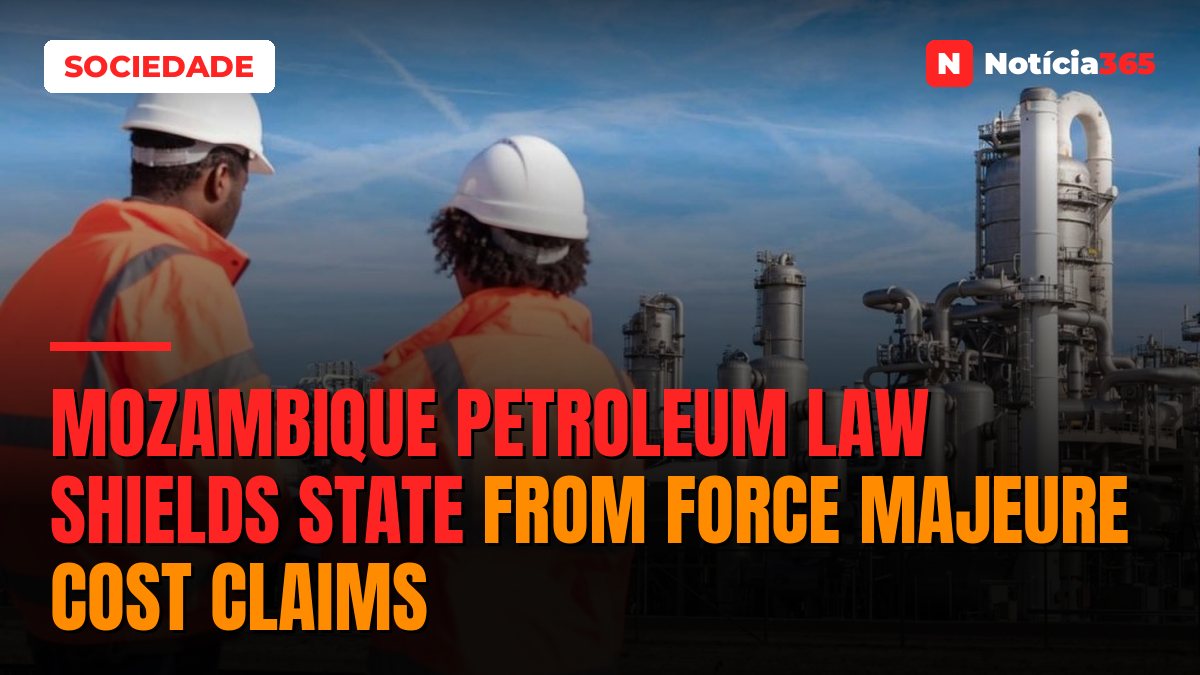

Mozambique’s new Petroleum Law establishes that in force majeure situations each party must bear its own costs, with the state under no obligation to compensate a concessionaire or reimburse expenses arising from the suspension of activities. If the situation is not fully resolved within one year, the government and the company must meet to assess the case and decide by mutual agreement whether the contract should be maintained, amended, or terminated.
These provisions are set out in Article 72 of Law No. 8/2026 of 3 June. According to sources from the Ministry of Mineral Resources and Energy and the National Petroleum Institute (INP), cited by the Mozambique Information Agency (AIM), the legislative revision took into account the experience of the suspension of the Mozambique LNG project, operated by French multinational TotalEnergies.
TotalEnergies declared force majeure in 2021 following a deterioration in security conditions in Cabo Delgado. The decision led to the suspension of the development of the liquefied natural gas (LNG) project, valued at approximately US$20 billion.

The new law further stipulates that concession contracts must identify the situations considered to constitute force majeure and establish the corresponding legal consequences. Among these rules is the exclusion of financial obligations for the state, clarifying the responsibility of each party in the event of operational interruptions.
If a force majeure situation persists for one year without being fully resolved, the parties must analyse the circumstances and agree on measures to reduce the impacts. By consensus, they may decide to maintain the contract, amend its terms, carry out a review, or bring it to an end.
“If the situation extends for a year, the parties sit down at the table or rescind the contract, but with no costs whatsoever for the government, for the state,” a source involved in drafting the legislation told AIM.
The legislative change comes against a backdrop of disagreements between the government and TotalEnergies over the costs of the Mozambique LNG project suspension, located in Area 1 of the Rovuma Basin. In October 2025, the company informed the executive that additional costs amounted to US$4.5 billion. TotalEnergies chief executive Patrick Pouyanné requested approval of the updated budget and a ten-year extension of the development and production period, proposing the start of production in the first half of 2029.
The government contested the figures presented, leading to an independent audit to assess the costs claimed by the company. According to sources close to the process, cited by Lusa, the audit identified a discrepancy of approximately US$2 billion between the amounts claimed and the documented expenditure.
“If the situation extends for a year, the parties sit down at the table or rescind the contract, but with no costs whatsoever for the government, for the state.”
According to TotalEnergies, the consortium decided to lift the force majeure declaration in late 2025. The full resumption of onshore and offshore activities was announced on 29 January 2026, following a meeting between Patrick Pouyanné and President Daniel Chapo in Afungi, in Cabo Delgado province.
Despite the resumption of activities, disagreements between the government and TotalEnergies over the additional costs of the suspension and the contractual conditions applicable to that period remained unresolved. The restart of the project therefore did not put an end to the financial and contractual questions related to the interruption of operations.
According to sources heard by AIM, the drafting of the new law included comparative studies of legislation from other African countries. The statute revokes Law No. 21/2014 of 18 August and Law No. 16/2022 of 19 December, establishing a new legal framework for petroleum activities in Mozambique.
Source: Diário Económico
Original article: https://www.diarioeconomico.co.mz/2026/10/13/oilgas/nova-lei-do-petroleo-exclui-indemnizacoes-do-estado-por-custos-de-forca-maior/