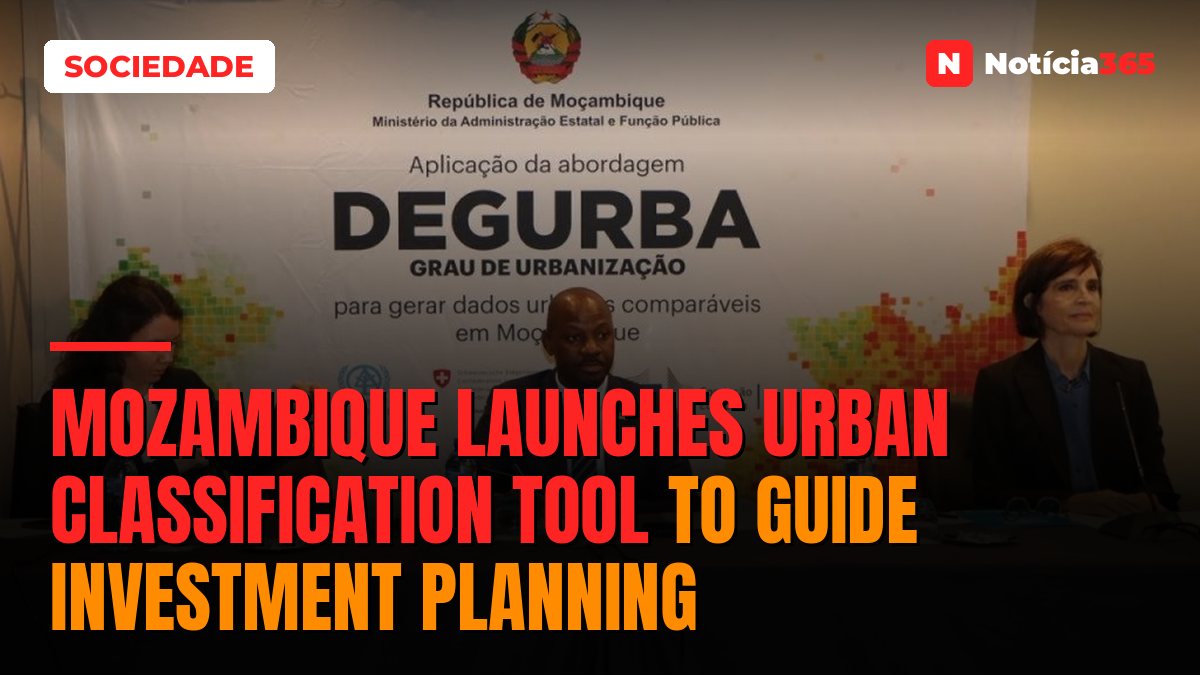

The Mozambican government on Monday, 12 October, launched a complementary methodology in Maputo to support territorial planning and guide the distribution of investments and public services. Known as the Degree of Urbanisation (DEGURBA), the tool enables analysis of population distribution and density and helps to map the relationships between cities, peri-urban zones, and rural territories, according to the Mozambique Information Agency (AIM).
Speaking at the Validation and Launch Seminar for DEGURBA Results in Mozambique, the Minister of State Administration and Public Service, Inocêncio Impissa, argued that administrative and territorial organisation must be analysed together with population distribution and investment needs.
"Knowing the territory better is not merely a statistical exercise — it is a matter of good governance and efficient management," he said.

The minister highlighted that the dynamics of certain cities and localities already extend beyond administrative boundaries, citing the cases of Maputo and Marracuene, Matola and Boane, Beira and Dondo, Tete and Moatize, and Chimoio and Gondola. He called for joint management mechanisms that would allow neighbouring territories to share equipment, spaces, and services.
Impissa clarified that DEGURBA does not alter administrative boundaries or replace existing national classifications. The methodology provides complementary information to support territorial analysis and decision-making.
Sandra Roque, representative of the United Nations Human Settlements Programme (UN-Habitat), emphasised the creation of a common information base built on national data and comparable over time.
"The challenge is not only to know how many people live in urban areas, but equally to understand where population growth is happening," she said.
According to Roque, this information allows authorities to anticipate needs related to housing, mobility, infrastructure, and public services, helping to set investment priorities.
The process, which began in January, involved technicians from several national institutions and included training sessions so that the country can apply and update the methodology independently. The results may also be integrated with data from the 2027 national census.
Marta Lopes, representative of the Swiss Agency for Development and Cooperation (SDC), underscored the importance of strengthening the capacity of national institutions to produce information and use it in the formulation of public policy.
"The most lasting impact comes when knowledge, methods, and capabilities are embedded in the institutions that will use them in the future," she said, calling for the work to continue beyond the project phase.
Lopes stressed that the data should be used in the development of policies, plans, and investments oriented towards sustainable development.
The seminar brought together public institutions, cooperation partners, and technical teams to validate the DEGURBA results and define how they will be used and integrated into national information systems.
Source: Diário Económico
Original article: https://www.diarioeconomico.co.mz/2026/10/12/desenvolvimento-2/executivo-lanca-ferramenta-para-melhorar-o-planeamento-territorial/