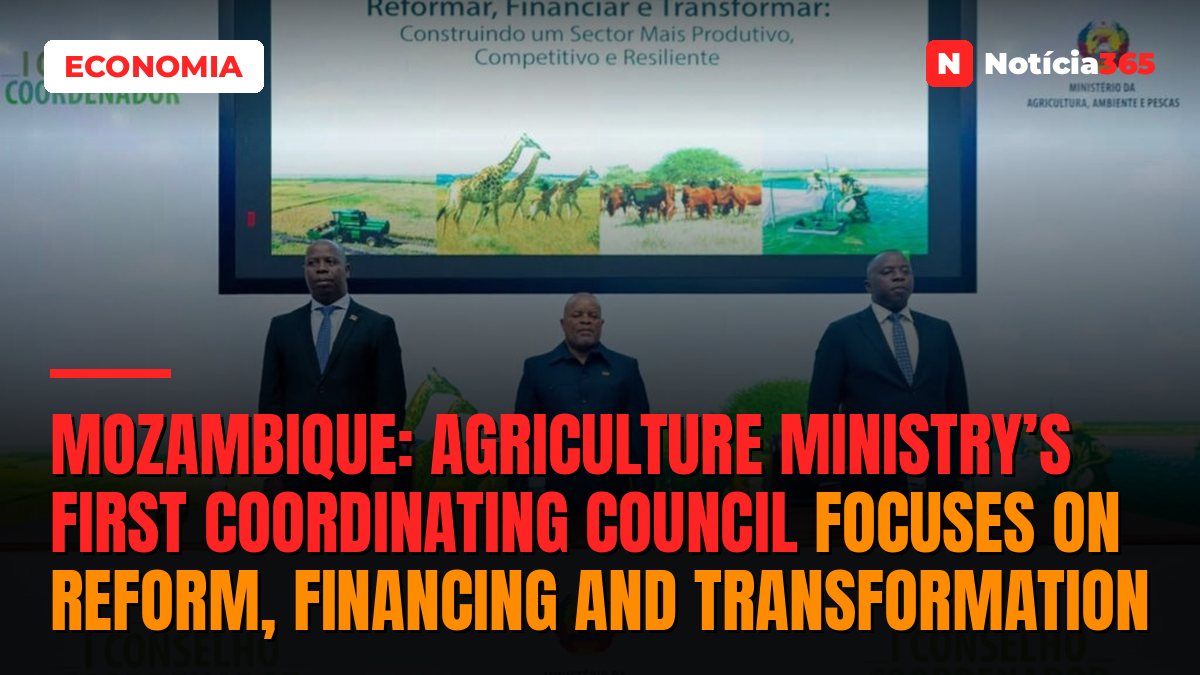
The Ministry of Agriculture, Environment and Fisheries (MAAP) opened its first Coordinating Council on Thursday in the city of Matola, under the theme “Reform, Finance and Transform: Building a More Productive, Competitive and Resilient Sector”.
At the opening, the Minister of Agriculture, Environment and Fisheries, Roberto Mito Albino, stressed the need to equip the sector with more agile institutions, coherent and consistent policies, better coordination between central, provincial and district levels, and a management culture focused on solving citizens’ problems.
For the minister, reform means removing barriers that hinder production, investment and access to services, placing producers, fishers, communities and businesses at the centre of the ministry’s work.

Photo: Ministério da Agricultura, Ambiente e Pescas
On financing, Roberto Albino explained that the challenge is to create the conditions to harness the existing potential in the agricultural, environmental and fisheries sectors through knowledge, technological development, infrastructure, services, markets and policies that support the business environment.
“That is why we must continue to establish integration and connectivity between the state, the private sector, banks, producer organisations, academia and our cooperation partners,” he stressed.
On transformation, the minister highlighted that MAAP is developing policy instruments for the sector based on a new strategic vision, with particular emphasis on structuring and implementing the Agricultural Transformation Programme and promoting initiatives focused on strategic value chains and agribusiness.
Roberto Albino also highlighted ongoing efforts to adapt legislation and other policy instruments, as well as to strengthen mechanisms for the sustainable management of natural resources in the areas of fisheries, land and the environment.
The minister also pointed to efforts to strengthen the capacity to respond to climate change, particularly phenomena such as El Niño, which could cause drought in the southern region of the country, with severe impacts on the population.
According to the minister, the opportunity to build an integrated ministry should not be limited to simply bringing together the agriculture, environment and fisheries sectors, but should translate into a genuine platform for the country’s economic, social and environmental transformation.
“Because reforming means changing the way we work, financing means providing the means to fulfil our ambitions, and transforming means ensuring that those ambitions improve people’s lives,” the minister concluded.

Photo: Ministério da Agricultura, Ambiente e Pescas