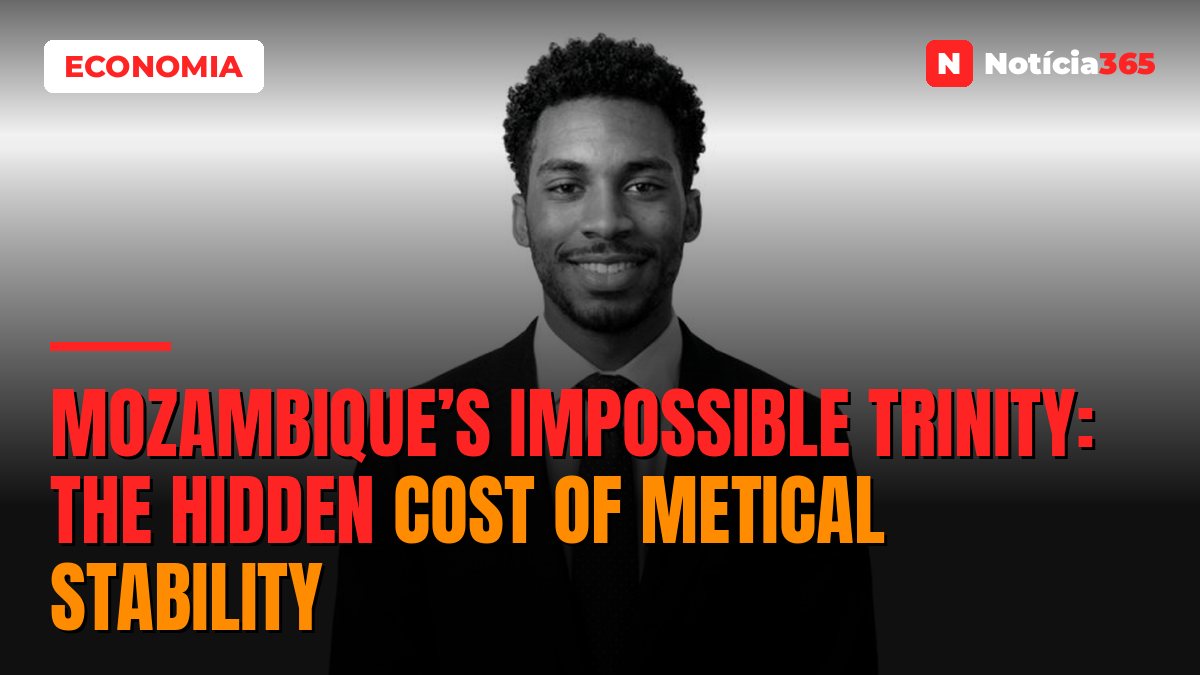

At first glance, the stability of the metical appears to be one of the few certainties in the Mozambican economy. But in an open economy, even stability comes at a price. That is the logic of the Impossible Trinity — or the Mundell-Fleming trilemma: a country cannot simultaneously maintain a stable exchange rate, an independent monetary policy, and free capital mobility. It may pursue two of these objectives, but must concede on the third.
In recent years, exchange rate stability has become one of the pillars of economic policy. Since 2021, the metical has held close to 63.9 per US dollar, avoiding significant fluctuations. In principle, this framework appears compatible with some room for monetary accommodation, in a context where the MIMO rate stands at 9.25% — its lowest level since the instrument was created in 2017. A closer reading, however, suggests a less comfortable reality.
The benchmark rate has remained unchanged since March 2026, inflation reached 7.48% in July, mandatory reserves in domestic currency were raised from 29% to 39% in May, and the prime rate remains at 15.5% — a signal that the decline in the official cost of money has not yet fully translated into more favourable credit conditions for the economy. Economic activity reinforces this reading: following a contraction of around -0.5% in 2025, first-quarter growth came in at just +0.1%. Exchange rate stability is therefore not synonymous with a fully expansionary monetary policy. On the contrary, it coexists with a cautious stance, conditioned by inflation and liquidity management.
“In practice, a country that restricts external payments, limits foreign exchange positions, and requires the conversion of export receipts is already — at least partially — sacrificing capital mobility to preserve exchange rate stability.”
But perhaps the most telling indicator lies neither in interest rates nor in growth figures, but in access to foreign currency.
Recent updates to the central bank’s foreign exchange regulations have introduced tighter limits on international card payments, progressively reducing the capacity to conduct cross-border transactions and narrowing the window through which economic agents can access foreign currency. At first glance, this appears to be a routine regulatory adjustment. Its economic significance, however, runs deeper: the exchange rate has remained relatively stable, but access to foreign currency has become more restricted. The adjustment has not occurred in the price of the dollar, but in its availability. While these limits do not, in themselves, constitute a full restriction on capital mobility, they reveal where the Trinity is beginning to give way: to keep the metical firm, access to foreign exchange is being tightened. The question, then, ceases to be how much the dollar is worth and becomes: who can actually obtain it?
The stability of the metical appears to be one of the few certainties of the Mozambican economy.
The most obvious response would be to conclude that Mozambique is facing only a temporary foreign currency shortage. This reading may, however, be insufficient, because the underlying problem may not lie solely in the observed effects, but in the cause that explains them. It is plausible that the authorities are prioritising exchange rate stability as an anchor of confidence in a context of rising inflation, heavy import dependence, and a still-recent memory of the exchange rate turbulence of 2016. If this is indeed the strategy being pursued, then the country is not merely managing cyclical pressures, but making an explicit choice among the vertices of the Impossible Trinity: preserving metical stability by gradually limiting part of capital mobility through administrative mechanisms.
Economic history shows that this kind of dilemma is far from unique to Mozambique. Thailand during the 1997 Asian crisis, and the United Kingdom at Black Wednesday in 1992, illustrate the costs of attempting to sustain exchange rate regimes under mounting pressure on international reserves and monetary conditions. Nigeria’s experience between 2015 and 2016 offers a complementary lesson: administrative restrictions and exchange control mechanisms may ease tensions in the short term, but rarely eliminate imbalances between supply and demand for foreign currency. The contexts differ, but the conclusion is similar: pressure can be managed and even deferred, but it rarely disappears.
The market faces restricted access to foreign currency and sacrifices part of its capital mobility.
For those who earn income in meticais and consume primarily domestic goods, a stable exchange rate means predictability. For those who depend on dollars to produce, invest, or import, that same stability can translate into restrictions, delays, and missed opportunities — costs that rarely appear in the statistics. It therefore becomes increasingly difficult to speak of the trilemma as if the choice had yet to be made. In practice, a country that restricts external payments, limits foreign exchange positions, and requires the conversion of export receipts is already — at least partially — sacrificing capital mobility to preserve exchange rate stability.
As revenues from major natural gas projects approach, the current strategy may yet prove sustainable, should the new foreign currency inflows reduce the pressures that today force difficult choices between exchange rate stability, monetary autonomy, and capital mobility. For now, however, this remains a future expectation, while current constraints are very real. The central question is therefore no longer whether exchange rate stability exists. The real question is different: how much does that stability cost, and who is footing the bill?
Source: Diário Económico
Original article: https://www.diarioeconomico.co.mz/?p=551383