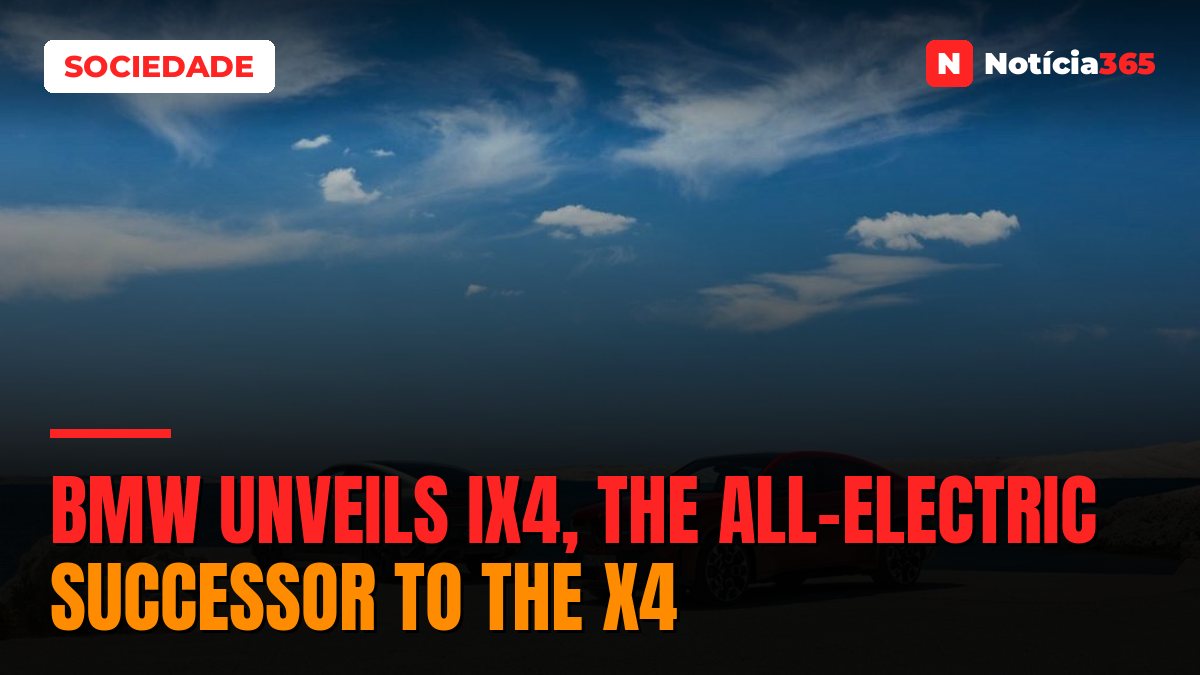

Rumours that began earlier this year have now been definitively confirmed. BMW has unveiled the iX4, a fully electric successor to the X4, built on the Neue Klasse platform and presented on Wednesday (7) as an SUV coupé.
The iX4 is underpinned by the sixth generation of BMW eDrive technology and arrives in two variants — the 40 xDrive and the 50 xDrive, both all-wheel drive — with production beginning next month. A third variant, the iX4 M60 xDrive, will enter production in March next year.
The entry-level 40 xDrive produces 374 hp and 520 Nm of torque, with the rear motor (265 hp) more powerful than the front unit (167 hp). The sprint from zero to 100 km/h takes 5.6 seconds, with a top speed electronically limited to 200 km/h.
Built on an 800-volt electrical architecture, it carries an 82.6 kWh net lithium-ion battery offering up to 638 km of range. The battery can be charged from 10% to 80% in 21 minutes at a peak charging rate of 300 kW.
The 50 xDrive, the top-of-range model at launch, delivers 469 hp and 645 Nm of torque. Again, the rear motor (326 hp) outpowers the front unit (167 hp), enabling a zero-to-100 km/h sprint of 4.9 seconds and a top speed electronically limited to 210 km/h.
Its larger 108.7 kWh battery supports a range of up to 828 km. The system also operates on an 800-volt architecture but accepts charging at up to 400 kW — meaning that, despite the larger capacity, it still achieves a 10-to-80% charge in 21 minutes.
Both variants share bidirectional charging capabilities, including vehicle-to-load, vehicle-to-home, and vehicle-to-grid functions.
The M60 xDrive, carrying M Performance inspiration, will follow at a later date. The performance-oriented variant is expected to offer up to 777 km of range, though these figures remain provisional.
The suspension setup features a double-wishbone aluminium-steel configuration at the front and a five-link arrangement at the rear. Braking is handled by ventilated discs at the front and solid discs at the rear.
Design
Like the X4, the BMW iX4 is an SUV coupé. It features a dynamic design including exclusive light signatures and the signature kidney grille, which emphasises the verticality of the front end — echoing the approach taken with the iX3 Neue Klasse.
At the rear, the light signature mirrors that of the iX3, with the design intended to accentuate the car’s horizontal proportions. A discreet duck-tail spoiler is present, and the door handles are flush-mounted.
In profile, a flowing roofline arcs from the B-pillar down to the rear end. Surfaces are clean, aided by the flush door handles. Standard equipment includes 20-inch alloy wheels shod with 255/45 R20 tyres.
Dimensions are identical across both variants: 4,782 mm in length, 1,895 mm in width, and 1,595 mm in height, with a 2,897 mm wheelbase. Kerb weight stands at 2,260 kg for the 40 xDrive and 2,380 kg for the 50 xDrive.
Buyers will be able to choose from nine metallic colours at launch, with three Frozen finishes joining the palette in March next year.
Interior
Inside, the iX4 carries over the cabin architecture already familiar from the iX3 Neue Klasse. A 17.9-inch Free-Cut touchscreen at the centre provides access to the infotainment system, while BMW Panoramic Vision — spanning the full width of the windscreen between the A-pillars — replaces the conventional instrument cluster. A BMW 3D Head-Up Display is also available as an option.
The multifunction steering wheel is new. The near-three-metre wheelbase optimises legroom in the cabin, and despite the sloping roofline BMW says there is ‘ample headroom in the rear seats as well’.
Boot capacity stands at 490 litres, expandable to 1,600 litres with the rear seats folded, while a 58-litre front storage compartment — a ‘frunk’ — sits beneath the bonnet.
Seven interior environments are available, with materials including Veganza (leather-free) and M PerformTex, as well as a combination of BMW Individual Merino leather and Veganza surfaces.
As with the iX3 Neue Klasse, the iX4 is equipped with four high-capacity processing computers — among them the Heart of Joy unit, which governs driving dynamics.
The car offers a range of Level 2 driver assistance systems, from lane-change warnings and cross-traffic alerts to semi-autonomous and remote parking. The Motorway Assistant enables hands-free driving on motorways at speeds of up to 130 km/h, including automated lane changes subject to driver confirmation. BMW intends to preserve driver engagement through its Symbiotic Drive system, which it says ensures ‘fluid interaction between assistance and human driving in all situations’.
Source: Diário Económico
Original article: https://www.diarioeconomico.co.mz/?p=550851