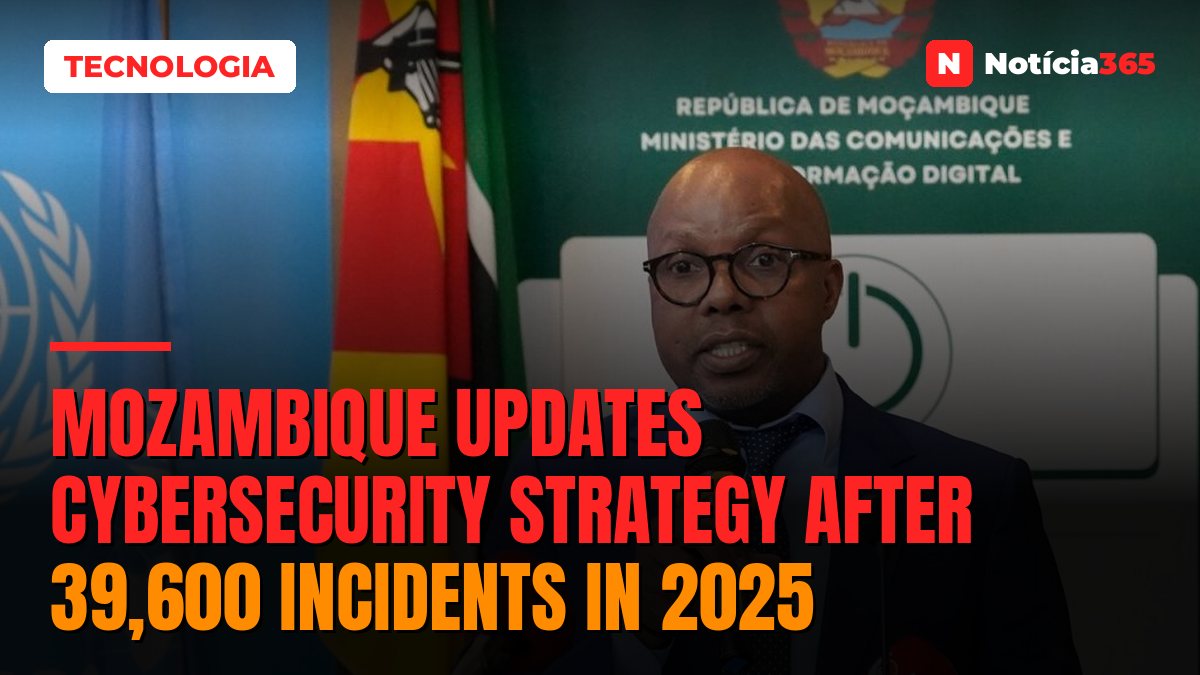

Mozambique is updating its National Cybersecurity Strategy for the 2026-2030 period, aiming to operationalise new legislation, define targets and responsibilities, and strengthen the protection of digital systems, following the registration of approximately 39,600 cyber incidents in 2025, according to the Lusa news agency.
The announcement was made by the Minister of Communications and Digital Transformation, Américo Muchanga, in Maputo, during the launch of activities marking Cybersecurity Awareness Month.
“The update of the National Cybersecurity Strategy for the 2026-2030 period is under way, and it will constitute the main instrument for implementing the Cybersecurity Law,” he said.
According to the minister, the document is intended to translate legal obligations into concrete initiatives, measurable targets, performance indicators, and monitoring mechanisms, supported by the resources required for implementation.
Data presented at the event point to approximately 39,600 cyber incidents in 2025, with electronic payment fraud and computer scams among the most frequently prosecuted technology-related crimes analysed by the Public Prosecutor’s Office.
Critical Infrastructure Requires Greater Protection
Américo Muchanga stated that the new strategy should enable the country to move from building basic capacities to a phase of greater institutional maturity, resilience, and digital trust.
“In this new cycle of the strategy, our country must evolve from the phase of establishing basic capacities to a phase of greater maturity, resilience, and digital trust,” he declared.
The minister emphasised the need to strengthen the protection of Critical Information Infrastructures, which span strategic sectors including energy, telecommunications, transport, health, finance, and public security.
In this context, he urged entities responsible for managing these infrastructures to accelerate the establishment and operationalisation of their respective Computer Security Incident Response Teams (CSIRTs), and to adopt preventive measures to ensure the security and continuity of services.
Government Advocates Training and Awareness
The minister also called for stronger public awareness efforts to prevent, detect, and respond to digital threats, stressing that security must keep pace with the expansion of connectivity.
“It is not enough to be connected — we need to be connected securely, prepared for risks, and aware of our responsibilities in the digital space,” he said.
Américo Muchanga also urged educational institutions to integrate cybersecurity into academic curricula, describing the training of specialists and scientific research as fundamental to addressing the challenges of digital transformation.
The minister stressed that protecting citizens, especially children and young people, requires coordinated action among the state, academia, the private sector, and civil society.
“Each of us has a role to play in preventing risks, protecting people and organisations, and strengthening the resilience and digital sovereignty of our country,” he concluded.
The strategy update follows the promulgation, on 12 June, by President Daniel Chapo, of the Cybersecurity Law and the Cybercrime Law, designed to strengthen the protection of citizens, state institutions, and digital data. The legislation provides for sanctions of up to 160 minimum wages.
Source: Diário Económico
Original article: https://www.diarioeconomico.co.mz/?p=550901