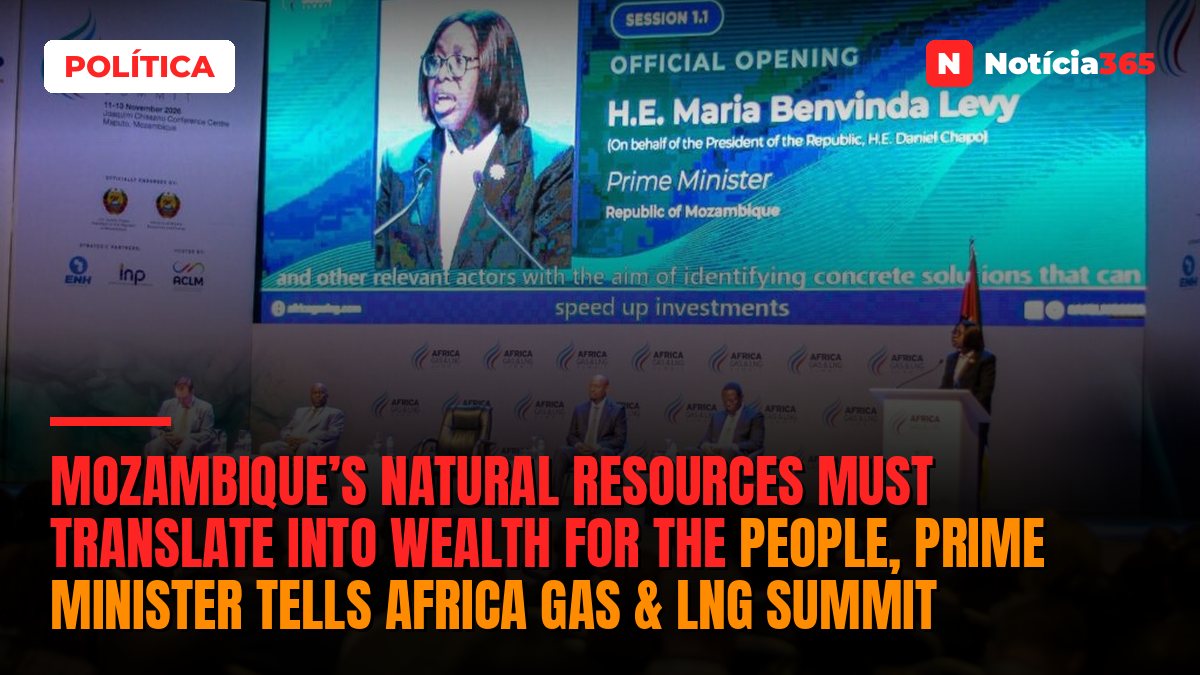
The Mozambican Prime Minister has argued that natural gas exploitation must translate into wealth for the population, pointing to new legislation as a means of strengthening local content, attracting investment and promoting sustainable economic development.
“We want the wealth of our natural resources to translate into wealth for the people,” Maria Benvinda Levi said during the opening of the first Africa Gas & LNG Summit 2026 in Maputo.
Mozambique currently has three major projects approved for monetising the vast natural gas reserves of the Rovuma Basin, in Cabo Delgado province, which are ranked among the largest in the world.
In addition to the Coral Sul project, which has been operational since 2022, and Coral Norte, which is under development, the projects led by TotalEnergies and ExxonMobil are advancing on the Afungi Peninsula, with the latter awaiting a final investment decision.
In her address, Levi stressed that Mozambique is creating the conditions to turn this natural resource potential into tangible benefits for its citizens. She recalled the recent approval and ongoing implementation of new legislation covering mining, petroleum and local content, aimed at strengthening national participation in the exploitation of natural resources.
This legal framework primarily reflects “the Government’s determination to ensure that growth in the energy industry is accompanied by the strengthening of national productive capacities, the dynamisation of Mozambican businesses and the creation of decent and sustainable employment opportunities”.
Secondly, the Prime Minister continued, it seeks to ensure “significant progress in consolidating a more structured institutional environment focused on concrete results”. Thirdly, it aims to promote “the strengthening of the business environment and greater transparency, in order to provide greater predictability in decision-making and create increasingly favourable conditions for productive investment”.
“With these and other measures that we have been implementing, we want to ensure that investors find regulatory stability, efficient institutions and a competitive business environment,” Maria Benvinda Levi added.
She also stressed that energy projects should contribute to strengthening Mozambique’s business sector and developing the country’s human resources.
“We also want these projects to contribute to strengthening national businesses, building the capacities and enhancing the skills of Mozambican professionals, particularly young people and women, as well as supporting the development of local communities,” she said.
In her address, Maria Benvinda Levi argued that natural gas should be viewed not only from an export perspective, but also as a driver of economic transformation.
“For Mozambique, natural gas represents not only an export opportunity, but also a strategic asset for expanding electricity generation, promoting industrial development, stimulating new economic activities and deepening the integration of regional energy markets,” she said.
She argued that the sector’s success would depend on its ability to generate economic linkages at national and regional levels, as well as strengthen cooperation between African countries, with a view to shared development and the integration of energy markets.
Addressing investors and industry representatives attending the conference, the Prime Minister reiterated the country’s openness to private investment and technological innovation.
“Mozambique is open to investment. It is open to new partnerships, new technologies, innovation and business initiatives that promote value creation and drive economic development based on shared responsibility and mutual benefits,” she concluded.