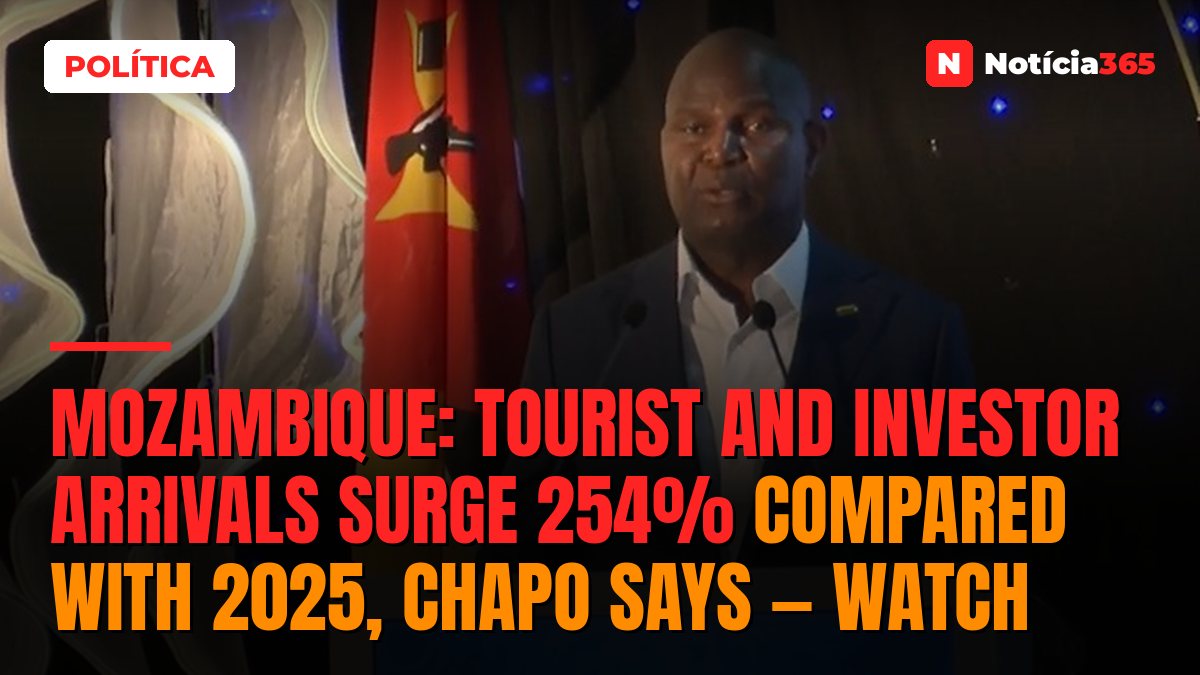
The number of tourists and investors arriving in Mozambique this year increased by 254% compared with the same period in 2025, Mozambican President Daniel Chapo has announced, attributing the growth to reforms introduced to boost the tourism sector.
Speaking at the opening of the second edition of the Mozambique Tourism Summit, in Vilankulo, Inhambane province, southern Mozambique, Chapo recalled that, a year ago, during the first edition of the event, the Government had committed to transforming tourism into one of the country’s main drivers of economic diversification and job creation.
“At present, in terms of the volume of arrivals of passengers, foreign nationals, investors and tourists in Mozambique, we are seeing an increase of more than 254% compared with the same period last year,” the Head of State noted.
According to the President, the results stem from measures introduced in recent months to facilitate the entry of visitors and attract investment, including the implementation of an electronic visa platform and the creation of the so-called “Visa Gold”, designed to attract foreign investors.
Chapo also highlighted the creation of the National Agency for Tourism Development and Investment (Anditur), which replaced the former National Tourism Institute (Inatur), as well as the Southern Corridor Special Tourism Economic Zone, which incorporates the destinations of Vilankulo, Pomene and Inhassoro, all in Inhambane province.
The President said Inhambane had been chosen to take on the role of the country’s main tourism development hub, serving as a model for promoting the sector’s growth in other parts of Mozambique.
“When we travel to Indonesia for tourism, we know that most people go to Bali. If we go to South Africa, we know that most people go to Cape Town. We need to have a reference point and a pilot centre for tourism development in Mozambique,” he said.
Daniel Chapo argued that the focus on tourism was particularly important at a time when the country was seeking to reduce its dependence on mineral and energy resources, maintaining that the sector had greater long-term potential for wealth creation.
“Gas will one day run out. Coal will run out. Graphite will run out. Heavy sands will run out. But as long as Mozambique remains here, bordered by the Indian Ocean, tourism will never run out,” he said.
The Head of State also identified tourism as a sector capable of stimulating other economic activities by integrating local suppliers into the value chains associated with tourism developments.
He explained that the aim was to strengthen connections between the city of Vilankulo, one of Inhambane’s tourist destinations, and other tourism centres in Southern Africa.
The President also announced that Mozambique intends to host the Global Tourism Forum in 2027, in an initiative to be organised in partnership with the World Tourism Organization (UNWTO) and the Global Tourism Institute.
Chapo also revealed that the Government had presented a portfolio of between 40 and 50 tourism projects to investors during the Mozambique Tourism Summit, including 25 projects structured for financing and partnerships.
The initiatives highlighted include the development of the Vilankulo waterfront, the expansion of airport infrastructure and new luxury tourism developments in Massingir and the Bazaruto Archipelago.
The Head of State argued that Mozambique should compete not only on the beauty of its beaches and landscapes, but also on the quality of the tourist experience, cultural authenticity and the confidence it offers international investors.