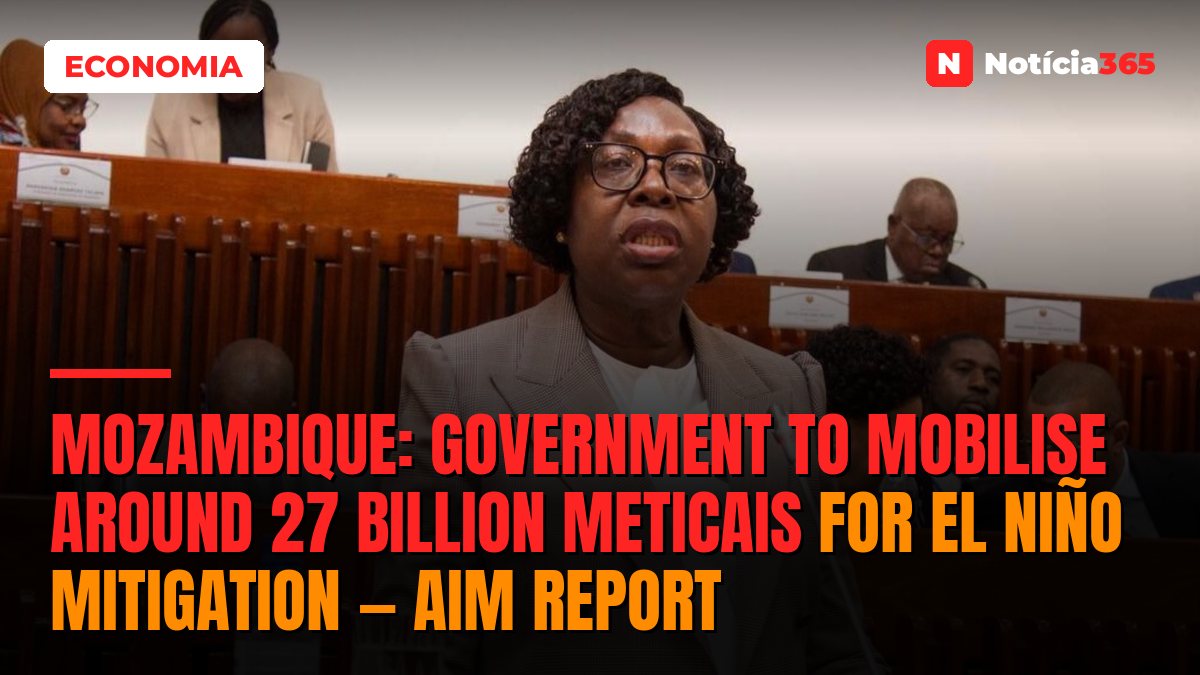
The Mozambican government plans to mobilise approximately 27 billion meticais (US$1.7 billion at the current exchange rate) to implement the 2026/27 National Plan for Mitigating the Impacts of El Niño weather phenomenon.
The plan aims to cover sectors of agriculture, health, education, water supply, food assistance, and social protection sectors.
According to the Prime Minister Benvinda Levi, who was speaking on Wednesday at the country’s parliament, Assembly of the Republic, in response to concerns raised by parliamentary groups, the measure is also aimed at distributing agricultural input kits to over 185,000 households, including the construction of multi-purpose silos to complement small-scale irrigation systems, and the rehabilitation or construction of dams, water supply systems, and multi-purpose boreholes, “all aimed at benefiting more than one million people.”
The 2026/27 rainy season points to normal rainfall in the Northern provinces of Nampula, Cabo Delgado, and Niassa. However, it points out a risk of severe drought in 76 districts across the southern provinces of Maputo, Gaza, Inhambane, and central provinces of Sofala, Manica, and Tete, due to the influence of the El Niño phenomenon.
In the health sector, epidemiological surveillance will be strengthened, and the proactive availability of medicines and other essential supplies, including oral rehydration salts, cholera kits, anti-malaria, and rapid diagnostic tests.
Regarding the deterioration of the country’s highway Road Number One (EN1), the Prime Minister stated that the government considers the road a priority, noting that, between 2015 and 2025, “domestic funds were used for maintenance work and targeted improvements on critical sections, covering a distance of approximately 342 kilometres.”
She added that a tender has been launched for the concession, under a public-private partnership, of the Marracuene–Xai-Xai stretch, with plans to progressively extend this model to other segments.
Regarding concerns about the availability of medicines and the operation of healthcare facilities, Levi announced the construction of 425 community health posts over the next five years, as well as the implementation of a Pharmaceutical Logistics Plan designed to improve the storage, distribution, and availability of medicines.
“The government also intends to strengthen transparency in hospital procurement contracts, along with security and control mechanisms for medicines and medical supplies”, she said.
Concerning fuel supplies, she pointed to instability in the Middle East as a factor affecting the production, export, and international pricing of petroleum products, noting that Mozambique relies on imports to meet its needs.
Among the measures adopted, she cited a resolution “which establishes exceptional mechanisms to facilitate payments to foreign suppliers and extends the operating hours of ocean terminals to include Saturdays and public holidays.”
Source: AIM